Come See What We Made
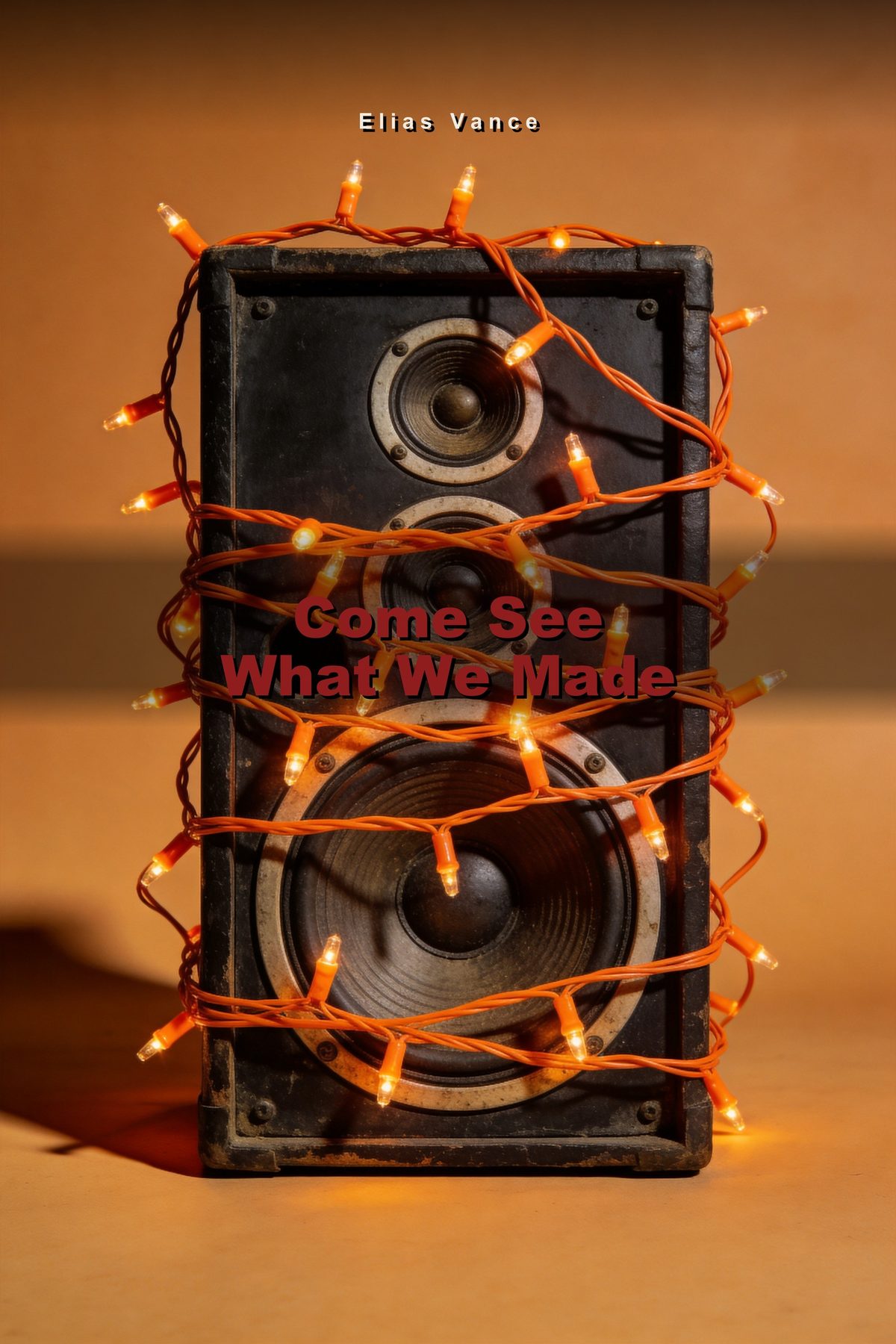
The porch speaker said, “Tell Biscuit I said nice try,” and my hands stopped in the tangle of orange lights.
I was kneeling on the porch boards, the string of bulbs looped twice around my left wrist, the plug end cold against my palm. The afternoon had that October thinness, light coming slantwise through the maples, the air smelling of wet leaves and someone’s woodstove. Three houses down, the Ferrises had already put up their inflatable ghost, the one that swayed and moaned when a car passed. My own porch was half-dressed: a plastic cauldron by the steps, a bundle of cornstalks leaning against the rail, the animatronic skeleton still folded in its box inside the door. I had been working since noon, and I had not said anything.
The speaker hung to the left of the doorbell, a white plastic oval with a small red light that blinked when it was active. It had not blinked. I sat back on my heels and looked at it, the lights still looped around my wrist, the bulbs pressing small circles into my skin. The sentence had been in Leo’s voice. Not a recording played through the speaker, not the tinny approximation the system used for its standard greetings. His voice: the slight hoarseness from the allergies that never cleared, the way he clipped the t in “Biscuit,” the rise at the end that made even his insults sound like questions.
Biscuit was the Gormans’ cat, a fat orange thing that liked to sit on our porch rail and watch Leo draw. Leo had been eight the last time Biscuit sat there. Leo had been dead eleven months.
I pulled the lights off my wrist and stood. The boards creaked under my boots. I pressed the doorbell, because that was the thing you did when the doorbell speaker said something it should not have said, and the chime rang inside the house, and no one answered. I was the only one home. I had been the only one home for eleven months, except for the weeks Aaron came to pack up Leo’s room and then stopped coming because the room was still not packed.
The smart-home app was on my phone, in a folder with the thermostat and the garage door and the camera I had installed after the accident, the one that watched the driveway and never showed anything but the mail truck. I opened it. The speaker had a log, a list of every announcement, every chime, every activation. I scrolled to the bottom. The last entry was from October 1st, three days ago: “Seasonal greeting uploaded. Audio file: leo_halloween_1.mp3.” I had uploaded that file myself. I remembered doing it, remembered sitting at the kitchen table with a cup of tea going cold, dragging the audio clip into the app, telling myself it was fine, it was a way of having him on the porch for Halloween, the one night he loved more than Christmas.
The log showed nothing for today. The speaker had not been activated. The red light was dark.
I closed the app and opened it again. The log refreshed. At the bottom, below the October 1st entry, a new line had appeared. It was timestamped 4:48 p.m. It was 4:47 p.m.
The phone felt warm in my hand. I locked it and put it in my pocket and went inside to find the skeleton box.
The house had that particular quiet that comes after a voice has stopped. I could hear the refrigerator cycling, the tick of the baseboard heat in the front room, the slow drip of the kitchen faucet I had been meaning to fix since August. The skeleton box sat by the coat closet, its cardboard flaps open, the plastic bones wrapped in tissue paper. I had bought it two years ago, at the hardware store in Rockland, because Leo had pointed at it and said, “That one, Mom. He looks like he’s waiting for something.” The skeleton had a motion sensor, a speaker that played a laugh track, and eyes that lit up red when someone walked past. Leo had named him Mr. Femur.
I carried the box to the porch and set it down. The air had cooled. The Ferris ghost swayed, its motor whining. I unwrapped the skull first, because that was the part Leo had always wanted to hold. The plastic was smooth and white, the jaw wired open in a grin. I set it on the rail, facing the street. Then the ribcage, the arms, the pelvis, the legs. The pieces fit together with plastic pegs, and I assembled him the way I had watched Leo assemble him, the same order, the same way he had insisted the left arm went in before the right because that was
Subscribe to read the rest of “Come See What We Made”.
Get every story in the The Dark Threshold collection — and the entire library — for one monthly price. Cancel anytime.