Enjoying the read? Get a new free Elias Vance story in your inbox every month — no spam, unsubscribe anytime.
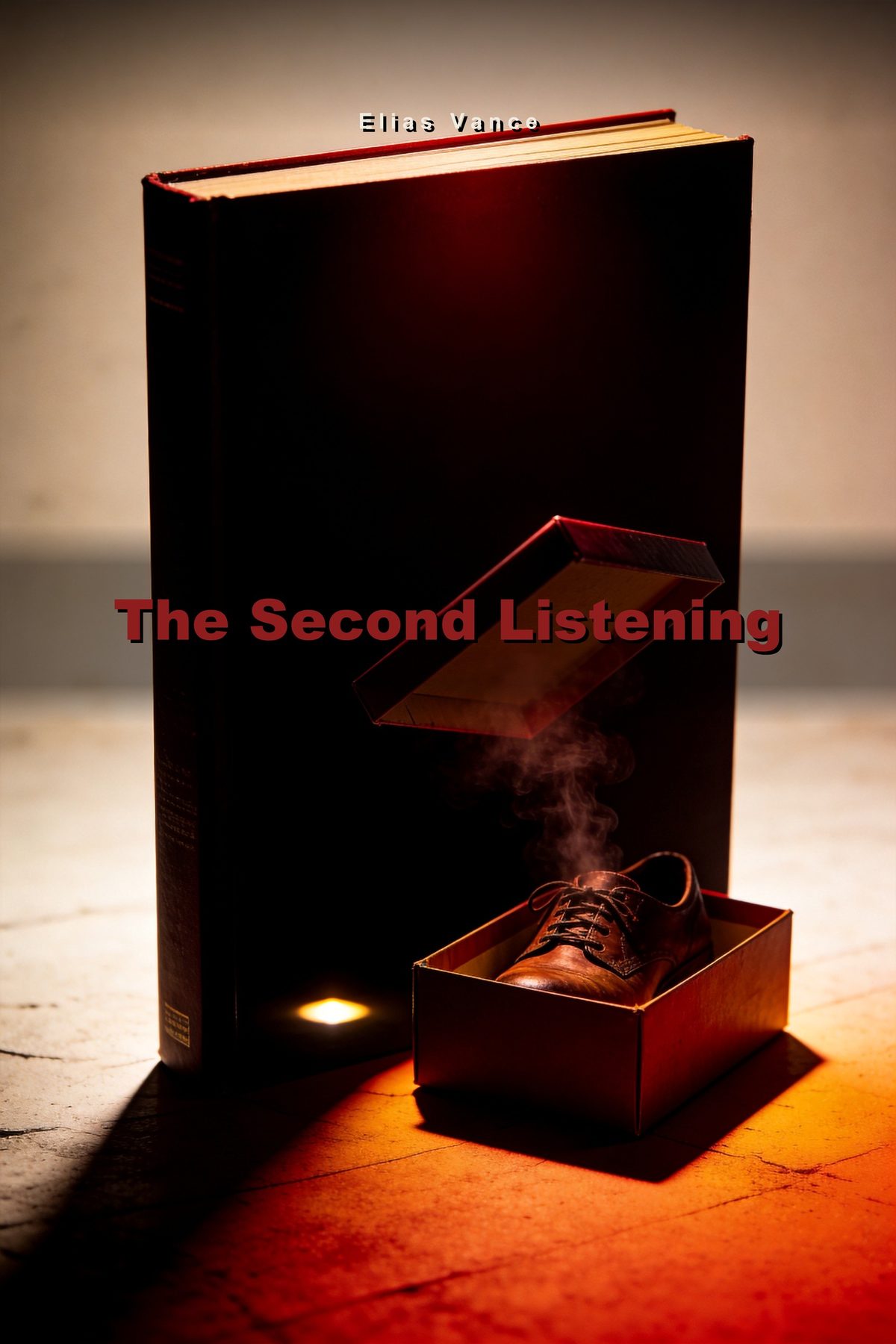
The shoebox exhaled when I lifted the lid. Fifty years of basement air, cedar and mildew and the slow oxidation of magnetic tape. I set the lid aside on the conservation bench and looked at what Eleanor Voss had left behind: seven cassettes, each in a brittle plastic case, each labeled in her narrow, forward-slanting hand. The one on top said Final Readings, March 1987. Beneath it, the word Voss repeated six times, like a signature she had been practicing.
I logged the accession number in the digital ledger, then in the paper ledger, because the archive liked redundancy. The room was cold the way climate-controlled rooms are cold: sixty-eight degrees, forty percent relative humidity, the hum of the HVAC a constant pressure against the eardrums. I pulled on nitrile gloves and lifted the first cassette from its case. The shell was beige, scuffed at the corners, the label peeling at one edge where someone's thumb had pressed it down too many times. I noted that in the condition report. Label adhesive failing at lower right quadrant. Minor scuffing to shell. No visible mold. No evidence of water damage.
The tape deck was a refurbished Nakamichi CR-7A, calibrated that morning. I threaded the cassette, adjusted the azimuth, and set the output to the reference monitors. Then I pressed play.
Keep reading
This story continues. One subscription — $6.99/month — opens every story in full: 39 live today, new ones added monthly, plus the six-voice audiobook.
Her voice came through with the expected artifacts: a low hiss, a slight warble in the sustained vowels, the faint mechanical thrum of the original recorder's motor. She was reading a poem, one I recognized from the published collection. The Door in Winter. I had transcribed it years ago for the digital catalog. Her voice was lower than I had imagined, rougher at the edges, the voice of a woman who had smoked and then quit and then started again. She read with a deliberate slowness, as if each word were a stone she was setting into mortar.
I leave you the sound of the door, she read. The hinge that remembers the weight of your hand.
I listened once through, transcribing as I went, my fingers moving over the keyboard in short, precise bursts. The poem ran four minutes and twelve seconds. When it ended, I rewound the tape and played it again, this time with the waveform visible on the monitor. The peaks and valleys scrolled past in steady formation, a mountain range of sound.
That was when I heard it.
Under the word listen in line three, a second voice. A whisper, barely more than a breath, riding the tail of the vowel. I stopped the tape. Rewound. Played again.
Nothing.
I played the section a third time, then a fourth, leaning closer to the monitors. The whisper did not return. I sat back and looked at the waveform. There was nothing unusual in the display, no spike or shadow that would indicate a second signal. Just the normal decay of a consonant, the small irregularities that came from a tape recorded on a home deck in a room with bad acoustics.
I logged it. Possible bleed from adjacent reel at 00:31. Low amplitude. Not reproducible on second playback. Proceeding with digitization.
The rest of the morning passed in the rhythm of the work. I cleaned the tape heads between cassettes, adjusted the azimuth for each new reel, made digital reference copies at 96 kHz/24-bit. The poems accumulated in my transcription file, one after another, each in Eleanor Voss's measured cadence. By noon I had completed four of the seven tapes. The fifth was the problem.
It was labeled Voss 5: Late Poems, Unpublished. The shell was a different color from the others, a dark gray instead of beige, and the label was written in pencil, the graphite smudged almost to illegibility. I had to hold it under the magnifier to confirm the accession number. The tape inside was thinner than the others, the kind of cheap stock that stretched and warped and shed oxide onto the heads. I noted that in the condition report. Tape stock appears to be standard ferric, low quality. Risk of binder hydrolysis. Handle with care.
I cleaned the heads, threaded the tape, and pressed play.
The first poem was a fragment, eight lines, untitled. The second was longer, a meditation on winter light through a kitchen window. The third was the one I knew as The Door in Winter, but different. The words were the same, but her voice was tighter, higher, as if she were reading through a closed throat. I listened, transcribing, and when she reached the word listen in line three, the whisper came again.
This time it was clearer. A single syllable, drawn out, riding the hiss like a stone skipped across water.
Stay.
I stopped the tape. My hand hovered over the transport controls. The word had been so distinct, so deliberate, that for a moment I thought someone had spoken in the room behind me. I turned. The conservation lab was empty. The door was closed. The HVAC hummed its steady note.
I rewound and played the section again. The whisper was gone.
I sat for a long moment, staring at the waveform. Then I did what I always did when a tape presented an anomaly: I documented it. Second instance of low-amplitude vocalization at 00:31 on source tape. Syllable indeterminate. Not reproducible on immediate replay. Possible tape defect or residual signal from previous recording.
The word possible was doing a lot of work in that sentence. I knew it, and I wrote it anyway, because the alternative was to write unexplained, and unexplained was not a word that belonged in a condition report.
I finished the transcription and moved on to the sixth cassette. The seventh. The work absorbed me, the way it always did, the small precise actions of cleaning and aligning and monitoring. By five o'clock I had completed the digitization of all seven tapes. I saved the files to the archive's server, backed them up to the external drive, and wrote the preliminary report. The anomaly on tape five remained a single line in the log, unremarkable, a footnote.
That night I dreamed of my mother's voicemail.
It was the same dream I always had. The phone ringing. My mother's voice on the other end, bright and ordinary, telling me about the tomatoes she had planted, the neighbor's dog that kept getting into the garden. And then the pause, the small catch in her breath, and the word she never finished. In the dream, I strained to hear the missing syllable, the final sound that would make the sentence whole. But the voicemail cut off, the way it always did, and I woke with my jaw clenched and the taste of copper in my mouth.
The voicemail was saved on my phone. I had listened to it a hundred times, maybe more. I had run it through spectral analysis, the same software I used at work, looking for a trace of the word she had been trying to say. There was nothing. Just the silence where the syllable should have been, the flat line of a signal that had ended mid-breath.
I had stopped listening to it years ago. But I still had it. I still had it, and I still dreamed about it, and I still woke in the dark with the conviction that if I could only hear that missing word, everything else would fall into place.
The next morning I arrived at the archive before anyone else. The building was quiet, the lights still on their nighttime dimming cycle. I made coffee in the break room and carried it to the conservation lab. The gray cassette was still on the bench where I had left it, still in its case, the label smudged and illegible.
I had planned to begin the cleaning protocol on the digital files, but instead I found myself threading the cassette into the deck. I told myself I was checking the tape for binder hydrolysis, that the thin stock needed a second pass to ensure the heads were clean. It was a reasonable explanation. It was even true, in part.
I pressed play.
The poem began. Her voice filled the room, rough and deliberate. I leaned forward, my elbows on the bench, my coffee going cold beside me. The word listen approached. I held my breath.
The whisper came again. Clearer now. Two syllables.
Stay, Miriam.
I sat very still. The poem continued, her voice moving through the lines, but I was no longer listening. The whisper had not been on the tape. I was certain of it now. The whisper had been in the room.
I stopped the tape. Rewound. Played again.
Nothing.
I played the section a third time, then a fourth. The whisper did not return. I sat back and looked at the waveform. The display was unchanged. No spike, no shadow. Just the normal decay of a consonant, the small irregularities of a home recording.
I picked up the phone and called Paul.
Paul was the archive's senior sound engineer, a man who had spent thirty years listening to the dead and had never once heard them speak. He arrived twenty minutes later, coffee in hand, and I explained the situation as neutrally as I could. I told him about the whisper, the two instances, the failure to reproduce the anomaly on immediate replay. I did not tell him about the dream. I did not tell him about my mother's voicemail.
He listened, nodded, and sat down at the bench. I played the tape. He leaned forward, his eyes on the waveform, his head tilted slightly toward the monitors. The poem played through. The word listen came and went. He heard nothing.
I played it again. Nothing.
He shrugged. "Could be the tape stock. Cheap ferric, thin coating. Sometimes you get a kind of ghost signal when the oxide flakes off and re-adheres. It's not a real recording, just noise that happens to sound like a voice."
I nodded. It was a good explanation. It was the explanation I had been reaching for since the first instance. I thanked him and he left, and I sat alone in the lab with the gray cassette and the humming air.
I played the tape again.
The whisper came immediately. Not under the word listen this time, but in the silence before it, a breath drawn in and released. And then the word, clear and distinct, in a voice that was not Eleanor Voss's and not mine.
Stay, Miriam.
I stopped the tape. My hand was shaking. I set it down on the bench and pressed my palm flat against the cold metal, waiting for the tremor to pass.
Then I did what I should have done from the beginning. I removed the cassette from the deck and carried it to the microscope. I examined the tape under magnification, inch by inch, looking for a splice, a second track, any physical anomaly that could explain the voice. There was nothing. The tape was uniform, the oxide coating intact, the edges clean. No extra track. No splice. No sign that anything had ever been recorded on it except the poems of Eleanor Voss.
I sat down at the bench and opened a new document on the computer. I wrote the date, the time, the accession number. I wrote down every action I had taken, every observation, every playback. I wrote until my fingers ached and the coffee in my cup had gone cold and the morning light had shifted across the floor.
The whisper appeared only on my copies. And only when I was the one listening.
I wrote that down too. I wrote it in the log, in the careful neutral language of the archive, and then I sat back and looked at the sentence on the screen. It sat there, flat and ordinary, a statement of fact. But the fact itself was not ordinary. The fact was impossible.
I closed the document and went home.
That night I listened to my mother's voicemail again. I don't know why. Maybe I was testing myself, seeing if the old wound had healed. Maybe I was looking for a whisper of my own, a second voice beneath the surface of her words. But there was nothing. Just her voice, bright and ordinary, and then the silence where the final word should have been.
I lay in bed and stared at the ceiling. The streetlight outside cast a pale rectangle on the wall, the shadow of the window frame bisecting it. I thought about Eleanor Voss, about the gray cassette, about the whisper that came and went like a breath on glass. I thought about the word stay, and the way it had sounded, not like a command but like a plea.
And I thought about the poem. I leave you the sound of the door. The final line, the one that had always seemed like a farewell. But now, lying in the dark, I wondered if it was something else. If the door she was leaving was not a closing but an opening.
I fell asleep with the question unresolved, and dreamed again of the voicemail, the missing word, the silence that would not give it back.
I woke with the word still missing, my mother’s voice cut clean at the edge of a syllable that had never arrived. The dream had been the usual one: the phone pressed to my ear in a kitchen that was not quite our kitchen, the counter tile a shade too blue, the hum of the refrigerator pitched a half-step low. In the dream I always knew the word was coming, and in the dream it never did.
The archive opened at eight. I was there at seven-forty, badge against the reader, the door’s soft click behind me like a tongue against teeth. The conservation lab smelled of isopropyl and the faint vanilla of old tape binder, a smell that had once seemed neutral and now registered as the odor of things about to come apart. I pulled on nitrile gloves, not because the tape required them but because the ritual helped. The cotton gloves were in the drawer where they always were. I chose the nitrile anyway.
The Voss tapes sat on the cart where I’d left them Friday, each in its acid-free sleeve, the shoebox label facing up. Last Readings. Someone had written it in felt-tip, the letters gone slightly fuzzy at the edges where the ink had bled into the cardboard. I had looked at that label a dozen times without wondering whose hand had written it. Now I wondered. Eleanor Voss had died alone in a rented room in Portland, Maine, in late autumn, the window open, a space heater humming beside the bed. The coroner’s report listed the cause as cardiac arrest. Her daughter had found the shoebox three years later while cleaning out a storage unit, and the tapes had come to us through a donor agreement that specified only that they be preserved and made available to researchers. No one had asked what was on them.
I lifted the first tape from its sleeve. TDK SA-90, chrome dioxide, the label in the poet’s own hand: Final Reading, 10/14. The date matched the last entry in her journal, which I had requested from the special collections department and which now lay on my desk, unopened, because I was not ready to read it. The tape itself was clean, no mold, no sticky-shed syndrome, the pack flat and even. I threaded it onto the Studer, set the speed to 7.5 ips, and adjusted the azimuth with a plastic screwdriver, watching the phase scope until the Lissajous figure settled into a diagonal line. This was the part of the work I loved: the moment when the machine and the tape agreed, when the alignment was exact and the signal came through as clean as it would ever be. It was a small perfection, and I trusted it.
I pressed play.
The poem began with the sound of the room. That was how I thought of it now, after three passes. Before the first line, there was a full second of room tone: the space heater’s low drone, a distant traffic wash, the faint creak of a floorboard under the poet’s weight as she settled into her chair. Then the voice, close-miked, a little dry, the sibilants sharp but not harsh.
I leave you the sound of the door.
The first line. I had misremembered it as the last, and the correction bothered me more than it should have. I paused the tape and checked my transcription from Friday. There it was, in my own handwriting: I leave you the sound of the door at the top of the page, not the bottom. The final line was something else entirely, and I had been too tired to notice. I turned the page over and read the last line I had transcribed, the words neat and small in my own hand: Do not listen to the silence after.
I sat with that for a moment. The lab’s ventilation system clicked on, a soft rush of air that made the tape hiss seem louder by contrast. I had written those words on Friday, and I had not remembered them. That was the part that unsettled me. I had transcribed the entire poem, all fourteen lines, and I had gone home with the wrong line in my head. I had dreamed about the wrong line.
I pressed play again.
The voice moved through the poem without hurry, each line given its full weight, the pauses between them long enough to breathe. I followed along on my transcription, checking each word against the recording. Line three: listen. I had marked it with a small asterisk on Friday, and now I listened to it again, leaning toward the monitor speaker, my hand on the volume knob. The word came through clean, the l soft, the i short, the n swallowed slightly. And beneath it, for a fraction of a second, something else.
A breath. Not the poet’s breath, which I had already learned to recognize, the slight dry intake before each line. This was lower, closer, as if someone had leaned into the microphone from the other side and exhaled once. I stopped the tape. I rewound. I played it again.
Nothing.
I played it a third time. The word listen arrived, hung in the air, and was gone. No breath, no overlap, no second voice. The room tone returned, and then the next line, and I let the tape play to the end without touching anything.
I logged it as I had logged it Friday: Possible bleed from adjacent reel, track 3, 0:47. The log entry was a lie, or at least a convenience. There had been no adjacent reel. The tape had come to us alone, in its own case, with no other cassettes touching it. But the alternative was not something I was prepared to write down, so I wrote the lie and moved on.
The cleaning protocol came next. I demagnetized the heads, cleaned the capstan and pinch roller with isopropyl, checked the tension arms, and made a digital reference copy at 96 kHz/24-bit. The copy took twelve minutes, and I sat through it without leaving the room, watching the meters, listening on headphones for anything that did not belong.
The whisper came back on the copy.
I was listening at low volume, the headphones pressed tight against my ears, when the word listen arrived again. And this time, beneath it, I heard the breath resolve into a syllable. Stay. Not a whisper exactly. More like a voice recorded at the wrong speed, pitched down, the vowel stretched. Stay. It was there for less than half a second, and then the poem moved on, and the room tone returned, and I was sitting alone in the lab with my own pulse loud in my ears.
I ran the spectral analysis. The copy showed a narrowband frequency at 3.1 kHz, centered at 0:47.3, lasting 0.4 seconds. I ran the same analysis on the source tape. The frequency was absent. I ran it again on the copy, then on a fresh copy made from the same source. The frequency appeared on both copies. It did not appear on the source.
I documented everything. The time, the equipment settings, the room temperature, the humidity reading from the wall gauge. I wrote down the brand of isopropyl I had used, the lot number on the cotton swabs, the exact position of the azimuth screw before and after adjustment. I wrote down the fact that I had not left the room during the transfer, that no one else had entered, that the door had been closed and the ventilation system had not cycled on during the critical window. I wrote down everything except the obvious conclusion, which was that the frequency appeared only when I was in the room.
The journal lay on my desk, unopened. I opened it.
Eleanor Voss’s handwriting was small and forward-slanted, the letters cramped but legible. The final entry was dated October 14, the same date as the tape. It read:
The door is not the end. I have tried to tell them. The silence after the line is not empty. It is full of the ones who listened first. I will read the poem once more, and then I will stop reading, and then I will listen. Do not follow me into the silence. Do not listen to the silence after.
I read the entry twice. Then I closed the journal and placed it back on my desk, squared with the edge of the blotter, and I sat for a long time with my hands flat on my thighs.
Paul arrived at nine-thirty. He was a sound engineer from the music department, a man in his fifties with a hearing loss in his left ear that he compensated for by tilting his head slightly when he listened. I had known him for six years, and I trusted him to hear what was on a tape and nothing else.
I played him the copy without telling him what to expect. He listened on headphones, his head tilted, his eyes closed. When the poem ended, he took off the headphones and handed them back to me.
Clean, he said. Nice transfer. The room tone is a little hot around 3k, but that’s probably the heater.
I asked him if he heard anything unusual on line three.
He shook his head. Just the word. Listen. Nice and clear.
I thanked him and he left. I sat alone in the lab with the copy still loaded on the Studer, and I pressed play.
Listen.
Stay, Miriam.
My own name, spoken in that same low, stretched voice, the syllables distinct, the M soft, the i long. I stopped the tape. I rewound. I played it again.
Stay, Miriam.
I checked the tape’s physical surface with the microscope. No extra track, no splice, no evidence of tampering. The magnetic particles were aligned exactly as they should be, the oxide layer uniform, the edges clean. I checked the case for hidden compartments. I checked the label for signs of removal and reapplication. I checked the shoebox, the sleeve, the donor paperwork. There was nothing.
I began to document my process obsessively. Every action, every breath, every time I pressed play. I wrote down the time of each playback, the duration, the volume setting, the position of my chair. I wrote down what I heard and what I did not hear. I wrote down the fact that the whisper appeared only on my copies, and only when I was the one listening. I wrote down the fact that my own voice, recorded at a lower pitch, saying I am the one who listens, matched the frequency of the hum I had begun to hear in the silence between the last word and the tape’s end.
And then I stopped writing, because there was nothing left to write that I was willing to read.
I sat at the workbench until the fluorescent tubes above me began to flicker, a faint sixty-cycle stutter I had trained myself years ago to ignore. The logbook lay open at my elbow, the last sentence trailing off into a smear of ink where my pen had rested too long. I read the sentence twice, then a third time, and each pass made it feel less like my own handwriting. The letters were too even. The pressure too consistent. I had written the words, I remembered writing the words, but the memory had the flat quality of a photograph of a photograph.
I closed the logbook and placed it in the drawer with the other logs, the ones that documented forty-one years of other people's voices. The drawer stuck the way it always stuck in humid weather, and I had to press my thumb against the lower right corner to seat it. That small, familiar resistance brought me back to the room. The workbench. The reel-to-reel deck with its dust cover folded back like a sheet. The shoebox that had held Eleanor Voss's final cassette sat on the floor beside the waste bin, and I had not yet decided whether to keep it.
The cassette itself was still mounted on the deck, threaded and taut. I had not rewound it after the last listening. It sat at the end of the tape, the leader clicking softly against the take-up reel each time the building's ventilation cycled on. I reached for the rewind button and stopped. My hand hovered there, fingers extended, and I watched them tremble in a way that had nothing to do with caffeine or fatigue.
The rational explanation had already failed. I had tested the equipment. I had tested the room. I had tested Paul's ears against my own, and Paul had heard nothing, and I had heard everything. The whisper appeared only on my copies, and only when I was the one listening. That was the fact I had written down. That was the fact I had stopped writing after.
I pressed rewind.
The tape spun backward with a high whine, the reels blurring, and I watched the counter tick down to zero. When it stopped, I sat for a long moment with my hand still on the deck's metal casing. The metal was cool. The room was cool. The archive's climate control held at sixty-eight degrees and forty percent relative humidity, and I could feel the slight dryness in my nasal passages, the way the air pulled moisture from me as I breathed.
I needed to finish the digitization. That was the job. The transfer had been interrupted at the end of my last session, and the digital file on the workstation showed a timestamp of 4:17 p.m., which meant I had stopped mid-poem. The final line of Eleanor Voss's last reading had not yet been captured. Or it had been captured and then deleted. The trash folder on the desktop held one item, and I did not remember deleting anything.
I clicked the trash folder open. The file was named Voss_Eleanor_FinalReading_20250821_MH.wav. I selected it and pressed restore. The progress bar filled in less than a second. The file reappeared on the desktop, and I stared at its icon, a small blue waveform frozen mid-pulse.
I should have played it. I should have opened the file and listened. Instead I stood up from the workbench and walked to the vault door at the far end of the conservation lab. The door was heavy, steel, with a combination lock that required two hands to operate. I dialed the combination from muscle memory, heard the bolts retract, and pulled the door open onto the archive's cold dark.
The vault hummed. That was the first thing I noticed, the hum of the climate-control system running its endless maintenance cycles. I had heard that hum a thousand times. I had worked in this archive for nineteen years, and the hum was as constant as my own pulse. But now it seemed to have a texture, a grain, like a voice speaking just below the threshold of comprehension. I stood in the doorway and listened, and the hum did not change, and I told myself that the hum had never changed, that the hum was only the sound of air moving through vents and coils, and that I was tired.
The shelving units stretched back into darkness, motion sensors clicking on lights in sequence as I walked deeper. Row after row of recordings. Reels, cassettes, lacquer discs, wire recordings, wax cylinders in their acid-free boxes. Each one held a voice that had once belonged to someone. Each one held a silence between the words, and I had spent my career making sure those silences were preserved exactly as they were. No noise reduction. No enhancement. The original, in its original form, forever.
Eleanor Voss's final cassette would join them. That was the protocol. That was the point.
I found the shelf where her collection was housed, a long run of boxes labeled with her name and the years of her productive life. The final box was already in place, but it was empty. I had removed the cassette for digitization and had not yet returned it. The empty box sat there with its acid-free tissue paper folded back, and the absence of the cassette inside it seemed, for a moment, obscene.
I turned away from the shelf and walked back through the vault to the lab. The lights clicked off behind me row by row, and I did not look back.
At the workbench, I opened a new log entry. I dated it. I wrote the project code. I wrote the following: Digitization of Voss, Eleanor, Final Reading, cassette 3 of 3. Transfer completed 2025-08-21. Anomalous low-level artifact noted during transfer, frequency 3.1 kHz, intermittent, source undetermined. Artifact present only on reference copies. Original cassette appears clean. Further analysis recommended.
I stopped writing. I read the entry over. The word anomalous sat on the page like a thing I had not chosen. I crossed it out. I wrote unidentified above it. Then I crossed that out too and wrote residual.
The pen was heavy in my hand. I set it down.
The digital file sat on the desktop, restored from the trash. I opened the audio editing software and loaded the file. The waveform spread across the screen in a long gray ribbon, the peaks and valleys of Eleanor Voss's voice rendered as jagged topography. I zoomed in on the final seconds. The last word of the poem ended in a sharp transient, and then the waveform flattened into near-silence, the faint hiss of the original tape visible only as a hairline ripple.
But there was something else. A tiny irregularity in the silence, a bump in the waveform that did not belong to the hiss. I zoomed in further. The bump was not a bump. It was a waveform, too regular to be noise, too faint to be heard at normal playback. I selected it with the cursor and amplified it by thirty decibels.
A voice.
My voice.
I am the one who listens.
I clicked the stop button. The room went quiet. The ventilation cycled on, and the reels on the deck shifted slightly, and I sat with my hands in my lap and my eyes on the screen and my breath moving in and out of me with a sound I could not stop hearing.
I had not recorded those words. I had never spoken those words aloud. But there they were, embedded in the silence after Eleanor Voss's final line, at a frequency that matched the hum I had begun to hear in the vault, and in the lab, and in the space between my own thoughts.
The rational explanation had failed. I had tested it. I had documented it. I had watched it fail.
So I did the only thing left that made sense.
I pulled a fresh reel of blank tape from the supply cabinet. I mounted it on the second deck, the one I used for preservation masters. I patched the output of the digital workstation into the input of the deck. I cued the digital file to the beginning of Eleanor Voss's poem. And then I opened a new audio track in the editing software, armed it for recording, and leaned toward the microphone.
I did not know what I was going to say until I said it.
This is a conservation copy, I said. My voice was steady. The recording level was good. I am Miriam Hale, audio conservator, and I am re-recording this tape to preserve the integrity of the original recording. The following annotation is intended to mask a residual artifact that appears to be an artifact of the digitization process. I am speaking over the artifact. I am speaking over the artifact.
I pressed record on the deck. I pressed play on the digital file. Eleanor Voss's voice filled the room, and I spoke over the silence after her last line, and my voice layered over the whisper, and the whisper layered under my voice, and for a long moment I could not tell which was which.
When the tape reached the end, I pressed stop. I rewound. I played it back.
The poem was clean. The silence was empty. My voice sat where the whisper had been, a flat professional annotation, and the hum beneath it was gone.
I made a new log entry. Conservation copy created 2025-08-22. Original cassette returned to vault. Preservation master labeled Voss, Eleanor—Final Reading (restored).
I carried the new reel into the vault and shelved it beside the empty box that still held the original cassette. I stood there for a moment, my hand on the shelf, the cold air settling around me. The hum of the climate-control system was just a hum. I listened to it and heard nothing else.
Then I walked back to the lab, sat down at the workbench, and lifted the needle on the turntable I kept for lacquer disc inspection. The turntable was off. The needle was not in contact with anything. But I lifted it anyway, and in the silence that followed, I heard the hum again.
I pressed rewind on the deck, though the deck was empty.
The hum grew.
I sat very still, my hand on the empty deck, and I listened to the silence between the last word and the tape's end, and the silence was not silent, and the hum was not a hum, and I knew that I had not preserved Eleanor Voss's voice. I had preserved my own. I had archived myself into the silence, and the silence had archived itself into me, and the door was still open.
I reached for the logbook. I opened it to a new page. I wrote the date. I wrote the project code. I wrote: The silence between the last word and the tape's end is not empty. It contains a frequency. The frequency is my voice. I am the one who listens. I am the one who is listened to.
I closed the logbook. I put it in the drawer. The drawer stuck, and I pressed my thumb against the lower right corner, and the drawer seated itself with a small, familiar click.
The room was quiet. The reels were still. The shoebox sat on the floor beside the waste bin, and I still had not decided whether to keep it.
Read Next
If you liked this story, keep going with these from The Dark Threshold.