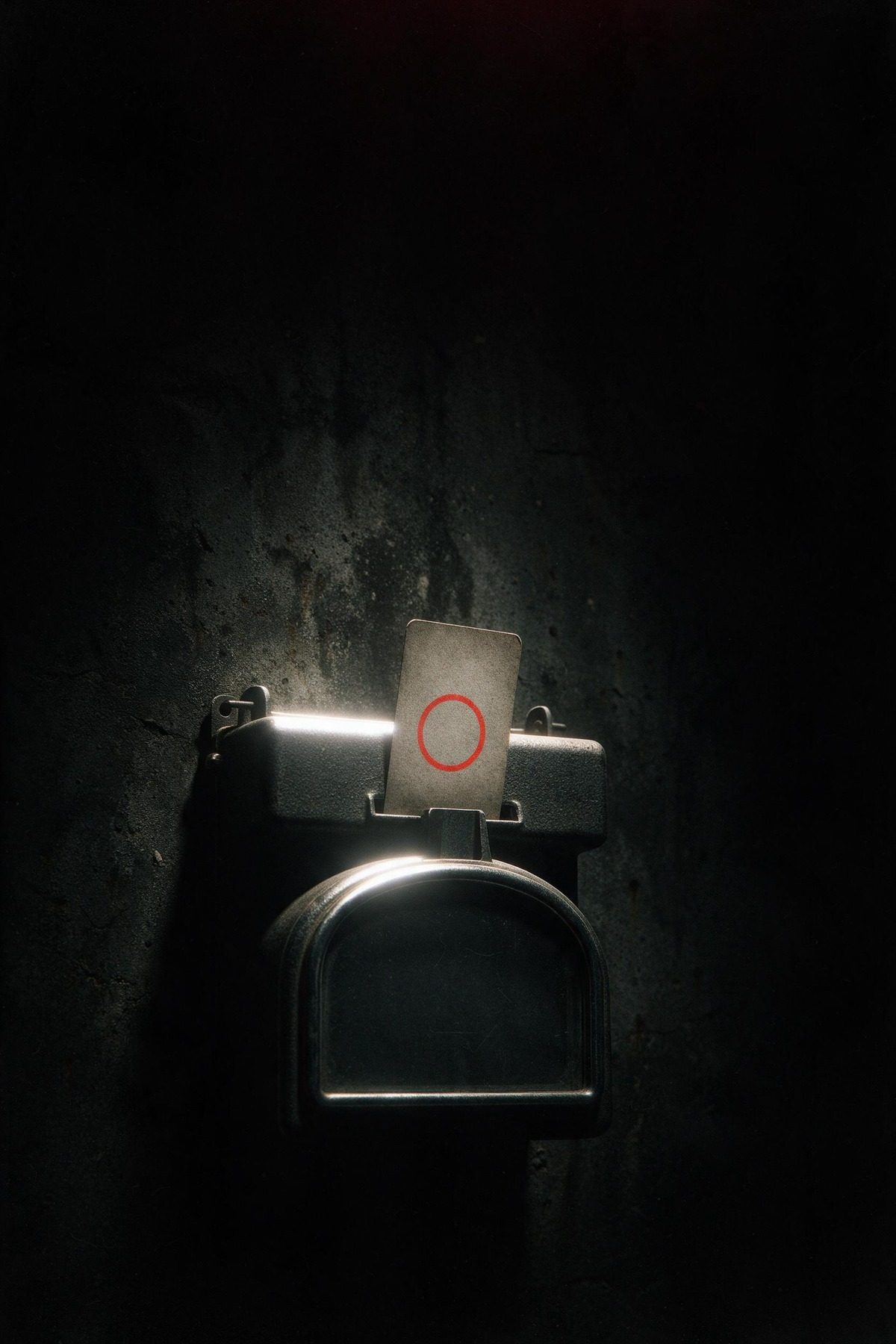
The time clock swallowed my card at 10:58 and spit it back with a click that sounded wet, like a tongue unsticking from the roof of a mouth. I wiped the card on my pant leg before I put it away. Twenty years I’d been doing that. The plastic came back smeared every night, same black streak, and every night I wiped it, and I told myself the smear was from my own glove, though I never touched the card with my gloves on.
The break room smelled like burned coffee and the floor wax they used in the 90s, the kind that left a shine like pond ice. Twenty-two chairs, I counted them once when I started, and twenty-two men and women in hi-vis vests and steel-toe boots sat in them, give or take the ones who stood by the vending machine. The tally clipboard hung on its nail by the door. I took it down. The sheet had twenty-three names already, before I’d put mine down. I counted the bodies in the room. Twenty-two. I counted again, slow, touching each head with my eyes the way I touch the forks of my lift before a shift. Twenty-two. I looked at the sheet. Twenty-three names, and the last one sat in my own handwriting, the tight loop on the capital D, the way I drag the tail of the e into the next letter. The ink was dry. I hadn’t touched the clipboard since yesterday.
The name under my thumb had gone to a smear, a dark blot of grease that could have been anything. I held it up to the fluorescent light. The paper had a thumbprint, my own, pressed into the pulp, and the ink had bled through to the back. I thought of Petrie, who usually clocked in late, who worked packaging and smelled like wintergreen from the lozenges he sucked all night. Petrie’s name sat halfway down the list, printed neat and small. But the extra name, the smudged one, sat at the bottom, in the space I always signed. I put the clipboard back on its nail. The nail left a red rust mark on the wall behind it, shaped like a hook.
Keep reading
This story continues. One subscription — $6.99/month — opens every story in full: 40 live today, new ones added monthly, plus the six-voice audiobook.
My forklift sat where I’d left it, battery plugged into the charger, the key still in the ignition because nobody stole keys here. The fluorescent light above my station buzzed in a pattern I almost recognized, a kind of Morse code I’d heard for years, three short, one long, two short. I stood under it for a minute, listening. The pattern repeated. Three short, one long, two short. I’d heard it every night. I’d never once thought about what it meant, and I didn’t want to start now, with six shifts left before my retirement party, which Marta had already taped a sign up for in the break room, DALE’S LAST SHIFT, with a drawing of a forklift that looked more like a praying mantis.
The lift started with its usual cough, a blue puff of exhaust that hung in the cold air off the loading dock. I drove my first loop, slow, the way I always drove, the forks two inches off the concrete, the mast tilted back just enough. The building hummed its night hum, a frequency that lived in the walls, in the steel beams overhead, in the fillings in my back molars. You didn’t notice it until you did, and then you couldn’t stop noticing it. Like the taste of the water from the break room fountain, which had a mineral edge, like licking a penny. I’d been tasting that penny for twenty years.
At 12:15 I came around the end of the packaging line, and Petrie’s station was empty. The conveyor belt ran, boxes moving along it with no one feeding the line, flaps up, tape gun hanging from its cord and swaying a little, as if someone had set it down a second ago. I stopped the lift. The boxes kept coming, one every three seconds, the rhythm of the line steady as a pulse. I watched them pass, each one sealed, each one stamped with the same blue lot number. The machine didn’t need Petrie. The machine had never needed Petrie.
I found Marta by the quality-control station, squinting at a tablet, her hairnet riding up on one side. I asked her where Petrie was. She looked at me with her head tilted, and the light from the tablet made her glasses two white squares.
“Who?”
“Petrie. Packaging. He was here at start of shift. I saw him by the vending machine.”
Marta shook her head. “I don’t know that name.”
I pulled the tally sheet from my back pocket, unfolded it, pointed at the smudge at the bottom. My finger left a little mark on the paper, a circle of oil from my skin. “This one. This is him.”
She looked at the sheet. She looked at me. “That’s you, Dale. You’re listed twice.”
I looked at the sheet. She was right. The smudged name had resolved into letters, and the letters spelled DALE ROURKE, in my handwriting, same as the line above it. Two Dale Rourkes, one after the other. I folded the sheet and put it back in my pocket. The cold air from the loading dock reached us, a long tongue of it, carrying the smell of hydraulic oil and the faint sweetness of diesel exhaust from the trucks idling at the bay. The conveyor belt kept running behind us, boxes passing, three seconds apart.
I didn’t say anything else. I got back on my lift and drove my loop, and the hum of the building seemed to sync with the engine, so that I couldn’t tell which vibration came from the machine under me and which came from the walls. The two sounds found the same pitch and held it, a low note that sat in my sternum. I drove through it. The forks stayed two inches off the concrete. The mast stayed tilted back. I was good at this job. I was the best forklift operator this building had, because I never let the building tell me what to do.
At 2:30 I took my break. The cafeteria was half-lit, the way it always was on night shift, with one bank of fluorescents off to save power, so the room had a dim end and a bright end. I sat at my table, the one by the window that looked out onto the parking lot, the one with the cigarette burn on the edge shaped like Florida. The tally sheet was already on the table, spread flat, with a red grease pencil laid across it like a knife.
A red line ran through the second DALE ROURKE. The line was heavy, pressed hard enough to tear the paper in one spot, a little valley of torn pulp. I looked up. The clock on the wall read 2:30. My watch said 3:15. I looked at the wall clock again. The hands hadn’t moved. The second hand pointed at the six and stayed there, trembling, like a compass needle trying to find north. I listened. The clock made no sound. It had ticked for twenty years, a sound I’d heard so often I didn’t hear it anymore, and now the absence of it was a hole in the air.
Behind me, a door clicked shut. The sound was close, inside the cafeteria, maybe ten feet away. I turned. There was the wall with the old fire alarm, the red box with the glass face, and beneath it the faded sign about the extinguisher. No door. The wall was blank cinderblock, painted that green they used in schools and hospitals and factories, the color of something that doesn’t want to be looked at. I stood up. My chair made a sound against the floor, a scrape that went on too long. The red grease pencil rolled off the table and hit the tile, and I left it there.
I walked back to the floor. The packaging line was shorter. One station was gone, not empty but physically absent, a gap in the line where a machine should have been, with four bolt holes in the concrete and a dark outline on the floor where the base had sat for years. The bolts were still there, driven into the concrete, their tops clean, no rust, as if they’d never held anything. I counted the workers on the line. Twenty-one. I pulled out the tally sheet. Twenty-three names. I put the sheet back. I didn’t ask anyone. I got on my lift and drove, and the building’s hum dropped a half-step, a note I felt in my chest before I heard it in my ears, like the moment before a storm when the pressure changes and your ribs know it first.
The rest of the loop took me past the charging station, past the shrink-wrap machine, past the pallet stacks that rose like canyon walls. I drove and I counted. Twenty-one workers. Twenty-three names. The gap in the line stayed behind me, a missing tooth in the building’s smile. I didn’t turn around to look at it again.
At 4:45 my lift’s battery light came on, a little amber eye on the dash, so I drove to the charging station and parked. The tally sheet was taped to the charger, chest-high, my name at the top, crossed out in red. I peeled it off. The tape left a residue on the metal, two strips of adhesive that caught the light. I held the sheet. The ink smeared under my thumb, and the second DALE ROURKE disappeared, not smudged this time but gone, leaving a clean white space where the letters had been, as if the paper had never held them. I turned the sheet over. The back was blank. I turned it again. The space was still white, and the first Dale Rourke remained, uncrossed, in my own hand.
A sound came from above, a heavy door closing, the kind of sound a steel fire door makes when it swings shut on its own weight. It came from the floor above. There was no floor above. The building had one story, a flat roof with HVAC units and a few vents, and I’d been up there once to look at a leak, and there was nothing but gravel and tar and the low hum of the fans. The sound came again, fainter, farther, like a door closing at the end of a hall. I looked up. The ceiling tiles were white, water-stained in one corner, the stain shaped like a hand with too many fingers.
I walked back to the main aisle. The shift had thinned. I counted as I walked, the way I always counted, because counting was the job, the real job, the one they paid me for. Nineteen workers. The tally said twenty-two. I stopped at the break room window and looked through the glass. A man in a forklift jacket sat at my usual table, the one with the cigarette burn, his face in shadow, his hands flat on the table in front of him. The jacket had a name patch on the chest. The patch said ROURKE. The man didn’t look up. The fluorescent light above him buzzed in its pattern, three short, one long, two short, and I realized I’d been hearing that pattern for twenty years, and I’d never once heard it until tonight.
I backed away from the window. My boots made no sound on the concrete, or maybe they did, and the building swallowed the sound before it reached my ears. The hum had shifted again, up this time, into a major key, almost cheerful, the kind of hum a person makes when they’re pretending not to watch you. The extra name was not a mistake. The extra name was a placeholder. The building kept a space for everyone, and when someone stopped fitting the space, the building filled it with someone else, someone who wore your jacket and sat at your table and signed your name in your handwriting. I walked back to my lift, and the battery light was still on, a little amber eye, watching.
At 5:58 I stood at the time clock. The tally sheet was in my pocket, folded into a square the size of a playing card. The main gate made its sound, the click of the lock, a sound I’d heard every morning for twenty years, and tonight it sounded final, like a period at the end of a sentence. I punched my card. The machine printed DALE ROURKE, 6:00 AM, no errors, the black ink clean and sharp. I put the card in my wallet, behind my license, next to the picture of my father, who had worked this same floor and disappeared one night twenty years ago, and whose name I’d never found on any tally sheet, though I’d looked.
I walked to the parking lot. The building was quiet behind me, no hum at all, the kind of quiet that comes after a sound stops, not before it starts. I counted the cars in the lot. Seventeen. There should have been eighteen. I counted again. Seventeen. My truck sat where I’d parked it, the only one under the burned-out light, the one that never got fixed. I got in and started the engine. The radio came on, low, a talk station, a man’s voice saying something about weather moving in from the west. I didn’t look back at the factory. I put the truck in gear and drove to the gate, and the guard waved me through without checking my badge, his face a pale oval in the booth, his hand already reaching for the gate button before I got there. The gate clicked shut behind me, and I drove out onto the county road, and the taillights of my truck made two red lines on the pavement, and I didn’t count how many of us walked through that gate, and I didn’t count the cars in the lot behind me, and I didn’t count the names on the sheet in my pocket, because the only way to stop the building from taking your name is to stop giving it your attention. The road stretched out ahead, dark and flat, and the radio said the temperature would drop by morning, and I drove, and I didn’t count.
I drove with the window cracked, because the heater had started blowing a smell like warm dust and old rubber, and I wanted the cold to keep me awake. The road unspooled under the headlights, blacktop gone gray with salt and frost. My hands sat on the wheel at ten and two, the same way they had for twenty years of driving home from that place, and I tried to let the rhythm of the tires settle me. The truck knew the way. It pulled past the closed Sunoco, past the billboard with the missing letters, past the ditch where a refrigerator had been lying on its side since October. I did not look in the mirror.
The tally sheet stayed in my jacket pocket, folded into a square the size of a cigarette pack. I could feel it there, a slight weight against my ribs, and every time I breathed in, the paper crinkled. I told myself it was just paper. A piece of paper with names on it, most of them people I had worked beside for years, people who would be clocking in again tonight at 10:58, same as always. But my jaw ached from clenching it, and my tongue tasted like the inside of a penny.
The radio cut out for a stretch of road where the power lines dipped low over the fields. Static, then a voice reading farm prices, then static again. I reached to adjust the dial and my hand shook, just a tremor, the kind you get from too much coffee and not enough food. I pulled my hand back and put it on the wheel. The cold through the window was sharp enough to make my left ear numb. I left it.
A pair of headlights came up behind me, high beams in my mirror, and I felt my chest tighten before I made myself look. A pickup, maybe a Chevy, riding my tail. I slowed a little, not because I wanted to let them pass, but because my foot had gone uncertain on the pedal. The truck behind me swung out and passed, a blur of rust and mud flaps, and the taillights shrank down the road until they were two red pinpricks, then nothing. I exhaled through my nose. The heat from the vent made a clicking sound, like a fingernail tapping the plastic housing.
I passed the grain elevator at the county line, the one with the light that never worked, and the road curved west toward the river. The sky had gone from black to a deep blue at the edges, the first suggestion of morning, and the fields on either side were stubble and frozen mud. A hawk sat on a fence post, wings hunched, watching the ditch for movement. I saw it for only a second before the road took it away, but the image stayed with me, the stillness of it, the patience.
My house came into view at the end of a gravel lane, a small white farmhouse with a porch light I never turned off. The yard was patchy, the mailbox leaned a little to the left, and the curtains in the front window hung exactly as I had left them. I pulled into the drive and killed the engine, and for a long moment I just sat there with my hands still on the wheel, listening to the tick of the cooling block and the faint whine of a dog somewhere down the road. The porch light made a yellow pool on the steps. The steps were empty.
I got out of the truck and the cold hit me full in the face, dry and clean, with a faint smell of wood smoke from the neighbor's chimney. I walked to the door, my boots crunching on the gravel, and I had the key in my hand before I reached the lock. The door opened with a little resistance, the way it always did in winter, and I stepped into the dark kitchen and closed it behind me. The house was quiet. The clock on the stove blinked 12:00, the way it always did after a power flicker, and the refrigerator hummed in the corner, a sound so familiar I usually didn't hear it. Tonight I heard it.
I did not turn on the lights. I stood in the kitchen with my jacket still on, the tally sheet still in my pocket, and I let my eyes adjust. The shapes of things came forward slowly: the table, the chairs, the coffee maker, the stack of mail I had left by the phone. I could smell the faint sourness of last night's coffee grounds, the dust in the air, the cold coming off the windows. I took the tally sheet out of my pocket and set it on the counter without unfolding it. It sat there, a white square against the dark laminate, and I looked at it for a while.
The refrigerator kicked off, and in the new silence I heard something else. A low hum, very faint, coming from somewhere in the house. I stood still and listened. It was not the refrigerator. It was not the clock. It was a sound I knew, a frequency I had felt in my chest for twenty years, and I had never once heard it outside the building. But here it was, in my kitchen, coming from the walls or the floor or the air itself, and I felt the hair on my arms rise under my jacket.
I walked through the house without turning on lights, following the sound. It grew louder in the hallway, a low drone like a transformer on a pole, and it was strongest at the door to the spare bedroom, the one I used for storage. I put my hand on the doorknob and the metal was cold, colder than the air, and I stood there for a long time with my palm pressed against it. The hum was steady. It did not pulse or waver. It simply was, and it came from the other side of the door, and I did not open it.
I went back to the kitchen and poured myself a glass of water from the tap. The water was cold and tasted like iron. I drank it standing at the sink, looking out the window at the gray light spreading over the field behind the house. The hum had faded, or maybe I had stopped hearing it, the way you stop hearing your own heartbeat after a while. I set the glass in the sink and turned around, and the tally sheet was still on the counter, but it had unfolded. One corner had lifted, as if the paper had been opened and then set back down.
I did not touch it. I walked to the bedroom and lay down on top of the covers with my boots still on, and I closed my eyes, and the ceiling fan above me made a slow creak with each rotation, a sound I had known for years, and I let it carry me down into a sleep that was not sleep, a thin place where the images from the night kept moving behind my eyelids. The empty station on the packaging line. The clock with its still hands. The man at my table with my name on his jacket. The gate clicking shut.
When I woke, the light in the room was flat and white, and my mouth was dry, and the clock on the nightstand said 2:47 in the afternoon. I had slept through the day. My body felt heavy, my joints stiff, and there was a pressure behind my eyes like the start of a headache. I sat up and swung my legs over the side of the bed, and the room tilted once, then settled. My boots were still on. My jacket was still on. The tally sheet was in my hand, folded again, and I did not remember picking it up.
I sat there for a while, looking at the paper in my hand, and then I unfolded it. The names were written in pencil, the way they always were, in a dozen different hands. I found my own name near the bottom, printed in the block letters I used for everything, and below it, the space where the second name had been, the one in my handwriting, the one that had been crossed out in red grease pencil. The paper there was clean. No smudge, no erasure mark, no trace that anything had ever been written. Just blank white space, the size of a name.
I folded the sheet and put it back in my pocket, and I walked through the house to the kitchen. The coffee maker was cold, the pot still half full from yesterday. I poured the old coffee into the sink and watched it swirl down the drain, and the smell of it rose up, bitter and stale. I made a fresh pot, the machine gurgling and hissing, and I stood at the counter while it brewed, watching the steam rise and fog the window above the sink. The field behind the house was gray and empty, the furrows frozen into ridges, and at the far edge, where the tree line began, a deer stood motionless, watching the house.
I drank my coffee black, standing up, and the heat of it burned the roof of my mouth. I thought about calling Marta, the line lead, to ask about the shift, to ask if anything had seemed off. But I did not know what I would say. I did not know what I would ask. I set the cup down and looked at the phone on the wall, and the phone looked back at me, and I left it alone.
The afternoon passed in small, ordinary ways. I shaved at the bathroom sink, the razor scraping against my jaw, and I watched my face in the mirror, the lines around my eyes, the gray in the stubble. I changed into clean clothes, a flannel shirt and work pants, and I hung the jacket on the hook by the door with the tally sheet still in the pocket. I ate a piece of toast over the sink, the crumbs falling onto the porcelain, and I washed them down with water. The hum did not return.
At 9:00 PM, I put on my jacket and went out to the truck. The air was cold and still, and the porch light threw my shadow long across the gravel. I stood for a moment by the driver's side door, looking back at the house, at the dark windows, at the empty steps. Then I got in and started the engine, and the radio came on with a burst of static before settling into a country station, a song about a man driving home to a woman who had left him. I turned it off.
The drive to the plant took forty minutes. I knew every mile of it, every turn, every pothole, and I drove it the way I always did, with my hands at ten and two and my eyes on the road. But my chest was tight, a band of pressure just below the sternum, and my fingers were cold inside my gloves. The gate came up on the left, the chain-link fence with the barbed wire on top, the guard shack with its yellow light, and I slowed to turn in. The guard, a man named Ellis who had worked there longer than me, waved me through without checking my badge. I raised a hand in return, and I did not look at his face.
The parking lot was half full, the cars in their usual rows, and I pulled into my spot near the east door. I sat for a minute with the engine running, looking at the building. The brick walls, the high windows, the exhaust stacks rising into the dark. The hum was there, even in the truck, even with the engine on, a low vibration that came through the seat and into my spine. I turned the key and the engine died, and the hum stayed, steady and patient, and I got out and walked toward the door, and the door opened before I touched it, and I stepped inside.
The time clock punched my card at 5:58 AM with a sound like a staple going through wet cardboard. I stood there a moment, my hand still on the card, and the machine clicked once, twice, then spat the card back out. DALE ROURKE. 6:00 AM. The ink was red, the same red as the grease pencil on the tally sheet, and I folded the card in half and put it in my shirt pocket next to the sheet I had not looked at in over an hour.
The break room smelled of burnt coffee and the faint chemical sweetness of floor cleaner. Marta's lunch bag sat on the counter, brown paper gone soft at the edges from years of refrigerated air. I had watched her pack that same bag every night for eleven years, same sandwich, same apple, same small plastic container of something pale. She was not in the break room. She had not been on the floor since the count dropped to nineteen.
I walked the main aisle toward the exit. The forklift sat where I'd left it, battery dead, forks lowered, the seat still warm when I passed my hand over it. The building's hum had settled into my molars, a vibration that made the fillings in my back teeth ache. I ran my tongue over them, felt the rough edge of the old silver, and kept walking.
The loading dock doors were closed. The dock light above bay three flickered, and for a second the shadows of the pallets stretched long and wrong across the concrete, like fingers pointing toward the personnel door. I smelled hydraulic oil, strong and new, though no one had run the dock lift since midnight. The smell followed me past the shrink-wrap station, past the baler, past the door to the maintenance cage where a single bulb burned over a workbench nobody had used in years.
My boots made a sound on the concrete that echoed too long. I stopped. The echo stopped a half-second later, out of sync. I started again, and the echo matched me step for step, then lagged, then matched again. I did not turn around. The hair on my forearms lifted, and I felt the cold air from the dock seep through the seams of my jacket, and I kept my eyes on the exit sign, the green letters steady, the word EXIT pulsing with the hum.
The gate clicked. I heard it clear through the brick, through the steel, through the layers of years and dust and the building's patient breathing. The lock on the main gate, the sound I'd heard every morning for twenty years, but this time it was final. This time the click did not echo. It just stopped.
I pushed through the personnel door and the cold hit me full in the face. November air, sharp with the smell of wet asphalt and diesel exhaust from the trucks that had idled at the docks all night. The sky had lightened to the color of old dishwater. I could see my breath, and I watched it hang in the air, a small cloud that lingered longer than it should have before it dissolved.
The parking lot stretched out before me, cracked asphalt, white lines gone gray. I counted the cars. It was habit, the same habit I'd had since my first week on the floor, when I'd count the cars to make sure I hadn't been the only one left behind. Seventeen. There should have been eighteen. I counted again, slower, pointing at each one with my finger like a child. Seventeen. Marta's blue Corolla sat in its usual spot near the fence. Petrie's truck, a red Chevy with a dent in the passenger door, sat three spaces down. I had seen Petrie's truck every night for six years. I could not remember Petrie's face.
I walked to my truck, an old F-150, gray, the driver's side door stiff in the cold. The key was cold in my hand, and the lock stuck for a moment before it turned. I climbed in, closed the door, and sat there with my hands on the wheel. The seat was cold. The steering wheel was cold. The rearview mirror showed the building behind me, the brick dark against the paling sky, the exhaust stacks still, no smoke rising, no birds on the roof. I had never seen a bird on that roof. Not once.
The engine turned over on the second try. The radio came on, some AM station, a man's voice talking about the weather, a cold front moving down from Canada. I turned it off. The hum was still there, under the engine noise, under the sound of my own breathing. I pressed my palm flat against the dashboard and felt it, a low thrum like a second heartbeat.
I pulled out of the space and drove toward the gate. The guard shack sat at the edge of the lot, a small white box with a window and a space heater that glowed orange inside. The guard, a man whose name I had never learned, stood in the doorway. He raised his hand. I slowed, reached for my badge, but he waved me through without looking at it. His face was pale in the early light, and his eyes were fixed on something behind me, something past the truck, past the parking lot, something on the roof or in the windows. I did not look back.
The gate clicked shut behind me. I heard it through the truck's closed windows, through the engine's idle, a sound like a bone snapping into place. I drove down the access road, past the sign that said ALDEN CROSS INDUSTRIES, past the chain-link fence with the barbed wire at the top, past the stand of pines where the crows used to gather in the fall. There were no crows this morning. There had been no crows for a long time.
The road stretched out, two lanes, empty. The fields on either side were brown and wet, the last of the corn stubble poking through the frost. I drove with both hands on the wheel, the speedometer steady at forty-five, and I did not turn on the radio. I did not look in the rearview mirror. The hum faded slowly, the way a bell fades after it's been struck, and by the time I reached the first stoplight on the edge of town, it was gone.
I sat at the red light and watched a man in a hooded sweatshirt walk a dog along the shoulder. The dog stopped, sniffed the ground, and the man waited, patient, his breath clouding in the cold. The light turned green. I drove past them, and the dog looked up as I passed, and its eyes were yellow in the headlights, and I thought of the tally sheet in my pocket, the names, the numbers, the red lines.
The diner on Main Street had its lights on, the OPEN sign buzzing in the window. A few cars sat in the lot, and through the glass I could see a waitress pouring coffee for a man at the counter. I almost pulled in. I almost parked and walked inside and sat at the counter and ordered coffee and eggs and toast, the way I did every morning after the night shift, the way I had done for twenty years. But I did not. I drove past, and the diner's light fell across the hood of the truck, and then it was behind me, and the road was dark again.
My apartment building sat at the end of a dead-end street, a two-story brick box with a cracked sidewalk and a row of mailboxes out front. I parked in my usual spot, the one under the broken streetlight that had been dark since March. I sat in the truck for a long moment, my hands still on the wheel, and then I reached into my shirt pocket and pulled out the tally sheet.
The paper was thin, cheap, the kind they bought by the case from an office supply catalog. I unfolded it carefully, the way I had unfolded it a hundred times that night, and I held it up to the weak light from the apartment building's entryway. The names were there, written in my own hand, the letters small and neat. The first DALE ROURKE sat near the top, third from the last. The second DALE ROURKE, the one that had been crossed out in red, was gone. Not crossed out. Gone. The space where it had been was blank, clean, as if the name had never been written at all.
I turned the paper over. The back was blank. I turned it again. The names were still there, twenty-two of them, and at the bottom, in a hand I almost recognized, a single word in red grease pencil: COUNT.
I folded the sheet and put it back in my pocket. I got out of the truck and walked up the cracked sidewalk to the door. The key turned in the lock, and the door swung open, and the hallway smelled of cooking oil and dust and the faint sourness of the old carpet. I climbed the stairs to the second floor, my boots heavy on the wood, and I unlocked my door and stepped inside.
The apartment was cold. The heat had not come on yet, and the radiators sat silent against the walls. I did not turn on the lights. I walked to the kitchen, opened the refrigerator, and stood there in the cold light, looking at the shelves. A carton of milk. A half-empty jar of pickles. A package of bologna, the plastic pulled back. I closed the door and the kitchen went dark again.
I took off my jacket and hung it on the hook by the door. The tally sheet was still in the pocket. I could feel its weight, slight as it was, a small rectangle of paper that had no right to weigh anything at all. I walked to the bedroom and sat on the edge of the bed, still in my work clothes, and I looked at the clock on the nightstand. 6:47 AM. The numbers glowed red in the dark.
I lay back on the bed, still wearing my boots, and I stared at the ceiling. The cracks in the plaster formed a shape I had never noticed before, a long diagonal line that branched like a river on a map. I followed it with my eyes, from the corner near the window to the center of the room, where it disappeared behind the light fixture.
The building was quiet. The building was always quiet at this hour, the other tenants asleep or gone, the pipes silent, the street outside empty. But there was something else, something under the quiet, a faint vibration in the walls, in the floor, in the frame of the bed. I pressed my hand flat against the wall and felt it. A low thrum, steady, patient.
I closed my eyes. The hum was still there, behind my eyelids, in the roots of my teeth, in the bones of my hands. I thought of the tally sheet, folded in my jacket pocket, hanging by the door. I thought of the names, the numbers, the red lines. I thought of the guard at the gate, waving me through without checking my badge, his eyes fixed on something behind me.
I did not get up to check the tally sheet. I did not count the names again. I lay there in the cold apartment, in my work clothes, in my boots, and I listened to the hum, and I waited for it to stop.
It did not stop.
Read Next
If you liked this story, keep going with these from The Dark Threshold.