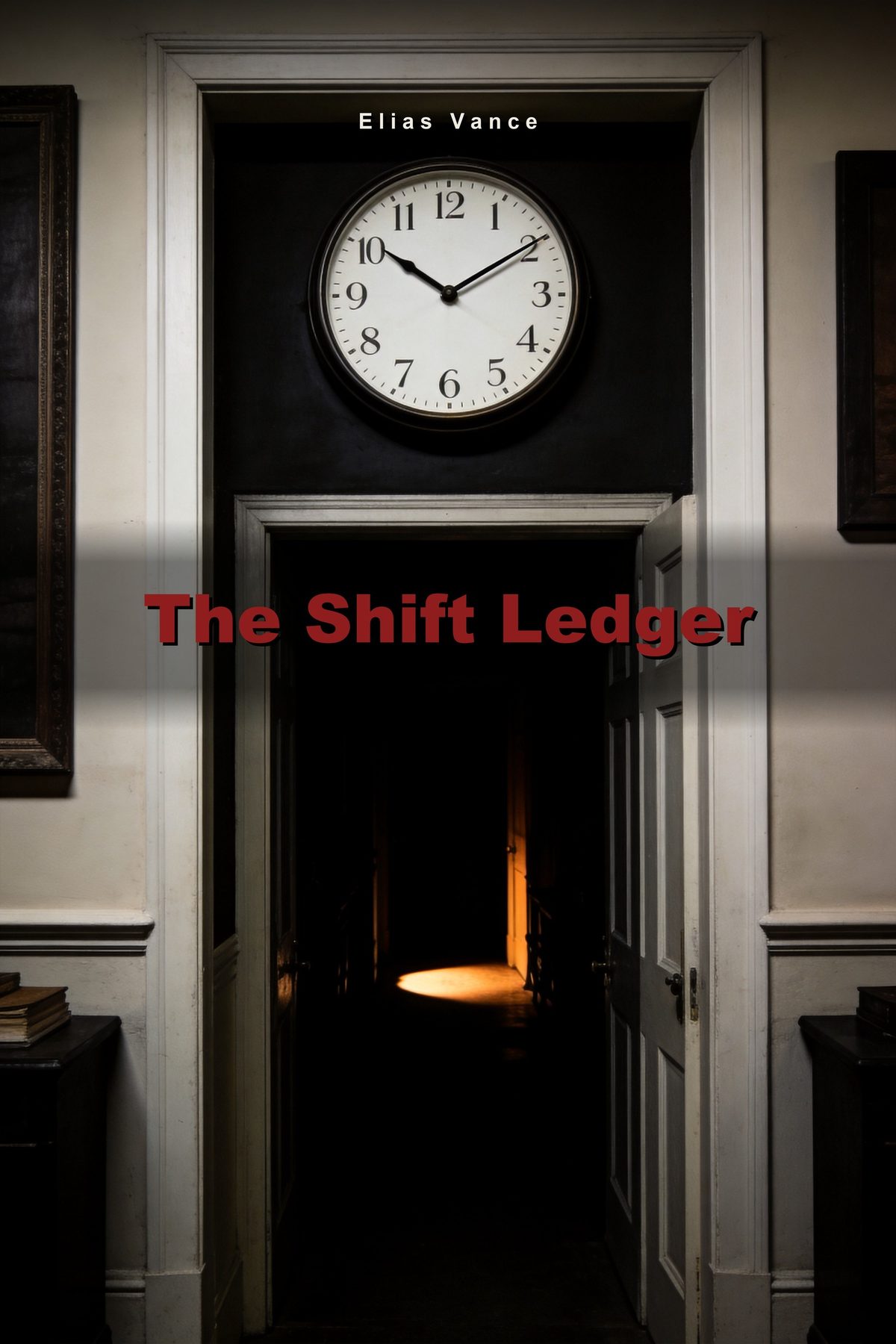
Enjoying the read? Get a new free Elias Vance story in your inbox every month — no spam, unsubscribe anytime.
The minute hand on the lobby clock hit 11:58 and I watched it settle there, a thin black line against a white face, and I thought about how many nights I had watched it do exactly that. Twelve years. The same hand, the same face, the same two minutes before the shift changed hands from evening to night. The lobby smelled like floor wax and the faint copper of old radiators. I had already counted the cash drawer twice. Two hundred forty in the till, a roll of quarters, a roll of dimes, and the folded stack of small bills from the restaurant bar. The register screen glowed its soft blue, showing six occupied rooms out of forty. Business hotel. Monday night. The kind of quiet that makes you hear your own swallow.
I pulled the shift ledger from under the desk. Black leatherette cover, cracked at the spine, the pages inside lined pale blue. I opened it to the current page and ran my finger down the column of times and initials. The evening clerk had signed out at 11:47. Her name, Lena, in blue ballpoint, the same loop on her L she always made. I uncapped my own pen and wrote my name in the next row: Jack Morrow. The pen moved across the paper and I stopped. The J looked wrong. Not wrong enough to point at, not wrong enough to show anyone, but the downstroke had a sharper angle than I remembered making. My J usually curved soft at the bottom, like a hook. This one ended in a straight line, the tail cut off clean.
I stared at it for maybe ten seconds. Then I blinked and told myself it was the pen. A new pen, the ink thicker, the ball bearing catching on the paper grain. I had bought a box of them at the supply closet last week. That was all. I closed the ledger and set it back under the desk. But I kept my hand on the cover a moment longer than I needed to.
Keep reading
This story continues. One subscription — $6.99/month — opens every story in full: 39 live today, new ones added monthly, plus the six-voice audiobook.
The grandfather clock in the corner ticked. It had been there since the hotel opened in 1979, a big oak thing with a brass pendulum behind a glass door. The night manager before me, a man named Frank who retired to Tucson, used to say the clock ran slow in summer and fast in winter, that the wood swelled and shrank with the humidity. I looked up at it now, at the pendulum swinging left and right, and for half a second the pendulum did not move. It hung at the right edge of its arc, stopped, as if someone had put a finger on it. Then it swung back. The sound of the tick came a beat late, like an echo of itself.
I stood up from the stool. My knees cracked. The lobby stretched out in front of me, empty chairs, empty carpet, the revolving door still. Outside, the parking lot lights made orange pools on the asphalt. A car passed on the road beyond, its headlights sweeping the front windows, and for a moment my own reflection slid across the glass, thin and dark. I looked older than I remembered. The reflection looked back at me with my face, my shirt, my tie, and then the car was gone and the glass went black again.
At 12:14 I started the audit. The computer terminal hummed. I ran the night's transactions, matched the restaurant receipts to the bar count, checked the wake-up call list. The work was the same work it always was. Numbers lined up. Doors stayed locked. The ice machine on the second floor kicked on with its low grind and then stopped. I wrote the totals in the ledger, my handwriting small and neat, and I did not look at the J.
Maria came down at 1:05. She pushed her housekeeping cart out of the service elevator, the wheels squeaking, and walked to the front desk with a key ring in her hand. She wore the gray uniform all the night staff wore, her hair pulled back tight enough to smooth the skin at her temples. She set the key ring on the counter and said, "I need the key to 214. Guest called for extra towels."
I looked at the register. The screen showed 214 as vacant. No check-in, no reservation, no name. I told her that. Maria frowned and looked at the screen herself, leaning over the counter so I could smell the soap on her hands, the faint bleach of the laundry room. "That's what the call said," she said. "Room 214. Towels."
I pulled the master key from the drawer and handed it to her. She took it and walked back to the service elevator. The cart wheels squeaked again, and the elevator doors opened and closed, and then the lobby was quiet. I sat there listening to the clock tick. The register still showed 214 vacant. I refreshed the screen. Still vacant.
I opened the ledger again. I don't know why. I flipped back a page, to the previous night's entries, and there was my name. Jack Morrow. The date above it was yesterday's date. Sunday. I had not worked Sunday. I had been home. I remembered that clearly, because I had cooked a frozen pizza and watched a documentary about deep-sea fishing and gone to bed at ten. But the entry was there, in my handwriting, the same blue pen, the same small neat letters. The J had the wrong slant. The tail cut off clean.
I touched the ink with my thumb. Dry. It had been dry for hours. A cold draft moved across the back of my neck, and I turned to look at the revolving door. No one had entered. The door stood still, its glass panels reflecting the empty lobby. But the air had moved, a thin ribbon of cold that smelled like outside, like wet pavement and exhaust. I turned back to the ledger and closed it. My thumb left a small smudge on the page.
The phone rang at 2:30. I picked it up and said, "Front desk." No one answered. I listened to the line, the faint hiss of an open connection, and then a click. I hung up. The phone rang again. I picked it up. Nothing. I held the receiver to my ear and heard a sound like breathing, slow and even, and then the click again. I set the receiver down gently, as if it were something that might break. The lobby clock ticked. I could hear my own pulse in my ears.
I pulled the guest register for the week. The printout was warm from the machine. I ran my finger down the list of names, the dates, the room numbers, and stopped at the bottom. Room 214. Checked in today. The name on the reservation was Jack Morrow. I read it three times. The address was my address. The phone number was my phone number. The method of payment was a card ending in four digits I did not recognize.
I picked up the phone and dialed 214. It rang once, twice, three times. I let it ring. The sound came through the receiver thin and far away, and I thought about the phone on the nightstand in that room, ringing in the dark. Four times. Five times. No answer. I set the receiver back in its cradle and looked at the register again. The name was still there. Jack Morrow. The letters neat, the J with the wrong slant.
I walked to the lobby mirror to straighten my tie. It was a full-length mirror next to the elevator bank, framed in brass, the glass slightly warped at the edges. I stood in front of it and lifted my hand to adjust the knot. My reflection did the same, but a half-beat late. I watched my hand reach the tie, and then, a fraction of a second later, the hand in the mirror moved. I lowered my hand. The reflection lowered its hand. But the delay was there, a lag so small I might have imagined it, like a video buffering. I leaned closer. The reflection leaned closer. My face in the glass looked the same, but the eyes seemed to focus just past my shoulder, as if looking at something behind me.
I turned around. The lobby was empty. The chairs sat in their rows, the carpet clean, the front doors locked. I turned back to the mirror. My reflection was already facing me, already still, as if it had turned a moment before I did. I stood there for a long time, watching my own chest rise and fall, watching the reflection's chest rise and fall, and I could not tell if the lag was real or if I was inventing it. My mouth had gone dry. I swallowed and the reflection swallowed, and I walked back to the desk without looking at the mirror again.
I wrote a note to myself in the margin of the ledger. Check 214. The words came out in my handwriting, the letters small and neat, but the slant was wrong. The C in check hooked too sharply. The 4 in 214 leaned forward like it was falling. I stared at the note and felt a cold line of sweat trace down my ribcage under my shirt. The lobby clock ticked. The ice machine kicked on somewhere above me, a low grinding sound that vibrated through the floor.
I sat on the stool behind the desk and waited. The clock read 3:12. The night stretched out ahead of me, the same night it always was, but the air in the lobby had changed. It felt thicker now, heavier, like the air before a storm. I could smell the ozone from the copy machine in the back office, though the machine was off. I could hear the fluorescent lights humming in the hallway behind the elevators, a sound I had not noticed in years. I could feel the shape of the ledger under my hand, the leatherette cover warm from my palm, and I thought about my father.
He had started forgetting things in small ways. A word here, a name there. He had once stood in the kitchen holding a carton of milk and asked my mother where the refrigerator was. The doctors had said it would progress slowly, and it did, and then it did not. By the end he did not know my name. He looked at me with polite confusion, like I was a stranger who had wandered into his room. I had sat with him in the hospital and held his hand and watched him search my face for something he could recognize. He never found it.
I did not want to forget. I did not want my own name to become a stranger to me. But the note in the ledger was my handwriting, and the J was wrong, and I could not stop looking at it.
At 3:40 I took the master key from the drawer and walked to the elevator. The lobby was silent behind me, the clock ticking its steady rhythm. The elevator doors opened with a soft chime. I stepped inside and pressed the button for the second floor. The doors closed. The car rose. I watched the numbers light up one by one, and I thought about the room at the end of the hall, the door with the brass number 214, and the phone ringing in the dark.
The elevator smelled like lemon polish and stale carpet, the same as it always did. I stood with my back to the handrail and watched the floor indicator climb from L to 2. The car shuddered once, a small mechanical correction, and then the doors opened onto the second-floor hallway. The corridor stretched away in both directions, lined with closed doors and the low amber glow of wall sconces set at intervals. The carpet here was darker than the lobby, a deep burgundy that swallowed the light. My shoes made no sound as I stepped out.
Room 214 sat at the far end, past the ice machine and the alcove where the vending machine hummed behind its glass. I had walked this hallway a hundred times, but tonight the distance felt longer, the air thicker. The wallpaper had a faint pattern, fleur-de-lis or something close to it, and I noticed for the first time that the pattern didn't quite repeat. Every few feet, one of the little flourishes bent the wrong way, like a typo in the design. I stopped and looked at it. The paper was old, maybe from the last renovation, and age could warp a pattern. But the bent flourishes were too regular, too deliberate. I touched one with my fingertip. The paper was cool and smooth, and the ink didn't smear.
I kept walking. My key ring knocked against my thigh with each step, a small brass sound in the quiet. The master key hung among the others, heavier than the rest, its teeth worn from years of use. I didn't remember taking it from the desk. I must have, though. There it was, cold against my palm when I closed my fingers around it.
The door to 214 had a brass number, just like the other doors, but the 1 was slightly lower than the 2 and the 4. A small thing. A loose screw, maybe, or a careless installation. I stood in front of it and listened. No phone ringing now. No sound at all. The hum from the vending machine didn't carry this far. The air in the hallway was still, and the only thing I could hear was my own breathing, shallow and quick.
I slid the master key into the lock. It turned without resistance, too easily, like the door wasn't latched. I pushed it open.
The room was dark. The curtains were drawn, but a thin seam of streetlight leaked in from the parking lot, enough to see shapes: the bed, the dresser, the armchair in the corner. The air hit me first, cold and dry, with a smell I couldn't place right away. Ozone, like after a thunderstorm, but also something older underneath, like the inside of a filing cabinet that hadn't been opened in years. Old paper. Dust and ink and the faint chemical sweetness of carbon copies.
I reached for the light switch. My fingers found the plate, and I flipped it. The overhead fixture flickered once, then held. The room came up in flat, even light: a standard double, clean and empty. The bed was made. That was the first thing I really saw. The bed was made with a single crease down the center of the coverlet, a straight line from pillow to footboard, so sharp it looked like someone had pressed it with an iron. The housekeepers didn't make beds like that. They smoothed the covers and tucked the corners, but they didn't crease. Nobody creased a hotel bed down the middle.
The nightstand held a telephone, a notepad, and a pen. Nothing else. The dresser was bare. The closet door stood closed. I looked at the bed again. The crease ran perfectly down the center, dividing the coverlet into two equal halves. I thought about the shift ledger downstairs, the way the ink had slanted wrong in my own hand, the way the date had been yesterday's. I thought about the phone ringing in a room no one had booked.
I walked to the nightstand. The notepad was blank, the pen uncapped but dry. The telephone was the same model as the one at the front desk, beige plastic with a coiled cord. I lifted the receiver. Dial tone. Steady and ordinary. I set it back in the cradle. My hand left a faint print on the plastic, a smudge of oil and sweat. I wiped it with my sleeve.
The closet door drew my eye. It was white, like the walls, with a brass knob that matched the numbers on the door. I didn't want to open it. The feeling sat low in my stomach, a cold weight, like I'd swallowed a stone. But I was already in the room. I had already come this far. I crossed the carpet and put my hand on the knob.
Before I could turn it, I heard the hum.
It came from behind the door, low and steady, the kind of sound a fluorescent light makes right before the tube dies. A buzz that lived in the teeth and the back of the skull. I held my breath. The hum didn't change. It was coming from inside the closet, from the dark space behind the door, and it had a rhythm to it, a pulse, like something breathing through a machine.
I turned the knob and pulled.
The closet was empty. A bare rod, a shelf above it, a folded luggage rack on the floor. The hum stopped the moment the door swung open. The silence that followed was worse than the sound. I stood there with my hand still on the knob, staring into the shallow space, at the white walls and the empty rod and the dust on the shelf. No light fixture. No outlet. Nothing that could hum.
I closed the door. The hum resumed.
I opened it again. The hum stopped.
I stood there for a long moment, opening and closing the closet door, listening to the sound start and stop, start and stop. My hand was shaking. I could see the tremor in my fingers, the way the knuckles jumped. I made myself stop. I left the door open and backed away, toward the bed, toward the door to the hallway. The hum was gone. The room was quiet. The overhead light buzzed faintly, but that was normal, that was just the fixture.
I turned to leave and saw the nightstand again. The notepad was no longer blank.
There was writing on the top page. I hadn't seen it before. I was sure I hadn't seen it before. It was my handwriting, the same cramped loops and forward slant, but the slant was wrong, just a few degrees steeper than my own. The note read: Shift starts at 11:00 PM. Do not leave.
I picked up the notepad. The paper was cool, and the ink was dry. I pressed my thumb against the last word and pulled away. No smudge. The ink had set. I looked at the words again, at the way the letters leaned, at the way the t's were crossed with a short, sharp stroke. I don't cross my t's like that. I never have.
The phone rang.
I dropped the notepad. It hit the carpet with a soft sound, and the phone rang again, a shrill mechanical bell that cut through the room. I stared at it. The receiver vibrated in its cradle. I picked it up on the third ring and held it to my ear.
No one spoke. But there was a sound on the line, a faint rustling, like paper sliding over paper. I listened. The rustling stopped. Then, very quietly, a voice said my name. Jack. It was my own voice. I knew the sound of it, the flat Midwestern vowels, the slight rasp from too many night shifts. But I hadn't spoken. The voice said my name again, slower this time, drawing out the vowel, and then the line went dead.
I set the receiver down. My hand was steady now, or maybe it was just numb. I looked at the notepad on the floor. The note was still there. The words hadn't changed. I backed toward the door, keeping my eyes on the closet, on the open door and the empty space inside. The hum didn't resume. The room was still.
I stepped into the hallway and pulled the door shut behind me. It clicked into place. I didn't lock it. I didn't think to lock it. I just walked, fast, past the vending machine and the ice machine and the wallpaper with its bent flourishes, and I didn't stop until I reached the elevator. I pressed the button. The doors opened immediately, as if the car had been waiting for me. I stepped inside and pressed L. The doors closed. The car descended. The floor indicator clicked from 2 to 1 to L, and I watched it the whole way down.
The lobby was empty. The front desk stood where I'd left it, the ledger open, the pen beside it. The grandfather clock in the corner showed 4:12. I looked at my watch. 4:12. The second hand on my watch ticked forward in small, even increments. The second hand on the grandfather clock didn't move at all. I stood there, watching the clock, waiting for the pendulum to swing. It hung straight down, motionless, a brass disk catching the light. My watch ticked. The clock didn't.
I walked to the desk and sat down in the chair. The ledger was open to the page I'd been working on. My name was there, signed at the bottom of the shift log, and the J was wrong. Angular, hooked, like the note in room 214. I flipped back a page. Yesterday's date. My signature. I hadn't worked yesterday. I knew I hadn't worked yesterday. But the page said I had, and the ink was dry, and the handwriting was close enough to mine that no one would ever question it.
I turned to a blank page. My name was already written there, at the top, with tomorrow's date. The same wrong slant. The same hooked J. I stared at it for a long time. The pen sat on the desk, uncapped. The ink in the barrel was black, the same black as the words on the page. I picked it up. The plastic was warm, as if someone had been holding it.
I wrote my name at the bottom of the page, below the other signature. I tried to make it look right, to match the slant and the loops, but my hand wouldn't cooperate. The J came out wrong. It looked exactly like the one already on the page.
The clock on the wall read 5:57. My shift ended in three minutes. I pulled the time card from my pocket and fed it into the clock-out machine. The machine whirred and stamped. I pulled the card out. MORROW, J. The J was a hook, a sharp angle, a letter I didn't recognize. I turned the card over. The back was blank. I put it in my pocket and walked to the revolving door.
The lobby was silent. The grandfather clock's pendulum hung still. The air smelled like lemon polish and stale carpet, and underneath it, faint but unmistakable, the dry paper smell of the ledger. I pushed through the revolving door and stepped out into the gray light of early morning. The parking lot was empty. The street beyond was empty. I walked toward home, my shoes scraping the pavement, and I didn't look back. But I could feel the hotel behind me, its windows dark, its doors unlocked, and I knew the shift was already waiting.
The air outside the hotel had a mineral edge, like wet concrete drying too fast. I kept my hands in my pockets and my head down. The streetlights had already clicked off for the dawn, but the sun hadn't fully committed. Everything sat in that gray pause between night and morning, when shadows lose their edges and the world looks flattened, provisional.
My apartment was eleven blocks east, past the closed diner with its chrome stools turned up on the counter, past the laundromat where a single dryer still tumbled someone's sheets in the window. I counted my steps without meaning to. It was a habit from the job, counting things. Cash drawer: forty-seven dollars in fives. Register: eighty-two names. Ledger: one signature, mine, with a J that hooked too sharp at the bottom.
I stopped at the crosswalk on Garfield and Third even though no cars were coming. The signal light burned red against the pale sky. I waited. The light changed to green, and I stepped off the curb, and halfway across I felt the hotel's windows still on my back, a row of dark rectangles facing east, catching nothing. I told myself it was just a building. Brick and glass and a revolving door that had turned me out into the morning.
The door to my apartment stuck in the humidity. I shouldered it open and locked it behind me. The place smelled like cold coffee and the wool blanket I kept folded on the couch. Everything was where I'd left it. That should have been a comfort. I stood in the entryway with my keys still in my hand and listened to the refrigerator hum. The sound was steady, ordinary, the same frequency as any other refrigerator in any other kitchen on this block. I didn't turn on the lights.
I made coffee because that was the routine. I ground the beans, filled the reservoir, pressed the button. The machine sputtered and coughed and filled the carafe with black liquid that steamed the kitchen window. I poured a cup and didn't drink it. My hands were cold. I held the mug anyway, letting the heat press into my palms, and I watched the window fog from the bottom up.
The clock above the stove read 6:14 AM. I checked it against my phone. 6:14 AM. The numbers matched. That was something. I sat at the kitchen table with the coffee going cold in front of me and tried to remember the walk home. The crosswalk. The laundromat. The diner with its stools turned up. But there was a gap somewhere, a soft blank spot between the hotel's parking lot and the first streetlamp, and when I tried to press into it, I got only the dry paper smell of the ledger.
I went to the bathroom and turned on the tap. The water came out cold and then warm. I splashed it on my face. The mirror above the sink was small and spotted with toothpaste, and I looked at myself in it for a long time. My reflection looked back. I raised my left hand. The reflection raised its left hand. I lowered it. The reflection lowered its hand. I counted the seconds. Nothing lagged. Nothing lingered. The face in the mirror was my face, tired at the edges, with a shadow of beard coming in and eyes that looked like they'd been open too long. I turned off the tap and dried my hands on the towel.
The towel smelled like the laundry detergent I'd used last week. Lavender, supposedly. It smelled more like dust and something sharp, something like the ozone in room 214. I dropped the towel on the counter and went back to the kitchen.
The coffee had stopped steaming. I drank it anyway, and it was bitter and lukewarm and it coated my tongue with a taste like old pennies. I poured the rest down the sink and watched it spiral into the drain. The clock above the stove read 6:31 AM. Seventeen minutes had gone somewhere I couldn't account for. I must have been standing in the bathroom longer than I thought. I must have been looking at my own face longer than I thought.
I pulled out a chair and sat down at the kitchen table with a pen and a pad of paper I kept for grocery lists. I wrote the word coffee at the top of the page. The handwriting was mine. I wrote milk. The handwriting was mine. I wrote my name, Jack Morrow, and the J came out with that same wrong angle, the hook too sharp, the curve too flat, like someone had taken my hand and adjusted it a fraction of an inch without telling me.
I put the pen down. The pad of paper sat on the table with my name on it, and I didn't recognize the letters, not quite. They were close. They were the kind of close that makes you lean in and squint, because the difference is so small you can't say what's wrong, only that something is.
The phone in my pocket buzzed. I pulled it out. A text from the hotel's front desk number. The message read: Shift starts at 11:00 PM. Do not leave. I stared at the screen until it dimmed. The timestamp said 6:47 AM, but I hadn't heard the phone buzz at 6:47. I'd heard it just now, at whatever time it actually was, and the phone had been in my pocket all along. I unlocked the screen and checked the conversation thread. The previous messages were old ones from Maria about shift swaps and a broken ice machine on the second floor. This new message sat at the bottom of the thread, gray bubble, no sender photo.
I typed back: Wrong number. The message sent. The screen showed Delivered. I waited. No reply. The clock above the stove read 6:52 AM.
I put the phone face down on the table and went to the living room window. The street below was empty. The cars parked along the curb were the same cars that always parked there, a silver Corolla with a dented rear bumper, a red pickup with a faded sticker on the tailgate. Across the street, the apartment building's windows were dark. No one was awake. No one was coming home from a night shift, no one was walking a dog, no one was standing at their window looking out.
I pulled the blinds down. The room went dim, and I sat on the couch with the wool blanket over my legs, and I did not sleep. I sat there with my eyes open and my hands folded on my chest, and I listened to the refrigerator hum, and after a while the hum sounded less like a refrigerator and more like the fluorescent light in the closet of room 214, a low steady vibration that got inside your teeth and stayed there.
The day passed in increments. I didn't eat. I didn't turn on the television. I sat on the couch and watched the light behind the blinds shift from gray to pale gold to gray again. The clock above the stove kept its own time. I checked my phone at 3:12 PM. Then at 5:40 PM. Then at 8:03 PM. The hours between those checks felt compressed, like the day was a sheet of paper being folded smaller and smaller.
At 9:15 PM I got up and took a shower. The water was hot and then cold and then hot again, and I stood under it with my hands braced against the tile, watching the water run down my arms and drip from my elbows. The soap smelled like the same detergent, lavender and dust. I dried off and dressed in my work clothes, the same black slacks and white shirt I'd worn the night before. The shirt was wrinkled at the cuffs. I ironed it anyway, pressing the heat into the fabric until the wrinkles flattened and the smell of hot cotton filled the apartment.
At 10:20 PM I laced my shoes and stood by the door with my keys in my hand. The phone in my pocket buzzed again. I didn't check it. I already knew what it would say.
The walk back to the hotel was longer than the walk home had been. The streetlights were on now, pooling orange on the sidewalk, and the air had cooled enough that I could see my breath in short puffs. The diner was dark. The laundromat was dark. The crosswalk at Garfield and Third had a signal that changed from red to green as I approached, as if it had been waiting for me, as if the whole street had been waiting for me.
The hotel rose up at the end of the block, its windows lit now, its doors unlocked. The revolving door turned slightly in the wind, or not in the wind, because there was no wind. I stood on the sidewalk and watched it turn, a slow quarter rotation, then stop. The lobby beyond the glass was empty. The front desk was empty. The grandfather clock stood against the far wall, and its pendulum was still.
I pushed through the door and stepped inside. The air hit me first, cold and dry and smelling of old paper and the faint chemical tang of carpet cleaner. The lobby lights were on at full brightness, the way they always were during the night shift. Everything was in its place. The leather chairs arranged around the low table. The brass luggage cart parked by the elevator. The front desk with its computer monitor glowing and its cash drawer closed and its shift ledger open to a blank page.
I walked to the desk. My shoes made no sound on the carpet. The clock on the wall read 10:52 PM. I had eight minutes. I opened the cash drawer and counted it. Forty-seven dollars in fives. I checked the register. Eighty-two names. I flipped to the shift ledger to sign in.
The page wasn't blank. My name was already there, written in black ink, with today's date. The J hooked too sharp at the bottom. The rest of the letters were close enough to mine that I couldn't say they weren't mine. I stood there with the pen in my hand and looked at the signature, and then I looked at the pen, and then I signed my name underneath it. The pen moved across the paper, and the signature it left was identical to the one above it. Wrong slant. Wrong J. My hand had made it, and I had watched it happen, and I had not stopped it.
The clock on the wall read 10:57 PM. I closed the ledger. The grandfather clock across the lobby let out a single chime, low and heavy, and the pendulum began to swing. I watched it for a long moment. Back and forth. Back and forth. The lobby was empty. The doors were unlocked. The shift was starting, and I was already there.
Read Next
If you liked this story, keep going with these from The Dark Threshold.