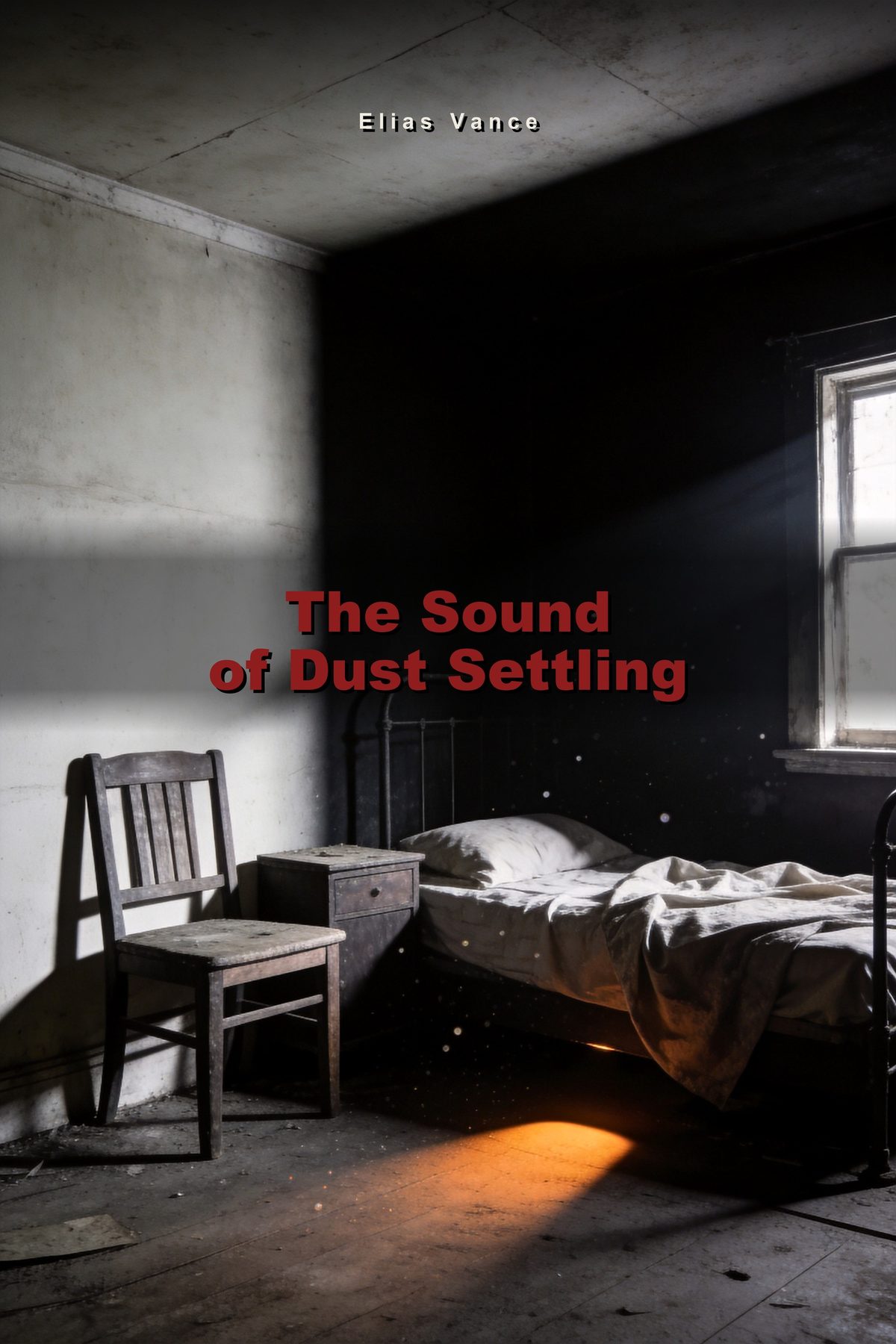
Enjoying the read? Get a new free Elias Vance story in your inbox every month — no spam, unsubscribe anytime.
The house held its breath at 7:15 every morning, and Maggie Voss had learned to breathe with it. She stood at the top of the stairs, one hand resting on the banister Paul had refinished the summer they moved in, and she listened. The refrigerator hummed its low note from the kitchen. The clock in the hallway ticked, a sound so familiar it had become a kind of silence. Through the small window at the landing, the gray November light fell across the carpet in a pale rectangle, and inside that rectangle she saw it: a crease, faint but new, running from the wall toward the stair rail, as if something heavy had been dragged across the nap and then the fibers had tried to rise again. She went down three steps and crouched. The crease was no wider than a finger, a shadow of pressure in the wool. She ran her thumb along it. The carpet felt cold, and the crease did not smooth away.
She left it. There was coffee to make, and the rooms to check.
The kitchen she entered without thought, her hand finding the light switch before her eyes adjusted, because forty years in a house teaches the body its geography. She filled the kettle, set it on the burner, and while the water gathered its heat she stood at the counter and looked through the doorway into the hall. From this angle the crease was invisible. The carpet lay flat and gray and ordinary. She turned back to the kettle and watched the steam begin to feather from the spout, and she told herself the crease was a trick of the light, though the light had not moved since she first saw it.
Keep reading
This story continues. One subscription — $6.99/month — opens every story in full: 39 live today, new ones added monthly, plus the six-voice audiobook.
Her morning ritual had not changed in the six months since Paul died. She made her coffee, black, in the blue mug with the chip on the rim that he had always left in the sink, and she carried it through the ground floor, room by room, cataloging. The living room: sofa cushions straight, the afghan folded over the arm, the stack of library books on the side table arranged largest to smallest. The dining room: table bare except for the bowl of wax fruit she had never liked but kept because Paul's mother had given it to them, the dust on the bowl's rim fine and even. The front hall: shoes in the tray, umbrella in the stand, the small brass key in the lock of the front door, turned horizontal, the way Paul had always left it. She did not touch anything. She only looked, and the looking was a kind of caretaking.
The study door was closed.
It was always closed. Paul had kept it closed even when he was inside, the door pulled nearly to the jamb, a habit from years of phone calls and tax documents and the quiet work of a man who needed a room that was only his. After he died, Maggie had gone in once, to find the will. She had opened the door, stepped into the smell of old paper and pipe smoke, and she had stood at the desk for a long time, not touching anything, until the silence grew too heavy and she backed out and pulled the door shut behind her. She had not opened it since. But every morning she stopped outside it, and she looked at the door, and she confirmed that it was closed. The brass knob dull, the paint around the frame unbroken, the keyhole dark. This morning, the door was closed. She stood with her coffee going cold in her hand and she listened at the wood. Nothing. The house held its breath. She moved on.
The stairs she climbed slowly, her left knee complaining on the seventh step, the way it had for a year now. At the top she turned left, toward the bedroom, and she paused at the threshold. The bed was made, the white coverlet pulled smooth, the two pillows in their cases, the one on the right slightly flattened where Paul's head had lain for forty years. She had not washed that pillowcase since he died. She would not wash it. It was a detail no one else would notice, but she noticed it every morning, and the noticing was a small, private act of fidelity.
She dressed in the clothes she had laid out the night before, a gray cardigan over a white blouse, wool trousers, the brown shoes with the soft soles. She brushed her hair, counting the strokes, twenty on each side, and she put in the small pearl earrings Paul had given her on their thirtieth anniversary. In the mirror her face looked back at her, sixty-four years old, the skin at her jaw beginning to soften, the eyes still sharp, too sharp, she sometimes thought, for a woman who had spent her life looking at other people's papers, other people's histories, cataloging and preserving and making order of the past. She had been good at her work. She had been precise. The precision had not left her, but lately it had begun to feel like a muscle she was using too hard, a grip that tired.
The day passed in its usual shape. She dusted the living room, moving the cloth over the shelves in long, even strokes, and she did not think about the crease in the carpet. She made a sandwich for lunch and ate it standing at the kitchen counter, looking out the window at the bare trees, the gray sky, the neighbor's cat walking along the fence with its tail held high. She washed the plate, dried it, put it away. The house was quiet, but it was always quiet now.
In the afternoon she sat in the living room with a book, one of the paperbacks from the library stack, a mystery she had already read twice but could not remember well enough to return. The light through the front window faded from gray to a deeper gray, and the room grew dim, and she did not turn on the lamp. She was not reading. She was listening to the house, the way she always listened now, without meaning to, the way a tongue returns to a sore tooth.
And then she heard it.
A soft, dry, granular whisper, like sand pouring from a closed fist into a pile. It was brief, no longer than a breath, and it came from the direction of the study. She put the book down on the side table, and she sat very still, her hands flat on her thighs, and she waited. The sound did not repeat. The refrigerator hummed. The clock ticked. The house was quiet again, but the quiet had a different texture now, as if something in it had shifted and settled.
She stood. Her knee protested, a small click in the joint, and she walked out of the living room and down the hall toward the study. The door was closed. She had known it would be. She stood in front of it, and she put her palm flat against the wood, and she felt nothing, no vibration, no warmth, only the cool, painted surface of a door that had been closed for months. She turned the knob. The latch gave with a small, dry sound, and the door swung inward.
The room was unchanged. The desk against the far wall, the green blotter, the fountain pen laid across it at a slight angle, the way Paul had left it. The bookshelves along the left wall, floor to ceiling, the spines in no order she had ever understood, but an order Paul had known. The armchair by the window, its leather cracked along the seat, the small table beside it with the reading lamp and the ashtray he had never emptied. The air smelled of dust and old paper and the faint, sweet ghost of pipe smoke. She stood in the doorway and she looked at all of it, and nothing was out of place.
She closed the door. She pulled it until the latch clicked, and she tested the knob, and she noticed that the latch was slightly loose, the knob turning a fraction too far before it caught. She made a mental note to fix it. Then she went back to the living room, and she picked up her book, and she did not read. The sound did not come again that day, but she heard it all evening, the memory of it, the dry whisper, the sand falling in a room where no sand was.
That night she lay in bed and listened to the house settling around her, the creaks and ticks of wood cooling, the wind at the window, the distant sound of a car on the road. She did not sleep well. When she did sleep, she dreamed of pouring, of a slow, steady stream of something fine and pale, falling from a height she could not see, piling up on a surface she could not reach.
The next morning she went through her ritual, and when she came to the study door she stopped. The door was ajar. Not much, no more than an inch, but the gap was there, a thin line of darkness between the door and the jamb. She had closed it. She had tested the latch. She had felt it catch. And now it was open.
She pushed the door wide and stood in the doorway, her heart beating in her throat, a small, fast pulse that she could feel in her temples. The room was unchanged. The desk, the pen, the blotter. The bookshelves, the armchair, the ashtray. The window, its shade half-drawn, the way Paul had always left it. She stepped inside, and the floor creaked under her weight, a sound so ordinary it almost calmed her. She walked to the desk and she looked down at the blotter. The pen was there, laid across the center. But it was not at the same angle. She had looked at it yesterday, and the pen had pointed toward the window. Now it pointed toward the door.
She picked it up. It was cold in her hand, the metal barrel smooth, the nib dry. She laid it back down, pointing toward the window, the way it had been, the way it should be. Then she turned and left the room, and she pulled the door shut, and she pushed on it, hard, to be sure the latch caught. It did. She stood there for a long moment, her hand on the knob, and then she went to the kitchen and made her coffee, and she did not go back to the study for the rest of the day.
But the sound came again that afternoon, the dry, granular whisper, and this time it was longer, a slow, seeping hiss that lasted three seconds, four, five, before it stopped. She was in the living room, and she did not get up. She sat with her book in her lap and she listened, and when the sound stopped she let out a breath she had not known she was holding. Her hands were cold. She pressed them together in her lap, and she waited, but the sound did not return.
The next morning she found the book. It was on the shelf in the study, a first edition of The Haunting of Hill House that Paul had bought at an estate sale in Vermont, and it was turned spine-in. She stood in front of the shelf and she looked at the place where the spine should have been, the gap of dark wood, the pages hidden. She reached up and pulled the book out, and she turned it around, and she put it back, spine out, the title facing her, the small white letters against the black cloth. Then she went to the desk, and she saw the pencil. It was on the right side of the blotter, not the left. She had not touched the pencil. She had not touched anything in this room except the pen, and the book, and the door.
She moved the pencil back to the left side. She straightened the blotter, which had shifted, no more than a quarter inch, toward the edge of the desk. She wiped the surface of the desk with her sleeve, and the dust came away on the wool, a fine, gray film. She had dusted this room yesterday morning. She had wiped every surface, and the cloth had come away clean.
She stood in the center of the room, and she listened. The house was quiet. The refrigerator hummed. The clock ticked. And then, from inside the wall behind the desk, she heard it. The soft, dry, granular whisper, the sand falling, the fine, pale stream of something settling in the dark. It came from inside the wall, behind the wainscoting, and it did not stop. It went on and on, a slow, continuous trickle, and she stood there with her hands at her sides, and she listened to the room remembering itself, and she did not move.
The sound had no source she could name. It came from inside the wall behind the desk, a fine dry trickle like sand passing through a narrow throat, and it went on without pause. Maggie stood in the center of the study with her arms at her sides and her weight balanced on both feet, the way she had stood in the stacks at the county archive when a box arrived mislabeled and she needed to decide whether to open it. The room held its shape around her. The desk lamp burned with its usual low hum. The curtains hung straight. Nothing moved, and the sound continued.
She pressed her palm against the wainscoting. The wood felt cool and slightly gritty, as though a film of dust had settled there in the last hour. The trickle vibrated through the panel into the bones of her hand, a sensation so faint she might have imagined it. She leaned closer. The sound was not uniform. It had a rhythm underneath the steady pour, a slow rise and fall, like something breathing through a clogged filter. She held her own breath to listen. The rhythm did not match her pulse. It kept its own time, patient and regular, and she took her hand off the wall and stepped back.
The desk was exactly as she had left it that morning. Paul's fountain pen lay on the blotter at a slight angle, the nib pointing toward the window. The pencil she had found on the right side two days ago was now in the center of the desk, aligned with the edge of the blotter as if someone had measured it. She had not moved it. She had stopped moving anything in this room three days ago, after the book turned itself spine-in on the shelf and she turned it back and the next morning it lay face-down on the armchair cushion. The corrections were not hers. They arrived between her visits, or during them, quietly, while she looked elsewhere.
She sat down in Paul's chair. The leather creaked under her weight, a sound too loud against the wall's soft pouring. The chair still held the faint odor of his tobacco, though he had not smoked in the house for eleven years. She had never been able to wash it out of the leather. Now she wondered if the smell had been returning on its own, molecule by molecule, the way the dust returned to the shelves after she wiped them. She pressed her fingers against the armrests and felt the worn spots where Paul's hands had rested, the dark smooth patches that had taken decades to form. The room was not forgetting him. The room was keeping him in a way she had not agreed to.
The sound stopped.
The silence that followed was not empty. It had weight, a pressure against her eardrums, as though the air in the room had thickened. She sat very still in the chair and listened to the absence of the trickle. The lamp hummed. The house settled somewhere below, a joist contracting in the cold. Outside, a car passed on the road, its tires hissing on the damp asphalt. Ordinary sounds. She waited for the trickle to resume, and it did not.
She stood and walked to the bookshelf. The first edition of The Haunting of Hill House sat in its usual place, spine out now, the black cloth cover unmarked. She had turned it spine-in two days ago as a test, and the next morning it had been corrected. Now it was spine out again, which meant the room had changed it back, or she had done it herself and forgotten. She reached up and touched the top of the spine with one finger. The dust there was fine and gray, a thin film that came away on her skin. She had dusted this shelf on Sunday. Today was Thursday.
She wiped her finger on her trousers and walked to the door. The sound began again behind her, soft and granular, pouring down inside the wall. She did not turn around. She closed the door with a click and stood in the hallway with her hand on the knob, feeling the latch give slightly under her grip. The sound was muffled now, a whisper behind the wood, but she could still hear it. It followed her down the hall, growing fainter with each step, until she reached the kitchen and turned on the tap to fill the kettle.
The kitchen was bright and clean. She had scrubbed the countertops that morning, and the stainless steel sink gleamed under the overhead light. The kettle began to heat, a low rumble that covered the sound from the study. She took a mug from the cabinet, the blue one with the chip in the rim that Paul had refused to throw away, and set it on the counter. The tea bag went in next, then the sugar bowl, then the spoon. She arranged them in a row, each object a few inches from the next, and waited for the water to boil.
The rumble deepened. Steam began to rise from the spout. She watched it curl into the air and dissolve, and she thought about the dust in the study, how it had appeared on the shelf an hour after she had wiped it clean, how it had not fallen from anywhere but had simply been there, a fine gray skin on the wood. She had watched it happen. She had stood at the shelf with a cloth in her hand, and the dust had returned while she watched, not settling but present, as if the room had exhaled it through the grain of the wood.
The kettle clicked off. She poured the water over the tea bag and watched the brown bloom spread through the water. The steam rose and wet her face. She carried the mug to the kitchen table and sat down, and the chair legs scraped against the floor, and the sound from the study was gone. The house was quiet. The tea cooled in the mug, and she did not drink it.
That night she lay in bed with the lamp on and the bedroom door open, listening. The hallway was dark. The study door was closed, a dark rectangle at the end of the hall. She had checked it before coming to bed, had turned the knob and pushed and confirmed that it was shut, had stood outside it for a full minute listening to the soft trickle inside the wall. The sound had been steady, unhurried, like sand running through an hourglass. She had gone to bed anyway.
Now she lay on her side with her knees drawn up and her hands folded under her chin, the way she had slept for forty years. Paul's side of the bed was empty. The sheets on his side were cold and smooth, pulled tight, the pillow fluffed and centered. She had made the bed that morning, as she did every morning, and she had not touched his side since. The pillow smelled of nothing. She had washed the cases in unscented detergent, and the fabric held only the faint starch of the line-dry, and she closed her eyes and tried to hear the sound from the study.
It was there. Faint, at the edge of her hearing, a dry whisper that might have been the wind in the eaves or the house settling or the blood moving in her ears. She held her breath. The whisper continued, and it had a rhythm, a slow pulse like a heartbeat heard through a wall. She opened her eyes and stared at the ceiling. The light from the lamp threw a yellow circle above her, and the shadows in the corners were deep and still. She lay without moving and listened to the pulse in the walls, and at some point she slept.
She woke at three in the morning with the lamp still on and the house silent. The silence was complete, a dead weight in the air. She sat up and swung her legs over the side of the bed. The floor was cold against her bare feet. She walked to the hallway and stood looking toward the study. The door was open.
She had closed it. She had turned the knob and pushed and felt the latch click, and now the door stood open a few inches, a strip of darkness against the dark hallway. She walked toward it. Her feet made no sound on the carpet. The hallway seemed longer than it was, the walls farther apart, and the air grew cooler as she approached the door. She pushed it open with one hand and reached inside for the light switch.
The study was empty. The desk lamp was off. The curtains were drawn. The air smelled of dust and old paper and something else, something dry and mineral, like the inside of a cave. She switched on the overhead light and the room jumped into focus. The desk was neat. The bookshelf was orderly. The armchair sat by the window with its back to the room. And on the desk, in the exact center of the blotter, Paul's fountain pen stood upright on its point, balanced impossibly, its gold nib pressed into the paper.
She stared at the pen. It did not fall. It stood there, a black cylinder balanced on a needle point, and the silence around it was absolute. She took a step into the room. The pen remained upright. She took another step, and the floor creaked under her foot, and the pen did not move. She reached out and took it, and the nib left a tiny puncture in the blotter, a black dot of ink that spread slowly into the paper. The pen was warm in her hand, as though someone had been holding it.
She set it down on the left side of the blotter, where it belonged. Then she stood with her hands at her sides and looked at the walls. The wainscoting was clean. The paint was smooth. No cracks, no gaps, no sign of the fine dry stream that had poured through the wall for hours. She walked to the wall behind the desk and pressed her ear against the wood. Nothing. The silence inside the wall was thick and complete, a held breath. She stayed there for a long time, listening to nothing, and then she went back to bed.
The next morning she did not make the bed. She left the sheets tangled on Paul's side and the pillow on the floor, and she walked to the study in her nightgown with her hair uncombed. The room was bright with morning light. The dust lay on every surface in a fine, even layer, gray and soft as ash. It covered the desk, the shelves, the chair, the windowsill, the floor. It had not been there the night before. She stood in the doorway and looked at the dust, and she understood that she had been wrong about the room. It was not forgetting her. It was remembering something else, and the dust was the residue of that memory, the fine gray silt left behind when a place dredges up what it has lost.
She walked into the room. The dust was soft under her bare feet, warm and dry. She sat down in Paul's chair, and the dust rose around her in a cloud, and she breathed it in. It tasted of nothing. She sat there while the morning light moved across the floor, and the dust settled back onto the arms of the chair and onto her knees and into the folds of her nightgown. She did not wipe it away.
The sound began again, soft and granular, from inside the wall behind the desk. She closed her eyes. The trickle filled the room, a fine dry pour, steady as breath. She listened to it for a long time, and she did not move, and the dust settled on her like a second skin, and the room remembered itself around her, and she let it.
The dust on her knees had dried to a pale gray film by the time she opened her eyes. The room had changed again. Not in any way she could name at first, only a shift in the air, the way a room feels after someone has been standing in it for a long time and then left. The curtains hung exactly as they had. The desk sat where it always sat. But the light through the north window came in at an angle she did not recognize, as if the sun had moved a few degrees off its morning track. She looked down at her hands. They rested on her thighs, palms up, and in the creases of each palm lay a fine line of dust, pale as powdered bone. She thought of Paul's hands, how they had looked in the last weeks, the skin loose over the knuckles, the nails ridged. She had trimmed those nails for him when he could no longer manage the clippers. He had sat very still in the armchair, his hand in hers, and he had said, You have a steady hand, Mags. She had filed each nail smooth and then buffed the edges with the soft cloth, and he had watched her face the whole time, not his fingers. The sound had stopped. She did not know when it had stopped, only that the room now held a silence so complete it pressed against her eardrums like cotton packed too deep. She stood. Her knees cracked, a sound too loud in the still air, and she left the study without looking back at the wall behind the desk.
In the kitchen she ran the tap until the water went cold and held her hands under it. The dust swirled in the basin, gray against the white porcelain, then slid down the drain. She dried her hands on the towel that hung from the oven handle, the one with the faded blue stripes that Paul had bought at a hardware store in Portland twenty years ago. The towel smelled faintly of soap and something else, something dry and mineral, like chalk dust. She lifted it to her nose. The smell was not in the towel. It came from her own skin. She put the towel down and stood at the sink for a long moment, her fingers curled over the edge of the counter, and she watched the water bead on the faucet's chrome mouth. One drop hung there, full of the kitchen's gray light, and then it fell. She did not hear it land. The house was too quiet for that now, or she had stopped hearing small sounds, she could not tell which. Outside the window above the sink, the neighbor's maple had begun to turn, the leaves going yellow at the edges first, the way they always did in early October. She could see a single branch swaying, but she felt no breeze through the window, and the glass was cold against her forehead when she leaned forward to look more closely. The branch moved again, a slow, deliberate dip, and then it stopped. She stepped back from the sink. The clock on the wall above the stove said ten-forty. She had been in the study for over three hours. She did not remember the time passing, only the dust on her skin and the sound like sand pouring from a closed fist, and the way the wall had breathed against her ear.
That afternoon she took the vacuum from the hall closet and carried it to the study door. The door stood open. She had left it open when she came downstairs, she was sure of it, and she had not been back. But the door was open now, and the room beyond it lay in shadow, the curtains drawn though she had not drawn them. She stood in the hallway with the vacuum's cord coiled over her arm, and she looked at the gap between the door and the jamb, the way the light from the hallway fell across the threshold and stopped, as if the room would not let it enter. The carpet in the hallway had a new crease, a long shallow depression that ran from the study door to the top of the stairs, as if something heavy had been dragged across it recently. She knelt and touched the crease. The fibers were flattened in one direction, away from the study. She had not noticed the crease this morning. She had not noticed it yesterday. But there it was, a faint track in the beige wool, and when she ran her finger along it the fibers did not spring back. She stood and plugged the vacuum into the hallway outlet and switched it on. The motor's whine filled the hallway, too loud, a sound that belonged to another house, a house with living people in it. She pushed the vacuum across the crease, back and forth, back and forth, until the fibers rose again and the track was gone. Then she switched off the vacuum and stood in the sudden quiet, listening. The house listened back. She could feel it listening, the walls and the floors and the closed doors all turned toward her like faces. She unplugged the vacuum and put it back in the closet and closed the closet door until the latch clicked. She did not go into the study. She did not close its door. She walked downstairs and sat in the living room with a book open on her lap and she did not read a single word.
The next morning she found the book on the floor. Not the one she had been reading, but the one from the study, the first edition of The Haunting of Hill House that Paul had bought at auction in Boston the year before they married. It lay face-down on the living room rug, its spine cracked open to a page near the middle. She had not brought it downstairs. She had not touched that book in weeks. She picked it up and closed it carefully, pressing the pages together, smoothing the dust jacket. The cover felt warm, as if it had been held in someone's hands for a long time. She carried it upstairs to the study and set it on the shelf in its proper place, spine out, title legible. The shelf was dusty. A fine gray film covered the wood and the tops of the books, and when she drew her finger through it the dust clung to her skin in a thin, even line. She looked at her finger. The dust was the same color as the dust that had settled on her in the study the night before, the same texture, fine as milled flour. She wiped her finger on her skirt and left the study without closing the door. The sound began again as she reached the top of the stairs. Soft, granular, a slow pour from inside the wall behind the desk. She stopped. The sound did not stop. It continued, steady as breath, and she stood at the top of the stairs with her hand on the banister and listened to it until her legs began to ache. Then she went down to the kitchen and made herself a cup of tea and drank it standing at the counter, and the sound followed her through the floor, through the soles of her shoes, a fine dry vibration that she felt in her teeth.
By the fourth day she had stopped correcting the changes. The pencil lay in the center of the desk, and she left it there. The blotter had a new ink stain, a small dark bloom near the upper left corner, and she did not try to clean it. The curtains in the study hung closed at noon, and she did not open them. The dust settled on every surface in a uniform layer, and she let it settle. She moved through the house with a new care, stepping around the edges of rooms, touching nothing that she did not need to touch. She ate her meals at the kitchen counter, standing, her plate held in one hand, and she washed the plate immediately and put it away. She slept in the armchair in the living room, not in the bedroom, and when she woke in the night the house was never fully dark. A faint gray light came from the study doorway at the top of the stairs, a light that had no source she could find, and she lay in the armchair and watched it until sleep took her again. The dreams were always the same: she was walking through the house, and every room she entered was the study, and every door she opened led back to the study, and the sound was everywhere, the soft granular pour, and the dust was falling like snow, and Paul was standing at the desk with his back to her, and when she called his name he did not turn, and when she touched his shoulder her hand passed through him and came away covered in dust. She woke with her hand outstretched, reaching for something that was not there, and the gray light from the study doorway was still burning, and the sound was still falling, and she did not get up to close the door.
On the fifth morning she woke in the armchair and knew that something had finished. The house was silent. Not the silence of absence but the silence of completion, the way a room feels after the last box is unpacked and the last shelf is arranged. She sat up. The light through the living room windows was ordinary morning light, pale and clean, and the dust on the coffee table was ordinary dust. She stood and walked to the foot of the stairs. The study door stood open at the top. She climbed the stairs slowly, her hand on the banister, and the banister was smooth and cool under her palm. The hallway creaked in its usual place. The door to the study stood open, and the room beyond it was bright with morning sun, and the curtains were open, and the dust lay on every surface like a fine gray cloth, even and still. She stepped inside. The sound did not come. The room was quiet, and the dust was still, and the desk sat in the center of the room with the pencil lying across the blotter and the chair pushed in and the lamp off. The books on the shelf were all turned spine-out. The wall behind the desk was smooth, the wainscoting unbroken. She walked to the window and looked out at the neighbor's maple, the leaves yellow at the edges, and she saw that the branch that had moved without wind now hung still. She turned back to the room. The armchair sat by the window, and she sat in it, and she looked at the desk, and she thought of Paul sitting there in the evenings, his glasses pushed up on his forehead, his pen moving across the page. She thought of the way he would look up when she came to the door and say, There you are, and the way the room had always smelled of his pipe tobacco and the lemon oil she used on the wood. She thought of the dust settling on his glasses when he left them on the nightstand, and she thought of the sound, the soft granular pour, and she understood that the room had not been forgetting her. It had been remembering something else. A version of the house, a version of the life, that she had never lived. And it had been correcting itself, adjusting each small detail to match that other memory, and she had been the one who was wrong. Or she had been right, and the room was wrong, and the difference between those two things was a door she could not open. She sat in the armchair for a long time, and the dust settled on her shoulders and her hair, and she did not move. The room held her. The house held her. And when she finally stood, her knees cracking in the quiet, she walked to the door and turned off the light and stepped into the hallway. She pulled the door closed behind her. The latch clicked. The sound did not come. The silence that followed was full of the weight of what she had agreed not to see, and she stood in the hallway with her hand on the doorknob, and she did not let go.
Read Next
If you liked this story, keep going with these from The Dark Threshold.