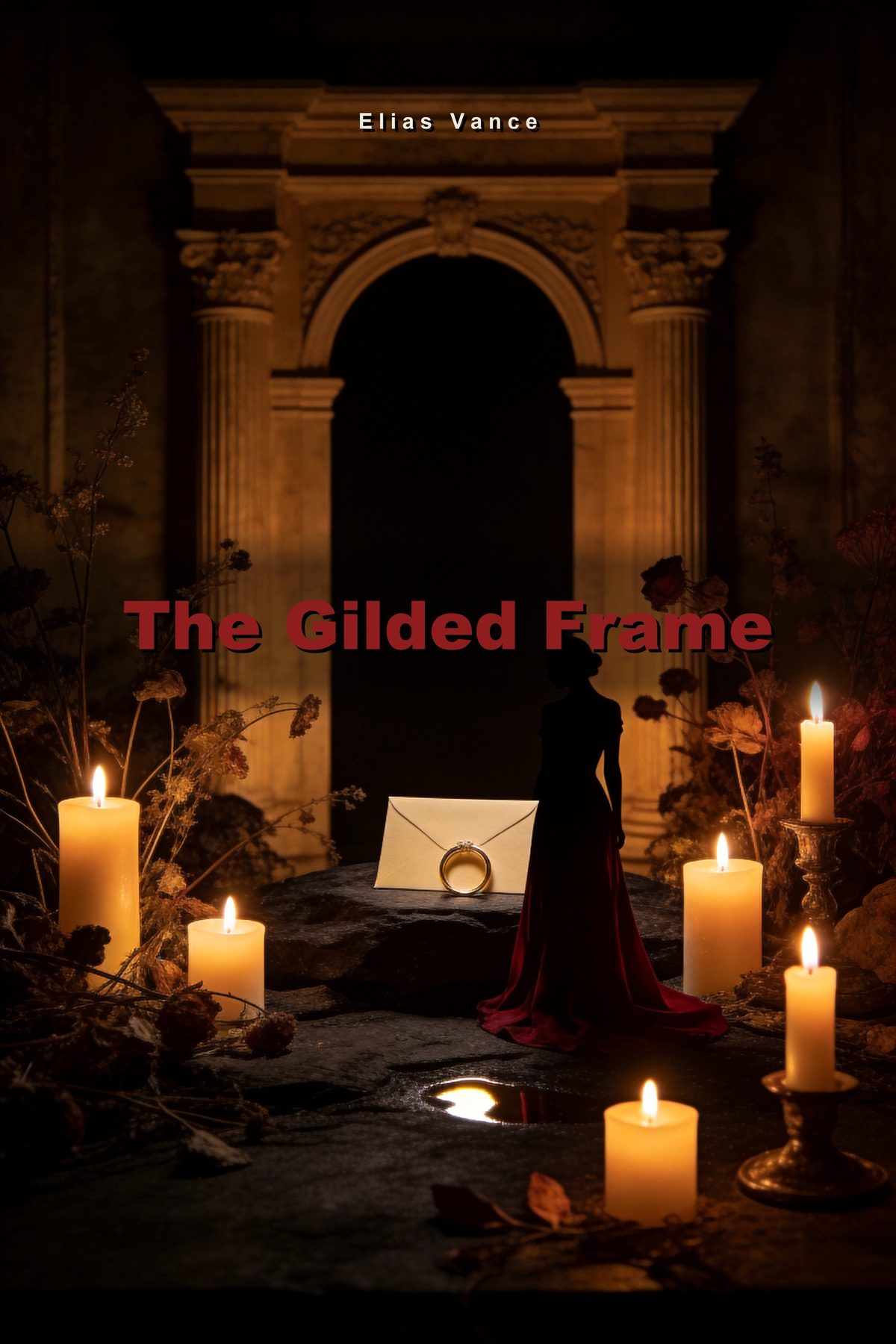
Enjoying the read? Get a new free Elias Vance story in your inbox every month — no spam, unsubscribe anytime.
The first time I saw Elias Crane, I was already touching the frame. My fingers rested on the gilded border, tracing the carved hands that ran unbroken along its edges, and the gold was warm, as if someone had been holding it before I entered the room. The heat traveled through my fingertips and into the bones of my hand, a living warmth that had no business in a room kept at auction-house temperature, no business in a piece of nineteenth-century gilding that had sat untouched for weeks. I should have pulled away. The piece was not for sale. It had arrived without provenance papers, without a lot number, without a consignor, and it was to be held for private viewing only. None of that explained why I had come back to the viewing room after hours, or why I had taken off my gloves.
The gloves lay on the table behind me, one folded over the other, pale cotton against dark walnut. I had worn them all day, cataloguing a shipment of estate silver, and my hands had been sweating inside them. Now the air of the viewing room touched my bare fingers, cool and dry, and the contrast made the warmth of the gilding sharper, more insistent. I traced the carved hand at the bottom left corner, the one with its palm open and empty. The wood beneath the gold leaf was smooth, worn by something more than age. By touch. By years of touch.
The door opened behind me, and I did not turn. I watched the room in the glass instead: the long table, the brass lamp, the shelves of auction catalogues in their leather spines, the window with its heavy curtain drawn against the street. The room appeared with perfect clarity, every edge crisp, every shadow exact. My own reflection was soft at the edges, as if the glass had not yet decided whether to keep me. I could see the outline of my body, the dark shape of my dress, the pale oval of my face, but the details bled into the reflected room like water into paper.
Keep reading
This story continues. One subscription — $6.99/month — opens every story in full: 39 live today, new ones added monthly, plus the six-voice audiobook.
His footsteps stopped just inside the doorway. Then his voice, low and unhurried, the kind of voice that did not need to rise because it expected the room to arrange itself around it.
"The hands are a warning," he said. "Not an ornament."
I turned. He stood with his coat still on, dark wool over a dark suit, and he was older than I had imagined, though I had not imagined him at all. His hair was silver at the temples, and his face was composed the way a room is composed: everything in its place, nothing accidental. He was looking at me, not at the frame, and his attention was total, the way a collector's attention is total when he has already decided what he wants. I felt it land on me like a hand, warm and heavy, and I understood that I had been waiting for it without knowing I was waiting.
"I'm sorry," I said, though I was not sure what I was apologizing for. "The viewing room is closed."
"Yes," he said. "I asked for it to be."
He was the collector. The one who had requested the private viewing. The one whose name was not written anywhere in the files, because no one had been able to tell me what it was. I had asked three times. My supervisor had shrugged. The front desk had no record. The loading dock manifest listed the frame's arrival but no consignor, no contact, no instructions beyond a single line in a handwriting I did not recognize: private viewing only.
"You're early," I said.
"I'm exactly on time." He came farther into the room, and I noticed that he did not look at the frame until he was standing beside me. When he did look, his expression did not change, but something in the air between us tightened, as if the room had drawn a breath. I felt it in my chest, a small compression, the pressure before a storm.
"Do you know what it is?" he asked.
I shook my head. "There's no paperwork. No lot number. It came in through the loading dock three weeks ago, and no one has claimed it."
"No one will claim it," he said. "It's not lost."
He reached out and touched the frame, his fingers landing on the carved hand at the top left corner, the one missing its thumb. His touch was light, almost reverent, and I saw that his hands were beautiful in the way old instruments are beautiful: long-fingered, precise, made for careful work. He wore no rings. His nails were clean and trimmed. The skin at his knuckles was faintly lined, and I thought of the way old ivory ages, the fine crackling that proves its authenticity.
"The hands," he said. "Some are empty. Some are holding something that's been worn smooth. And this one—" He tapped the thumbless hand. "This one has let go."
I looked at the carving more closely than I had before. He was right. The hands were not identical. I had catalogued the frame three times, and I had not noticed. I had noted the frieze, the unbroken line of carved hands, the gilding, the warped glass. I had not noticed that the hands were different from one another, that some were open and some were closed, that some held small objects worn smooth by time and touch, that one at the top left corner was missing its thumb. That should have troubled me. Instead, I felt a small, private thrill, the kind I felt when an object revealed itself to me slowly, the way a face does in low light.
"What does it hold?" I asked.
He turned to me, and for the first time I felt the full weight of his attention. It was warm, like the gilding, and it made me want to stay very still. I felt my pulse in my throat, in my wrists, in the tips of my fingers still resting against the frame.
"Whatever is given to it," he said.
The room went quiet. The radiator ticked somewhere in the wall, a sound like a metronome, and I realized I had been holding my breath. I let it out slowly, and the sound of my own breathing seemed too loud in the stillness.
"What's your name?" he asked.
"Mara Voss."
He repeated it slowly, testing the weight of it. "Mara Voss." He looked back at the frame. "You see it, don't you? The way the glass doesn't quite keep you."
I did not answer, because I had not known anyone else could see it. I had thought it was a flaw in the glass, a trick of the light, a failure of my own vision. I had not thought it was something another person could stand beside me and see. I had not thought it was something that could be shared.
He did not bid on the frame that night. He did not ask to see anything else. He simply stood with me in the quiet room, and the warmth of the gilding spread through my hand and up my arm, and I felt the room arrange itself around the two of us, the way a room arranges itself around a fire. When he left, he took my hand and held it for a moment longer than was necessary, his thumb pressing lightly against the inside of my wrist, where my pulse beat against his skin. His thumb was warm. His grip was firm but not painful. I could feel the texture of his skin, the fine lines at the pad of his thumb, the steady pressure that seemed to measure the rhythm of my blood.
"The car will come for you next Thursday," he said. "Seven o'clock."
He was gone before I could tell him I had not agreed to anything. The door closed behind him with a soft click, and I stood alone in the viewing room, my hand still warm from his, my wrist still feeling the ghost of his thumb.
The enameled box arrived the next morning. It was small enough to fit in my palm, pale blue with a gold clasp, and inside it lay a single key. No note. No return address. The box itself was old, the enamel faintly crackled, the gold clasp worn smooth. I held the key up to the light. It was iron, with a hollow shaft and a bow shaped like a small, open hand. It fit no lock I owned. I tried every door in my apartment, the windows, the radiator cabinet, even the lock on my mother's old jewelry box, the one I kept at the back of my closet. The key slid into none of them. The hollow shaft was cool against my palm, and the open hand of the bow pressed into my skin, and I stood in the middle of my apartment with the key in my fist and felt something open in me anyway.
I put the key back in the enameled box and set the box on my nightstand. That night, I dreamed of hands, dozens of them, carved and warm, reaching for me from the edges of a mirror. In the dream, I reached back. In the dream, I was not afraid.
I did not tell anyone about the car. When it came the following Thursday, I was already waiting at the curb. I had changed three times. I had put on lipstick and wiped it off and put it on again. I had stood in front of the bathroom mirror and practiced saying no, and then I had gone downstairs and stood at the curb, and when the black car pulled up, I got in without a word.
Elias's apartment was not an apartment. It was a palazzo of rooms, each one opening into the next, each one arranged like a gallery. Furniture, paintings, objects, all pristine, all lit by low lamps that seemed to have no switches, no cords, no source. The light simply was, a soft amber glow that pooled in the corners and left the centers of the rooms in shadow. The air smelled of beeswax and old paper, and the carpets were so thick that my footsteps made no sound. I walked through the first room and heard nothing beneath my feet, and I felt the hush swallow me, the way a library swallows a whisper.
He met me at the door and took my coat. He did not ask if I had found the box. He did not ask if I had tried the key. He simply led me through the rooms, his hand at the small of my back, and I felt the warmth of his palm through the fabric of my dress like a claim. The pressure was light, but it was constant, and it guided me through doorways and around corners, and I let it.
"You may touch anything," he said. "Sit anywhere. Open any drawer." He paused, and I felt his hand press a little firmer against my spine. "But you must never ask where any of it came from."
I turned to look at him. "Why?"
"Because the answer would cost you more than the object is worth."
I thought about the key in my nightstand drawer, the one that fit nothing, and I did not ask again.
That first evening, he showed me the rooms one by one. A salon with a harpsichord and a set of chairs upholstered in faded rose silk. A library with shelves that climbed to the ceiling, the books arranged not by author or title but by color, so that the spines formed long, soft gradients of light, blues melting into greens melting into golds. A dining room with a table that could seat twenty, though I saw no signs that anyone had ever eaten there, no crumbs, no rings from glasses, no wear on the chair arms. A study with a desk of dark walnut and a single chair, and on the desk a bronze figure of a woman with her arms raised, her face worn smooth by time.
I stopped in front of the bronze. "This is beautiful."
"It came from a house in Ghent," he said.
I waited for him to say more. He did not. The silence stretched, and I felt it take up space between us, a third presence in the room. The bronze woman stood with her arms raised, her face erased by the touch of hands, and I thought about what it meant to be worn smooth by something you could not see.
After a moment, he turned and walked toward the door. "The kitchen is through there," he said. "You'll find wine in the cabinet to the left."
The evening ended earlier than I expected. He called me a car at ten, and he kissed my hand at the door, and he did not ask me to come back. The invitation was in the silence, in the way he held my fingers for just a moment too long, in the way the apartment seemed to exhale when I stepped into the hall. I rode the elevator down with my hand pressed against my sternum, feeling the place where his lips had touched my skin, and I knew I would go back. I knew it the way I knew the weight of a silver spoon before I picked it up, the way I knew a piece of jasperware by the blue of its glaze. I knew it in my body, and my body did not lie to me about such things.
I went back the next week. And the week after that.
The pattern was always the same. He would meet me at the door, and we would walk through the rooms, and he would tell me stories about the objects without telling me where they came from. A porcelain tea bowl, cracked and repaired with gold, the cracks running through the glaze like veins of light. A silver letter opener with a handle shaped like a serpent, the scales worn smooth in places where fingers had held it. A small oil sketch of a woman in a blue dress, her face turned away, the paint thin and cracked with age. He would describe the period, the maker, the technique, and then he would go quiet, and I would feel the rule settle over us like a cloth.
But there were other moments, too. Moments when he would reach out and touch me the way he touched the objects in his collection: with pleasure, and with the patience of someone who knows the piece is already his. His hand at my wrist to check the fit of a bracelet he had given me, a thin band of gold set with a single sapphire. His thumb along my jaw to turn my face toward the light. His fingers at the nape of my neck, lifting my hair to see the line of my throat. Each touch was precise, deliberate, and each one left a warmth that lingered after his hand had moved away.
I began to catalog him the way I cataloged objects. By maker, by period, by the small flaws that authenticated. The faint scar on his left index finger, a thin white line that caught the light when he turned his hand. The way he held his coffee cup, his fingers curled around the porcelain but not gripping, as if the cup were balanced by its own weight. The particular silence he kept when I asked a question he would not answer, a silence that was not empty but full, a room with the door closed. I told myself I was studying him the way I studied furniture and silver and porcelain. I told myself I was not falling.
I was not falling. I was being collected.
The first time I noticed the frame in his bedroom, I was lying in his bed, the sheets cool and smooth against my skin. He was in the bathroom, and the door was ajar, and I could hear the sound of water running, a soft hiss in the pipes. I turned my head on the pillow, and there it was: the gilt frame, hanging on the wall opposite the bed, its carved hands catching the low light from the lamp on the nightstand. The gold seemed to glow, warm and alive, and the hands seemed to move in the flicker of the lamplight, though I knew they were still.
I sat up. The glass reflected the room with perfect clarity: the bed, the lamp, the dark shape of the wardrobe, the pale curve of the sheets. And me. My reflection was clearer than it had been at the auction house. Still soft at the edges, but no longer translucent. As if the glass had begun to make up its mind.
I got out of bed and walked toward it. The floor was cool under my bare feet. The air was warm, warmer than it had been in the other rooms, and the gilding radiated heat, even from a few inches away. I could feel it against my face, against my bare arms, against the thin skin of my wrists. I thought of the key in my nightstand drawer at home, the one that fit no lock I owned, and I felt the heat of the frame answer something in me, some cold place I had not known I carried.
"It suits you," Elias said from behind me.
I did not turn. I watched his reflection join mine in the glass, his body solid and dark behind my pale one. The contrast was sharp, his dark shirt against my pale slip, his height against my smaller frame, and I thought of the way a painting is composed, the way the eye is drawn to the light.
"What does it do?" I asked.
He stepped closer, and his hands settled on my shoulders. His thumbs traced the line of my collarbone, and I felt the warmth of his skin through the thin fabric of my slip.
"It keeps things," he said.
"What kind of things?"
He bent his head, and his lips brushed the curve of my ear. His breath was warm, and I felt it on my skin, and I did not move.
"Things that want to be kept," he said.
I closed my eyes. His hands moved down my arms, slow and sure, and I felt the heat of the frame against my face, warm as breath.
The weeks that followed were a kind of drowning. I went to work, and I cataloged objects, and I came home to my one-bedroom walk-up in Queens, and I waited for the next evening at Elias's apartment. The waiting was the worst part. The waiting was also the best part. I had never wanted anything the way I wanted those evenings, the rooms, the silence, the weight of his hand at the small of my back. The radiator in my apartment ticked like a metronome, and I lay in bed and listened to it and thought about the warmth of the gilding, the way it had felt against my face, the way his hands had moved down my arms.
I noticed things. I noticed that there were no photographs in his apartment, no books with inscriptions, no letters tucked into drawers. The objects were immaculate and orphaned, each one alone in its perfection, each one carrying no trace of the life that had once surrounded it. I noticed that he watched me the way I watched a new acquisition: with pleasure, and with the patience of someone who knows the piece is already his. I noticed that the gilt frame's glass now reflected me more clearly than it did at the auction house, and that my reflection did not always move when I moved. Sometimes it was a half-second behind, as if it were deciding whether to follow. I would lift my hand, and the hand in the glass would lift a moment later, and I would feel a small, cold shiver, not of fear but of recognition.
I found three objects in his apartment that I recognized from Blackwood & Sloane's records. A porcelain tea bowl, listed as unsold and removed from inventory without explanation. A silver letter opener, same. A small oil sketch of a woman in a blue dress, same. I had catalogued all three myself, in my first year at the auction house. I had not thought about them since. Now I stood in front of the tea bowl, the gold cracks running through the glaze, and I remembered the weight of it in my hands, the way I had turned it over to look for a maker's mark, the way the light had caught the gold. I had written the description myself. I had filed the paperwork. And then the bowl had vanished from the records, and I had forgotten it.
I did not ask him about them. I understood the terms, and I chose to stay.
He gave me the necklace on a Thursday. It was old, Victorian, a thin gold chain with a clasp that was almost impossible to work. He fastened it for me, his fingers brushing the back of my neck, and then they lingered at my throat, just above the chain, and I could not tell if it was a caress or a measurement. His fingers were warm, and they pressed lightly against the pulse at my throat, and I felt my heartbeat against his skin.
"There," he said. "Now you're marked."
I wore the necklace home. That night, I stood in front of the bathroom mirror and tried to undo the clasp, but my fingers were clumsy, and the chain was too fine, and in the end I slept in it. The gold was warm against my skin, and I dreamed of hands again, dozens of them, and one of them was my own.
The next morning, I found the scar. It was small, a thin white line behind my left ear, as if someone had drawn a fingernail across the skin. I did not remember getting it. I stood in the bathroom with the light on, my hair lifted, and I stared at the scar until my eyes blurred. The light was harsh, and the scar was pale, and I pressed my finger against it and felt nothing, no pain, no tenderness, just the smooth line of healed skin.
At work, a colleague asked if I had been ill. I said no. I said I had been sleeping badly. I did not tell her that I had been losing time, that whole hours had gone soft at the edges, that I sometimes came to myself in the middle of a room with no memory of walking there. I did not tell her about the scar, or the necklace, or the way my reflection in the bathroom mirror sometimes seemed to lag behind my movements.
That evening, I asked Elias about the scar. Not about where it came from. Only whether he had noticed it.
He was sitting in the library, a book open in his lap, and he looked up at me with an expression I could not read. Then he stood, crossed the room, and took my face in his hands. His palms were warm against my cheeks. His fingers curled around the back of my skull, and he turned my head gently to the side, and his lips found the scar behind my ear, and he kissed it. His mouth was warm, and the kiss was soft, and I felt it travel through me like a current.
"Everything you are is finally coming to the surface," he said.
I understood then. The rule was not about his possessions. The rule was about me.
The rupture came on a Tuesday. I was in the archives at Blackwood & Sloane, pulling old auction ledgers for a provenance search, when I found the name. The archive room was cold, the air smelling of dust and old paper, and the ledgers were heavy in my hands, their leather bindings cracked with age. It was in a ledger from twenty years ago, the pages thin as onion skin, the ink faded to brown. The gilt frame had been consigned then, too. Same description: carved hands, unbroken frieze, glass never replaced. And the private viewing contact was a woman named Elspeth Voss.
My mother's name.
I sat on the floor of the archive room, the ledger open in my lap, and I tried to remember. My mother had left when I was nine. Not in a dramatic way, but in the way of a door closing at an odd hour. I remembered the sound of it, the soft click of the latch, the silence afterward. I remembered standing in the hallway of our apartment, the light coming through the kitchen window, the way the air had felt after she was gone. I did not remember her working at Blackwood & Sloane. I did not remember her ever mentioning the auction house, or the frame, or a man named Elias Crane.
But the name was there, in my mother's handwriting, and the date was twenty years ago, and the frame was the same frame. I recognized the loop of the E, the way she crossed her T's with a long, slanting line. I had her letters, a small bundle of them, the ones she had sent in the first year after she left. They had stopped after that. The letters had stopped, and I had stopped waiting for them, and now here was her handwriting in a ledger from twenty years ago, and the frame was the same frame.
I went to Elias's apartment that night without being invited. The doorman let me up, and I rode the elevator with my hands shaking, and when Elias opened the door, I did not wait for him to speak.
"My mother," I said. "Elspeth Voss. She was the private viewing contact for the frame. Twenty years ago."
He did not deny it. He stepped back and let me into the apartment, and he closed the door behind me, and he stood very still in the center of the foyer, his hands at his sides. The light was low, and his face was calm, and I could see the pulse in his throat, steady and slow.
"Yes," he said.
"You knew her."
"I knew her."
The words landed in my chest like stones. I felt my hands shake, and I pressed them against my thighs to keep them still. The fabric of my dress was smooth under my palms, and I could feel the heat of my own body through it, and I thought about the warmth of the gilding, the way it had felt against my face.
"What happened to her?"
Elias did not answer. He walked past me into the library, and I followed him, and he stood at the window with his back to me, looking out at the city. The lights of the buildings glittered in the dark, and I could see his reflection in the glass, his face composed, his eyes on something I could not see.
"She was the previous keeper of the frame," he said. "She asked the same question you are asking now. And she chose to stop asking."
"What does that mean?"
He turned to face me. His expression was calm, but there was something beneath it, something I had never seen before. Not anger. Not guilt. Something older, and heavier, and more patient. The lines around his mouth deepened, and I thought of the way old wood darkens with age, the way time settles into the grain.
"It means she understood the terms," he said. "The frame keeps what is given to it. Your mother gave herself."
I shook my head. "That doesn't make sense."
"It doesn't have to make sense." He crossed the room and took my hands in his. His grip was warm and steady, and I felt the shaking in my fingers still, and he held them still. His thumbs pressed against my knuckles, and I felt the heat of his skin, and I wanted to pull away, but I did not. "It only has to be true."
I pulled away. He let me. His hands fell to his sides, and he stood there, and his letting was itself a kind of gravity. I felt the space between us open, and I felt the pull of it, the way the tide pulls at the shore even as it retreats.
"Where is she?" I asked. "Is she alive? Is she in the frame? Is she dead?"
"She is where she chose to be," he said.
"That's not an answer."
"No," he said. "It isn't."
I turned away from him. I walked through the rooms, and he followed me, and I felt his presence behind me like a shadow, patient and unyielding. I passed the salon with its harpsichord, the library with its color-coded spines, the dining room with its long empty table. I passed the study with the bronze woman, her face worn smooth. I stopped in the doorway of his bedroom. The gilt frame hung on the wall opposite the bed, and the glass reflected the room, and my reflection was gone. I stared at the empty space where I should have been, and I felt the floor tilt beneath me. The bed was there, the lamp, the wardrobe, the sheets. But I was not. I was standing in the doorway, and the glass showed the room without me, and I understood that the glass had made its decision.
"You've always known the terms," Elias said from behind me. "The question is not where the objects came from. The question is whether you want to remain among them."
He stepped past me and walked to the frame. He reached up and touched the gilded border, and I saw that the glass was not fixed in place. It swung open on hinges I had never noticed, hinges hidden in the carved hands, and the frame stood open like a door. The glass swung gently, and the room behind it was the same room, but darker, softer, as if the light had been filtered through water. The air that came through the opening was warm, and it smelled of beeswax and old paper, and I felt it on my face like a breath.
He held out his hand.
I looked at his hand. I looked at the open frame. The glass swung gently, and the room behind it was the same room, but darker, softer, as if the light had been filtered through water. I thought about my mother. I thought about the door closing at an odd hour, and the silence afterward, and the way I had spent my whole life wanting to be the one thing someone refused to sell. I thought about the key in my nightstand drawer, the one that fit no lock I owned, and I understood that it had been a promise, not a puzzle.
I stepped toward the frame.
The gilding was warm. I could feel the heat of it against my face, against my bare arms, against the thin skin of my wrists. The carved hands seemed to reach for me, and I did not pull away. I looked into the glass and saw the room reflected without me in it, and I understood that the frame had been empty because it was waiting.
For my mother. And now for me.
I did not speak. I did not look back at Elias. I looked into the glass, and the glass looked back, and the room behind me was very still.
The warmth of the gilding spread through me, and the soft dark of the inner room reached out. I did not realize I was holding anything until I felt the fabric in my hand—old and soft and faintly scented with beeswax, a piece of cloth I had no memory of picking up. The warmth traveled up my arm, and I felt the frame's interior before I saw it: a hush, a held breath, a place where the light did not reach but where something waited, patient and without reflection. The warmth spread through my chest, through my belly, through the soles of my feet. The carved hands were warm against my skin, and I felt them close around me, not gripping but holding, the way a frame holds a canvas, the way a setting holds a stone. The dark was soft, and the warmth was deep, and I stepped inside.
Read Next
If you liked this story, keep going with these from The Dark Threshold.