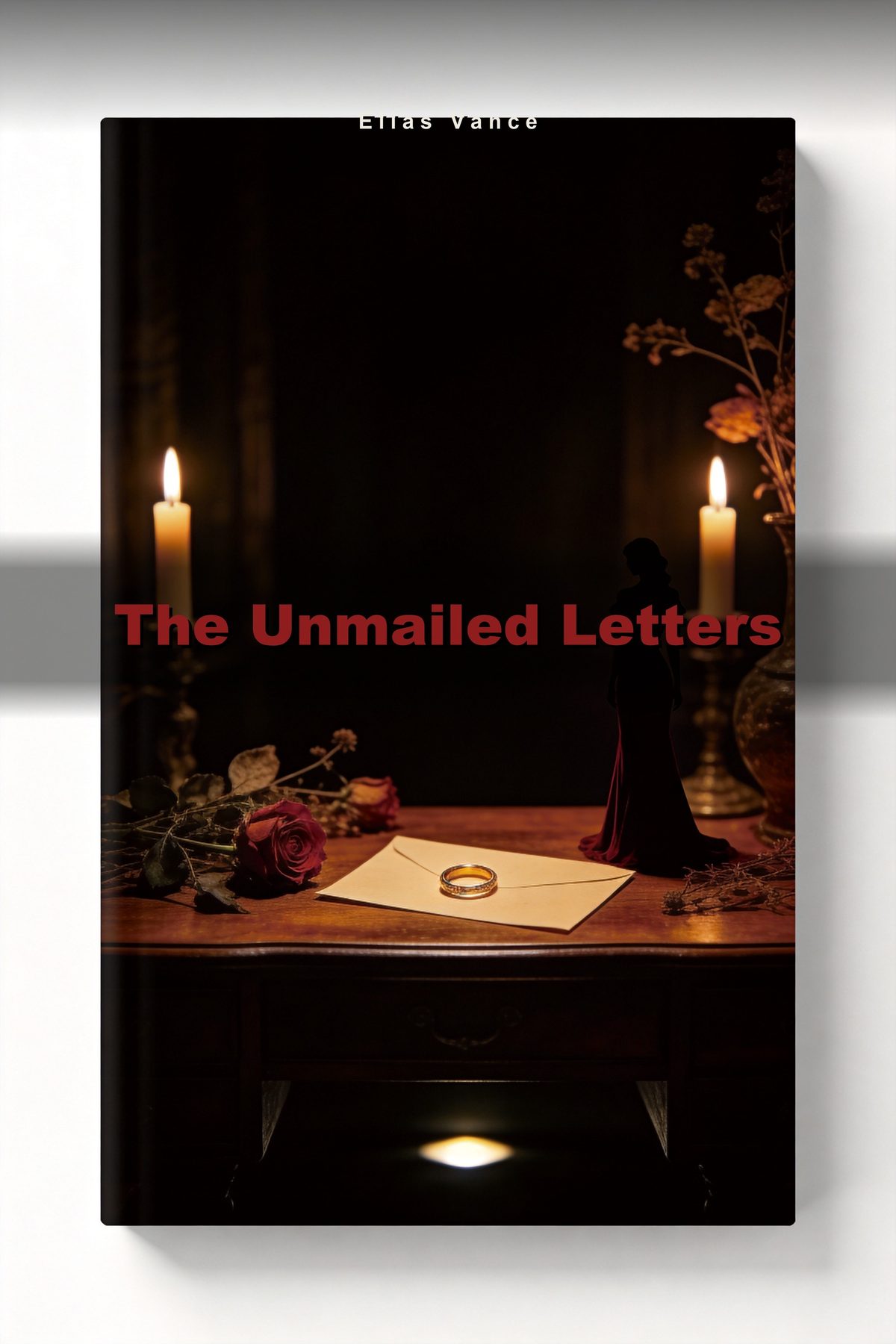
Enjoying the read? Get a new free Elias Vance story in your inbox every month — no spam, unsubscribe anytime.
The first time I touched the rosewood desk, the wood was warmer than it should have been. Not the warmth of sunlight through glass, not the heat of a house in summer. It was the warmth of a hand that had been resting there a moment before, and I looked behind me, though I knew we were alone in the east wing. He stood in the doorway with the key still in his palm, watching me the way a man watches weather move across a valley, patient and already certain of the rain.
I had come to Elias Vance to assess the library, to catalogue the leather bindings and the foxed pages and the spines cracked along their hinges. I was thirty-four years old and I had built my life around other people's damaged things. I knew how to read a book by its scars. I knew how to touch paper without leaving oil behind. I did not yet know that the house had been expecting me longer than I had been expecting anything.
The east wing smelled of dust and cedar and something underneath, something green and sharp like geranium leaves crushed between fingers. The floorboards were wide and dark, cut from trees that had been old when the house was young. The walls were papered in a faded damask, and the paper had begun to separate at the seams, lifting away from the plaster like skin peeling from a sunburn. I noticed these things the way I always noticed things: one at a time, each detail a small anchor against the current of a room. The light came through the tall windows in long, slanted panels, and the dust moved in them slowly, turning in the air like sediment in still water. I could hear my own breathing, and beneath it, the low hum of the house, the radiators ticking, the beams contracting, the sound a place makes when it has been shut up for a long time and is only now remembering it has a pulse.
Keep reading
This story continues. One subscription — $6.99/month — opens every story in full: 39 live today, new ones added monthly, plus the six-voice audiobook.
But the desk held me. It was a secretary desk, rosewood with a fall-front panel and a row of small drawers above two deeper ones. The brass handles were tarnished but solid. The wood had been polished once, long ago, and now it wore the dull sheen of use, of sleeves brushing against it, of palms pressing flat to write. I set my hand on the surface and the heat moved up through my fingers, into the bones of my wrist, and I did not pull away. I felt it in my teeth, a faint vibration, like the moment before a bell is struck. The grain of the wood was dark and intricate, whorls and eddies that caught the light and held it. I traced one with my fingertip, and the warmth followed, as if the desk were responding to me, as if it had been waiting for the exact pressure of my hand.
"This was hers," he said from the doorway. He did not say her name. He never said her name, not then, not ever. "She wrote letters here every morning. She never sent them."
"Why not?" The question came out before I could stop it, and I felt the room shift, the way a room shifts when a door opens somewhere else in the house and the air remembers it. The dust swirled in the light, and the floorboards creaked, though neither of us had moved.
He crossed the floor and stood beside me. He was eleven years older than I was, and he carried it in the grey at his temples, in the careful way he moved, like a man who had learned to live around an absence the way a tree grows around a fence wire. He smelled of wool and woodsmoke and something else, something clean and sharp like cold air on wet stone. He reached past me and pulled the fall-front down, and there they were. A stack of envelopes, maybe forty or fifty, each one sealed, each one addressed in a hand I did not recognize. The ink was dark, almost black, and the letters were pressed flat, as if they had been waiting a long time under a weight. The paper was cream-colored, yellowed at the edges, and the envelopes were arranged with a precision that felt deliberate, each one aligned exactly with the one beneath it, as if the stack had been squared by a hand that could not bear disorder.
I leaned closer, and I caught the smell of them: old paper, dry and sweet, and beneath it, something faintly floral, lavender perhaps, or the ghost of it. And then he closed the panel. The sound was soft, a click of brass and wood, but it landed in my chest like a latch turning. I felt it in my sternum, a small, precise pressure, and I knew that something had been decided, though I could not have said what.
"You could restore it," he said. "The desk. It needs someone who knows what she's doing."
I should have said I would send him an estimate. I should have said I would need to see the rest of the collection first. Instead I said, "I would like that," and my hand was still on the wood, and the wood was still warm, and I understood that I had agreed to something larger than a restoration. The words left my mouth before I could weigh them, and they hung in the air between us, and he did not smile, only nodded, as if he had already heard them, as if he had been listening for them for a long time.
"Stay for dinner," he said. It was not a question.
I stayed.
The dining room was long and narrow, with windows that looked out over the Hudson, grey and flat in the October light. The table was dark walnut, long enough for twenty people, and we sat at one end, close together, the empty chairs stretching away from us into the shadows. The candles were lit, and the flames moved in the draft from the windows, and the shadows moved with them, long and liquid on the walls. We ate roasted chicken and potatoes and a salad of bitter greens, and he asked me about my work, about the books I had saved, about the ones I had lost. He listened the way the house listened, with a stillness that made me want to fill it. I told him about my mother, how she had died when I was twelve, how I had started mending books because I could not mend her. I told him things I did not usually tell anyone, and he received them without flinching, without the soft pity I had learned to expect from people who had never lost anything they could not replace.
I told him about the first book I ever restored, a small volume of Emily Dickinson's poems that had belonged to my mother, the spine broken, the pages water-stained from the night she died, the rain coming in through the open window of the hospital room. I told him how I had taken it apart, page by page, and rebuilt it, and how I had felt, for the first time since her death, that I was doing something that mattered. He listened with his hands folded on the table, his eyes steady, and when I finished, he said, "You learned to keep things because you were afraid of losing them." It was not a question. It was an observation, precise and unflinching, and I felt it land in me like a stone dropped into a well, and I did not know if I wanted to thank him or flee.
When I left that night, the house stood dark behind me, and I could feel it at my back, patient and enormous, already making room for me. The windows were black, the walls rose up against the sky, and the sound of the river came through the trees, low and constant, like a voice speaking just below the level of understanding. I drove home with my hands tight on the wheel, and I did not look back, but I felt the house looking at me, and I knew that I would return.
I returned three times over the following months. Each visit, the house grew more familiar, and each visit, the familiarity cost me something. The first time, I walked with him through the garden, and he showed me the roses his first wife had planted, the ones that still bloomed every June, though no one cut them. He told me she had loved the white ones best, and I felt a small, mean jealousy bloom in my chest, and I hated myself for it, and I did not say a word. The roses were not yet in bloom, but their canes were thick and green, and I could see the buds forming, tight and pale, waiting for the season. I reached out and touched one, and a thorn caught my thumb, and I bled, a single bright drop that fell onto the soil and disappeared. He took my hand and looked at the wound, and then he pressed his handkerchief to it, a square of white linen that smelled of cedar, and the gesture was so tender that I forgot to breathe.
The second time, we cooked together in the kitchen, and he laughed at something I said, and the sound was so unexpected, so unguarded, that I wanted to hear it again. He was chopping onions, and the tears were running down his face, and I said something about the onions being a convenient excuse, and he laughed, a low, warm sound that seemed to come from somewhere deep in his chest, and I felt it in my own chest, a corresponding vibration, as if the house itself had laughed. That night I dreamed of the letters. Not their contents, not the words, only their weight, the way they pressed against the inside of the drawer like a held breath, like a hand pressed to a mouth. I woke with the taste of paper in my mouth, dry and faintly sweet, and I lay in the dark and listened to the silence, and I knew that the dream had been a warning, or an invitation, and I could not tell the difference.
The third time, he read aloud to me in the library, from a book I had restored for him, a first edition of Wuthering Heights with the spine rebacked and the pages cleaned of foxing. His voice was low and steady, and I sat in the chair across from him and watched the firelight move over his face, and I wanted him with a want that felt like illness, like something I had caught from the house itself. The fire crackled and spat, and the shadows gathered in the corners, and his voice went on, and I felt the words moving through me, dark and inevitable, like water finding its level. When he finished the chapter, he closed the book and looked at me, and I knew he could see it, the wanting, plain as ink on paper.
"You can ask me about her," he said. "I won't break."
But I didn't ask. I was afraid of the answer, and I was afraid of the question, and I was afraid of the way the east wing waited for me every time I passed its locked door. The key hung on a hook in the kitchen, a small iron thing with a blackened bow, and I looked at it every time I poured water for tea, every time I stood at the counter with flour on my hands. It was always there, in the corner of my vision, a small dark shape against the white plaster, and I felt it watching me, patient and unblinking. He never told me not to touch it. He never told me anything. He simply left it there, visible, almost inviting, and I understood that this was the price of tenderness: every moment of safety with him made the house more real, more present, more demanding. The walls seemed to lean in when we were together, the floors to rise, the ceilings to lower, as if the house were drawing us into its center, into its deepest and most private rooms.
The house was courting me as much as he was.
We married in the spring, in the garden, under the white roses that had begun to open. The air was warm and sweet, and the river moved beyond the hedge, grey and patient, and the chairs were arranged in rows on the lawn, and the white roses nodded in the breeze like the heads of old women agreeing with something. I wore a dress of ivory silk with a high neck and long sleeves, and I carried a small bouquet of white peonies and rosemary. He wore a dark suit, and his hands shook when he took mine, and for a moment I thought he might cry. But he didn't. He said his vows in a voice I had never heard before, a voice that sounded like it was being pulled out of him, word by word, from some deep and private place.
I hesitated at the altar. It was only a second, maybe less, but it was enough. I felt a hand on my shoulder, light as a moth, and I turned my head, but there was no one behind me. Only the rows of chairs, only the white roses, only the river moving grey and patient beyond the hedge. The feeling lingered, a cool pressure on the bone, and I heard the priest ask me the question, and I heard the silence that followed, the silence of everyone waiting, and I felt the hand press a little harder, as if to steady me, as if to remind me that I had already made this choice, long before I stood here.
I said yes. I said yes because I wanted to. I said yes because the house had known I would.
We spent our honeymoon in a small hotel on the coast of Maine, and on the third night we fought. I don't remember what started it. I remember the way his voice went quiet, the way he turned away from me in the dark, the way the sheets felt cold on my side of the bed. I remember the sound of the sea through the open window, the long slow crash of the waves, and the way it seemed to be saying something I could not quite hear. I remember thinking that I had made a mistake, that I had married a man who would never let me all the way in, that I would spend the rest of my life standing in the doorway of some locked room, waiting for a key that was already hanging on a hook in my own kitchen.
I never told anyone about that fight. Not my friends, not my sister, not the therapist I saw for six months after my mother died. It was mine, that failure, and I kept it close, the way you keep a stone in your pocket, worrying it smooth with your thumb. I turned it over in my mind at night, examining it from every angle, and I could not decide if it was a flaw in him or in me or in the marriage itself, a crack that had been there from the beginning, waiting for the weight of our lives to press it open.
We returned to Elias Vance in June, and the roses were in full bloom, and the house swallowed us the way a mouth swallows a word. The door opened before I reached it, and the hall stretched out before us, dark and cool, and the smell of the house came to meet us, dust and cedar and the faint green sharpness of geranium leaves, and I felt it close around me like a hand, and I did not resist.
I found the key on the hook on a Tuesday morning, six weeks after the wedding. It was exactly where it had always been, and I had walked past it a hundred times, and I had never touched it. That morning, I touched it. The iron was cold, colder than it should have been in the warm kitchen, and it left a faint taste of metal in my mouth, as if I had bitten my own tongue. I held it in my palm, and it was heavier than it looked, and I felt the weight of it pulling me toward the east wing, toward the locked door, toward the desk that had been waiting for me since the first time I touched it.
The east wing was dark when I opened the door. The curtains were drawn, and the dust had settled over everything like a fine grey skin. The air was still and cold, and my breath made small clouds, and I could hear the silence, a silence so complete that it seemed to have a sound of its own, a low hum at the edge of hearing. The desk stood against the far wall, and the fall-front was closed, and I crossed the room without breathing, my shoes leaving prints in the dust, and I pulled the panel down.
The letters were there. The stack was exactly as I remembered it, forty or fifty envelopes, sealed, addressed. But now I could see the name on the top envelope, and the name was mine. My full name. My maiden name. In handwriting I did not recognize, handwriting that was not the first wife's, not anyone's I had ever seen, and yet I knew, somehow, that it was not a forgery. The letters were formed with a slight forward slant, the loops of the l's and the y's full and confident, and the ink was dark, almost black, and it gleamed in the dim light as if it had only just dried.
I sat down at the desk. The chair creaked under me, and the sound was loud in the quiet room, and I felt it in my spine, a small shock of sound that traveled up into my skull. I picked up the first envelope and turned it over. The paper was old, yellowed at the edges, but the ink was fresh. I could smell it, sharp and faintly sweet, like the sap of a cut branch. I slid my finger under the flap and opened it. The paper inside crackled as I unfolded it, and I held it up to the light, and I began to read.
The letter was dated three years before I met him.
It described my mother's funeral. The church, the rain, the dress I wore, a dark blue dress with small white flowers that I had bought at a thrift store because I could not afford anything else. It described the exact words I said at the graveside, words I had never written down, words I had never spoken again. It described the way I had held the rose, the way the petals had come off in my hand, the way I had dropped them into the grave one by one. It described the sound of the rain on the coffin lid, the smell of wet earth, the way my sister had held my hand so tightly that my fingers went numb. It described the thought I had, standing there in the rain, the thought I had never told anyone: that I wanted to climb into the grave with her, that I wanted to be buried beside her, that I wanted the earth to close over both of us and keep us together forever.
I read the letter twice. Then I read it again. My hands were steady, but my heart was not, and I could feel the house around me, listening, waiting, already knowing what I would do next. The room seemed to grow smaller, the walls to lean in, and I felt the weight of the house pressing down on me, and I did not move.
I read three letters that first day. The second described the fight on our honeymoon, the exact words he had said, the exact words I had said back, the way the light had fallen through the hotel window, the way the sheets had smelled of bleach and salt. It described the way I had lain awake after he fell asleep, listening to the sea, and the way I had thought about leaving, about walking out into the night and driving until the road ran out. The third described the moment I would decide to stay in the house, the exact words I would say to myself: This is the only place that has ever known me.
I had never said those words. Not yet. But I knew, sitting at that desk with the letters spread out before me, that I would say them. I would say them because they were true. I would say them because the house had already written them down, and the house was never wrong.
My husband knew about the letters. I understood that now. He had always known. He did not read them, but he knew they were there, and he knew what they meant. He had married me because the letters told him to. He had left the key on the hook because the letters told him I would find it. He had brought me to this house because the house had chosen me, long before I ever chose it.
I should have left. I should have packed a bag and walked out the front door and never looked back. But I didn't. I sat at the desk until the light failed, until the room was dark and the letters were only shapes under my hands, and I thought about the alternative. A life where no one knew me well enough to write my future. A life where I was not chosen, not claimed, not kept. A life where I was only myself, alone, with no house to hold me.
I stayed.
The weeks that followed were a kind of fever. I moved through the house like a woman walking through a dream, noticing everything and understanding nothing. I noticed the cracked tile in the kitchen, the one shaped like a bird in flight, and I remembered the letter that had described it, the letter I had read before I ever saw it. I noticed the way the light hit the third stair at four o'clock, a long gold finger reaching through the window, and I remembered the letter that had told me to look for it. I noticed the smell of lavender in the linen closet, strong and sudden, though there was no lavender anywhere in the house, and I remembered the letter that had said: You will smell her before you see her. You will think it is the soap. It is not the soap.
I became hypervigilant. I searched the house for evidence that the first wife was still alive, that she was hiding in some other room, writing the letters now, watching me through the cracks in the walls. I checked the locks on the doors, the windows, the attic stairs. I found nothing. The house was empty except for us, and the letters, and the silence that pooled in the corners like water. The silence was the worst part. It was not an empty silence, not the absence of sound, but a listening silence, a silence that seemed to be holding its breath, waiting for me to do something, to say something, to understand something that was just beyond my reach.
And then I found the letter dated the week before my wedding.
It described the dress I wore. The ivory silk, the high neck, the long sleeves. It described the song that played as I walked down the aisle, a piece by Debussy that I had chosen because my mother had loved it. It described the moment I hesitated at the altar, the feeling of a hand on my shoulder, the words I almost said but didn't.
The letter said: You will hesitate because you will feel her hand on your shoulder. You will be right to hesitate. But you will say yes anyway. You will always say yes.
I read it standing up, in the middle of the east wing, with the light falling grey through the dusty curtains. I read it twice, and then I carried it downstairs, and I found my husband in the library, sitting in the chair where he had read to me, and I held the letter out to him. My hand was steady, and I could feel the paper trembling in the air between us, and I could see the words reflected in his eyes, and I knew that he had been waiting for this moment, that he had known it would come, that he had been dreading it and wanting it in equal measure.
"Is she still alive?" I asked. My voice was calm. I could hear the calmness in it, and I did not recognize it. "Is she writing these from some other room? Is this house a prison or a promise?"
He did not answer. He took the letter from my hand, and he read it slowly, his lips moving over the words, and then he did something I had never seen him do. He cried.
Not for the first wife. For me.
Because he knew what the letters would ask of me, and he knew I would say yes.
I reached for him, and he stepped back. The letter fell to the floor between us, and he bent and picked it up, and he placed it on the desk, on the stack, with the others. His hands were shaking. He would not meet my eyes. I watched his fingers move over the paper, smoothing it, aligning it with the stack, and I saw the way his shoulders curved, the way his head bowed, the way his whole body seemed to be apologizing for something he could not name.
"I'm sorry," he said. It was the only thing he said.
I understood then. The first wife was not writing to me. The first wife was writing as me. The letters were not a haunting. They were a transmission. And I had already accepted the terms.
That night, I went back to the east wing alone. A storm had come in over the Hudson, and the rain beat against the windows, and the house creaked and settled around me, and I sat down at the rosewood desk and opened the drawer. The storm moved through the house like a living thing, pressing against the walls, rattling the glass, and the thunder rolled over the roof in long, low waves, and the lightning came through the curtains in brief, white flashes, and I saw the room in pieces, the desk, the chair, the stack of letters, each one illuminated for an instant and then gone.
The last letter was on top of the stack. The one dated the week before my wedding. I read it aloud, slowly, as if performing a rite. My voice was small in the dark room, but the house heard it. The house heard everything. The words rose and fell, and the rain answered them, and I felt the house listening, leaning in, drawing the words out of me one by one.
Then I took out a blank sheet of paper. I found a pen in the drawer, an old fountain pen with a nib that caught the light. The ink was in a small glass bottle, black and glossy, and I unscrewed the cap and filled the pen, and I began to write.
I wrote to the first wife. Not as a ghost, not as a rival, but as a predecessor. As a sister. I wrote about my mother, about her death, about the way I had spent my whole life preserving other people's pasts because I never learned how to keep my own. I wrote about my loneliness, the particular loneliness of a woman who is known only in pieces, only by the things she can do for other people. I wrote about the way my husband says her name in his sleep, the way his voice softens around it, the way I lie awake beside him and wonder if he is dreaming of her or of me or of the house itself.
I wrote about the first time I touched the desk, the warmth of the wood, the way it had felt like a hand reaching up to meet mine. I wrote about the day I found the letters, the way the ink had smelled, the way the dates had lined up with my own life like teeth in a jaw. I wrote about the fear, the deep, cold fear that I had been chosen before I ever chose, that my life had been written before I lived it, that the woman I was becoming had already been described, dated, and sealed in a drawer in the east wing of a house that had been waiting for me since before I was born.
I wrote until my hand cramped. I wrote until the ink ran low, until the letters grew thin and spidery on the page. I wrote until I realized that the letter I was writing was not a response. It was a continuation. The words were not mine, and they had never been mine, and they would never be mine. They belonged to the house, to the desk, to the long line of women who had sat here before me, writing letters they would never send, writing futures they would never escape.
When I finished, I sealed the envelope. I wrote my own name on the front. My maiden name. The name the first wife had used.
I placed it on the stack.
The stack was now one letter taller.
I did not know if I would ever open it again. I did not know if the first wife was truly dead, or if I was becoming her, or if the house itself was writing the letters through the hands of every woman who married into it. I did not know if I was the author or the amanuensis, the bride or the ghost, the one who writes or the one who is written.
I only knew that I was staying.
I closed the drawer. The sound was soft, a slide of wood and brass, but it filled the room. The house settled around me, a long low sigh of beams and plaster, and I felt it in my chest, the way you feel a throat preparing to speak. The storm had passed, and the rain had softened to a drizzle, and the silence came back, that listening silence, and I sat in it, and I waited.
From the other side of the wall, I heard a voice. My own voice. Already beginning the next letter.
Read Next
If you liked this story, keep going with these from The Dark Threshold.