The Sifted Hour
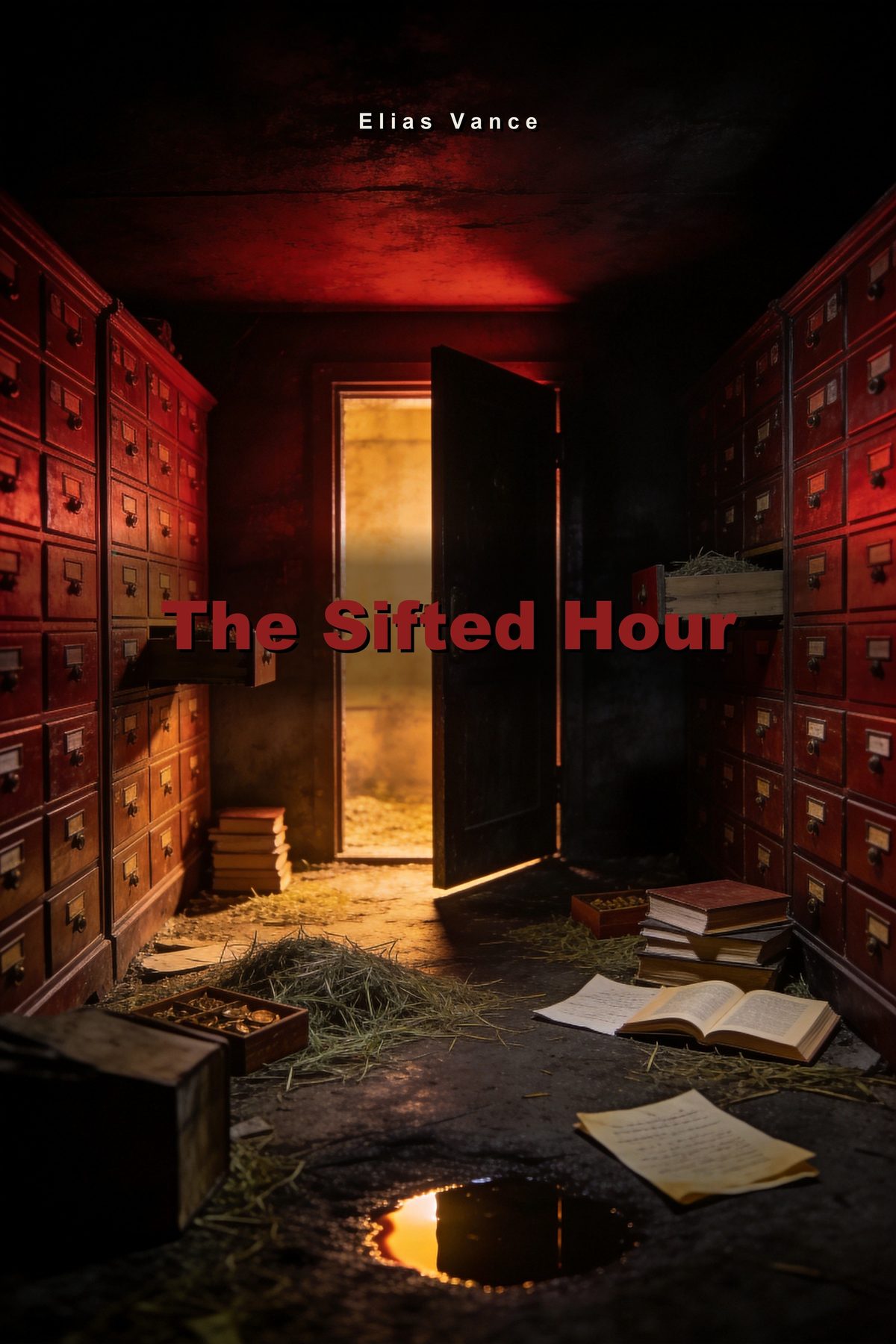
The vault exhaled when I opened the door, a dry breath smelling of buffered paper and the faint camphor we still used in the cedar drawers. I stood in the threshold for a count of five, as I always did, letting the climate control settle around me. Fifty-eight degrees, thirty-five percent relative humidity. The gauge to the left of the door read exactly that, its needle steady. I recorded the numbers in my daily log, then stepped inside and let the door sigh shut behind me.
My name is Elias Vane. I am forty-one years old, and for the past six years I have been the senior archivist for the Merriweather County Records Division, which includes the closed county asylum's archive. I know what people think when they hear that. They think of damp corridors and screaming wards. They think of the dead. The truth is smaller and quieter: a basement room with motion-sensor lights and a dehumidifier that hums at a frequency I have learned to ignore. My job is to make the past legible, to turn paper into pixels, to ensure that nothing is lost and nothing is added.
The morning inventory took forty minutes under normal conditions. I moved along the steel shelving units, checking the call numbers against the clipboard in my hand. The asylum collection occupied rows four through nine, a little over four thousand volumes and document boxes, all processed, all accounted for. I ran my finger along the spines as I walked, the way a man might run a stick along a fence. It was a habit I had developed early, something to do with the silence.
I reached row seven, where the intake ledgers lived. The 1934 volume sat in its usual place between 1933 and 1935, a heavy black buckram binding with the year stamped in gold on the spine. I pulled it from the shelf. The binding was warm.
Not warm in the way that paper gets warm when a room has been too hot. The vault was cold, and the volumes around it were cold. This one felt as if it had been held in someone's hands for a long time, the way a book warms against a body. I turned it over. The buckram was dry and intact, no water damage, no sign of recent handling. I opened the front cover and checked the accession stamp. Merriweather County Asylum, Intake Records, January–December 1934. The ink was old and stable.
The pages were thin, ruled, filled with the cramped copperplate of a clerk named H. Alder, whose handwriting I knew well. Each entry recorded a patient's name, age, date of admission, diagnosis, and assigned number. I had scanned this ledger myself two years ago. I knew its last page: patient number 1934-118, admitted December 29, 1934, diagnosis melancholia. The entries stopped there.
But when I turned to the final page, there was another entry below the last one.
It was dated today.
I stood very still. The motion-sensor lights, which had dimmed slightly during my pause, brightened again. The entry was written in a hand I recognized, a hand I had seen on a thousand field reports and purchase orders and time sheets. It was my own.
Patient Number: 1934-119. Name: Elias Vane. Age: 41. Date of Admission: [today's date]. Diagnosis: chronic self-doubt. Committed by: self.
I read it three times. The words did not change. The ink was black, the same iron gall we used in the conservation lab, and it had bled slightly into the fibers of the page, the way old ink does. I touched the corner of the entry with my fingertip. The ink was dry. The paper was cold again, as if the warmth I had felt on the binding had been a trick of the skin.
I closed the ledger and stood with it pressed against my chest. The rational part of my mind, the part that had been trained in archival science and had spent two decades handling documents, began its work. A prank. A member of the staff, someone with access to the vault, had added an entry to the ledger as a joke. It was a cruel joke, given my brother, but people were cruel. I would log the anomaly, check the security footage, and speak with the other archivists. The ledger would go back on the shelf. The matter would be resolved.
I carried the volume to my desk in the reading room, which was a separate space from the vault, separated by a glass wall. I filled out an incident report, describing the new entry in neutral language: "Unauthorized addition to intake ledger 1934, discovered 8:15 AM, handwriting appears to match archivist's own." I noted the patient number, the date, the diagnosis. I did not note that the
Subscribe to read the rest of “The Sifted Hour”.
Get every story in the The Dark Remains collection — and the entire library — for one monthly price. Cancel anytime.