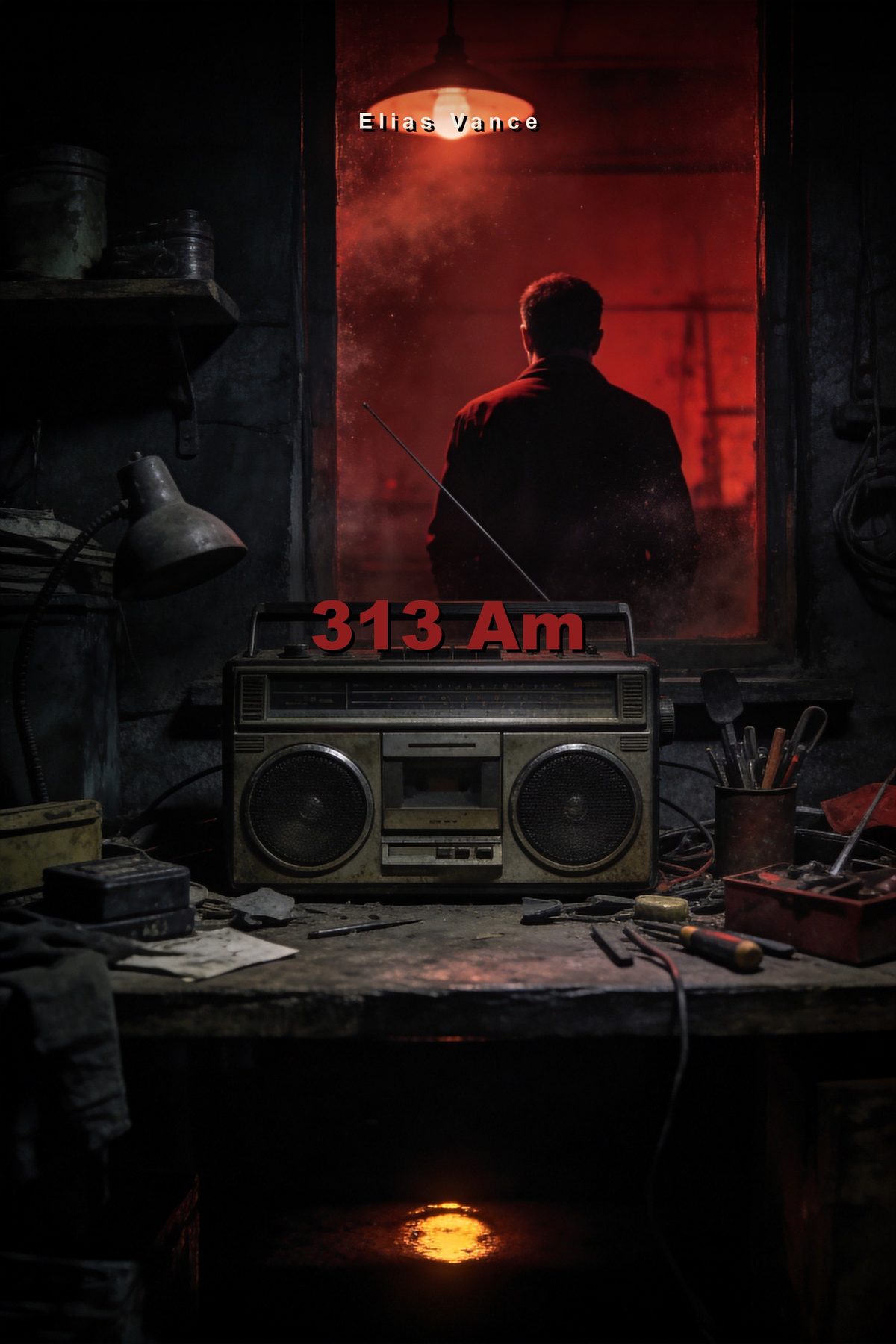
3:13 A.M.
3:13 A.M. is a quiet horror story by Elias Vance about a man who inherits his late father's workshop radio, and discovers that every night at exactly 3:13 it tunes into a broadcast that should not exist — a calm voice that sounds exactly like his own, reading tomorrow's news.
Enjoying the read? Get a new free Elias Vance story in your inbox every month — no spam, unsubscribe anytime.
“The radio in my father's workshop picks up a voice that sounds exactly like mine, reading tomorrow's news, and last night it read my obituary, and it got my age wrong by a year, which I have decided to find comforting.”
More free stories from The Dark Threshold
Ten complete horror stories, free to read — no signup, no paywall. Pick your next nightmare.
The radio in my father's workshop picks up a voice that sounds exactly like mine, reading tomorrow's news, and last night it read my obituary, and it got my age wrong by a year, which I have decided to find comforting.
I have been cleaning out the workshop since he died. That is the job I gave myself, the only job I can do in that room without losing my mind, and it is going to take me the rest of my life, because my father never threw anything away, and because I keep finding reasons to stop. The workshop is a room at the back of the house, a room that smells of sawdust and solder and the particular warm static smell of old radios, and it is exactly the room it was the night he died, down to the mug on the bench with the cold coffee in it, and I have been cleaning it out for a year, and I have not thrown away a single thing.
The radio is the reason. I have not thrown away the radio because the radio will not let me. That is the whole story, and the whole story is that simple. It is an old valve radio, the kind with a round dial and a warm orange glow when it is on, and it sits on the bench where it always sat, and I turn it on when I go in, the way my father used to turn it on, and I have been turning it on for a year, and it has been waiting for me.
It found the station on the forty-second night. I had been in the workshop until past three in the morning, going through boxes of my father's things, and the radio had been on, and it had been doing what radios do — a little news, a little music, the slow crawl of the dial — and then, at exactly 3:13, the static cleared the way static never clears in my house, and a voice came through, clear as a phone call, and the voice said:
"— and at seven o'clock this evening, a fire broke out in the warehouse district. Fire crews are on the scene. The fire is believed to have started in the —"
I knew the voice. I stood up, and the voice went on, and I knew the voice the way you know a voice you have been hearing your whole life, and I stood in the workshop with a box of my father's things in my hands, and I listened to a woman read the news at 3:13 in the morning on a frequency that does not exist, in a voice that was mine.
Not like mine. Mine. My voice, doing what my voice does when I read the news aloud to myself in the car: the same flat delivery, the same way of coming down hard on the ends of sentences, the same slight rise when I am reading something I do not believe. The voice was mine, and it was reading tomorrow's news, and I sat back down on the stool, and I listened, and I did not sleep, and at the end of the broadcast — at 3:13, always at 3:13, the same minute every night — the voice said, "That is the news. Goodnight," and the static closed over it, and the workshop was quiet, and I could hear my own heart, which was loud.
I have listened every night since. That is the part I cannot stop doing. I have gone into the workshop at 3:13 for the better part of a year, and I have turned on the radio, and the static has cleared, and the voice has read me the news from a date six days in the future, and it has never once been wrong.
You will want to know how I know it is never wrong. I know because I check. I am a man who checks things, the way my father checked things, and I have checked the voice's news against the world for a year, and every prediction has come true — the storm, the score of a game I do not follow, the small fire in a warehouse across town. I cut the articles out of the paper and I keep them in my coat pocket, because I need to be able to prove to myself that I am not dreaming.
And then, last night, the voice read my obituary.
The obituary is the thing I cannot stop turning over. Here is the exact shape of the wrongness, and it is the shape of a thing that is almost right. The voice read it the way it reads everything — flatly, the way you read the weather. It said my name. It said the age — fifty-two, and I am fifty-three, and I told myself the voice had got my age wrong by a year, which is the part I have decided to find comforting, because it means the voice is not omniscient, because it means the voice can make a mistake, because if the voice can make a mistake about my age, then it can make a mistake about the rest of it. And then it said where I was found. It said the warehouse district. It said the fire.
I have been to the warehouse district exactly once in my life, and I was not at the warehouse when the fire happened, because the fire happened last Tuesday, and I was in the workshop all day, and I read about it in the paper, and I cut the article out, and I am holding it now. The article is real. The paper is real. I was not there. I am alive, and I am sitting in my father's workshop, and the radio is off, and I am alive.
But here is the thing I have been circling for a year, and it is the whole of what I have learned in a year of listening to a dead man's radio at 3:13 in the morning.
The voice is not reading tomorrow's news.
I worked it out two nights ago, when I stopped believing the date. I worked it out the way you work out a thing that has been true your whole life and that you have been too afraid to look at directly. The voice is not six days ahead. It is thirty years behind. It has been reading the same bulletin, at the same minute, every night, for thirty years, and I have been hearing it wrong, the way you hear a word wrong in a language you are afraid of, and I have been hearing it wrong on purpose, because the truth was the one thing in that workshop I could not bear to check.
The bulletin is from the night my father died.
The warehouse fire. The man found in the rubble. The age in the report — fifty-two, my father's age, one year younger than I am now. I heard the age the way I heard the name: as mine, wrong by a year, because the alternative was hearing my father's age read into an empty room, and I could not bear that, and so I made it mine, the way I made the name mine. The missing-persons report. It has all been the same broadcast, over and over, for thirty years, and the man in the report is my father — my father, whose name I share, whose name the voice has been reading into an empty workshop every night for thirty years, waiting for someone to come in and turn the radio on and finally hear it correctly. I am not the man in the report. I never was. I heard my own name because I wanted to hear my own name, because the alternative was hearing my father's name read over and over into a room where nobody was listening, and I could not bear that, and so I made it mine.
The voice is my father's. It has always been my father's. My father read the news aloud at the kitchen table every morning, the way some men read the paper, and I grew up hearing my voice come out of his mouth, because a son's voice is his father's voice, because I have been hearing my father every time I heard myself, because that is what we are. The voice on the radio is my father, reading the news the way he always read the news, and he has been reading it into an empty workshop for thirty years, and I have been sitting in that workshop for a year, listening, and I have been the only person in the world who could hear him, and I have been hearing him wrong.
Tonight I am going to go in and turn the radio on, and I am going to listen to the whole bulletin, and I am not going to hear my name, and I am going to let him finish.
But before I do — the last thing. What I saw when I looked at the workshop last night, the thing I have been avoiding, the last thing I have left to check.
The workshop is starting to smoke. Not a fire. Nothing burning. Just the faintest thread of smoke, rising from the bench by the radio, the way smoke rises from a mug of cold coffee, the way smoke rises from a place where a fire has been out for a long time but is not quite cold. I have been cleaning out this workshop for a year, and I have not thrown away a single thing, and I have been standing in a room that has been smoking, gently, patiently, the way an old man smokes a pipe, and I have been telling myself it was dust.
The fire was not the warehouse. I know that now. The fire was my father, and he has been burning out slowly for thirty years, and the only thing that has kept him from going out — the only thing that has been feeding the ember — is the radio, and the news, and the voice, and the hope that someone would come in, and turn it on, and finally hear him.
I am going in now. It is 3:13.
I went in. The radio cleared, the way it always clears, and the voice came through, and I sat on the stool with my father's things still in my hands, and I listened to the whole bulletin — the warehouse, the fire, the man found in the rubble — and I heard the name, and the name was my father's, and I heard the age, fifty-two, and I let it land, and I did not make it mine.
And when the voice said, "That is the news. Goodnight," I said, into the workshop, "I'm here, Dad. I've got it. You can put the paper down."
The smoke went out. All of it, at once, the way a flame goes out when you stop feeding it. The workshop went quiet — not the quiet of a room holding its breath, but the quiet of a room that is finally empty — and I sat there for a long time with the mug of cold coffee on the bench in front of me, and then I stood up, and I did the thing I have not been able to do for a year.
I threw the mug away. The one that has sat on the bench since the night he died, with the cold coffee still in it. I picked it up and I carried it to the bin and I let it go.
Some nights now, when I drive past the old street, I roll down the window, and there is nothing — just the ordinary static of the world, the radio going about its business — and that is the whole mercy: there is nothing left to hear, because he put the paper down at last.
The workshop is empty. The bench is bare. The mug is in the bin, and the coffee is cold, and I am the only thing left in the room that was my father's, and I am the son who was there.
---
“In this short horror story from The Dark Threshold, a man inherits his father's workshop radio, which by night picks up a voice that sounds exactly like his own, reading tomorrow's news. When it reads his obituary, missing his age by a year, he clings to the mistake, mistaking a countdown for comfort.”
— from 3:13 A.M. — Quiet Horror Story | The Dark Threshold by Elias Vance · read more at The Dark Threshold
More stories like this




That was one door. There are six more.
6 series · 82 stories · EPUB + PDF