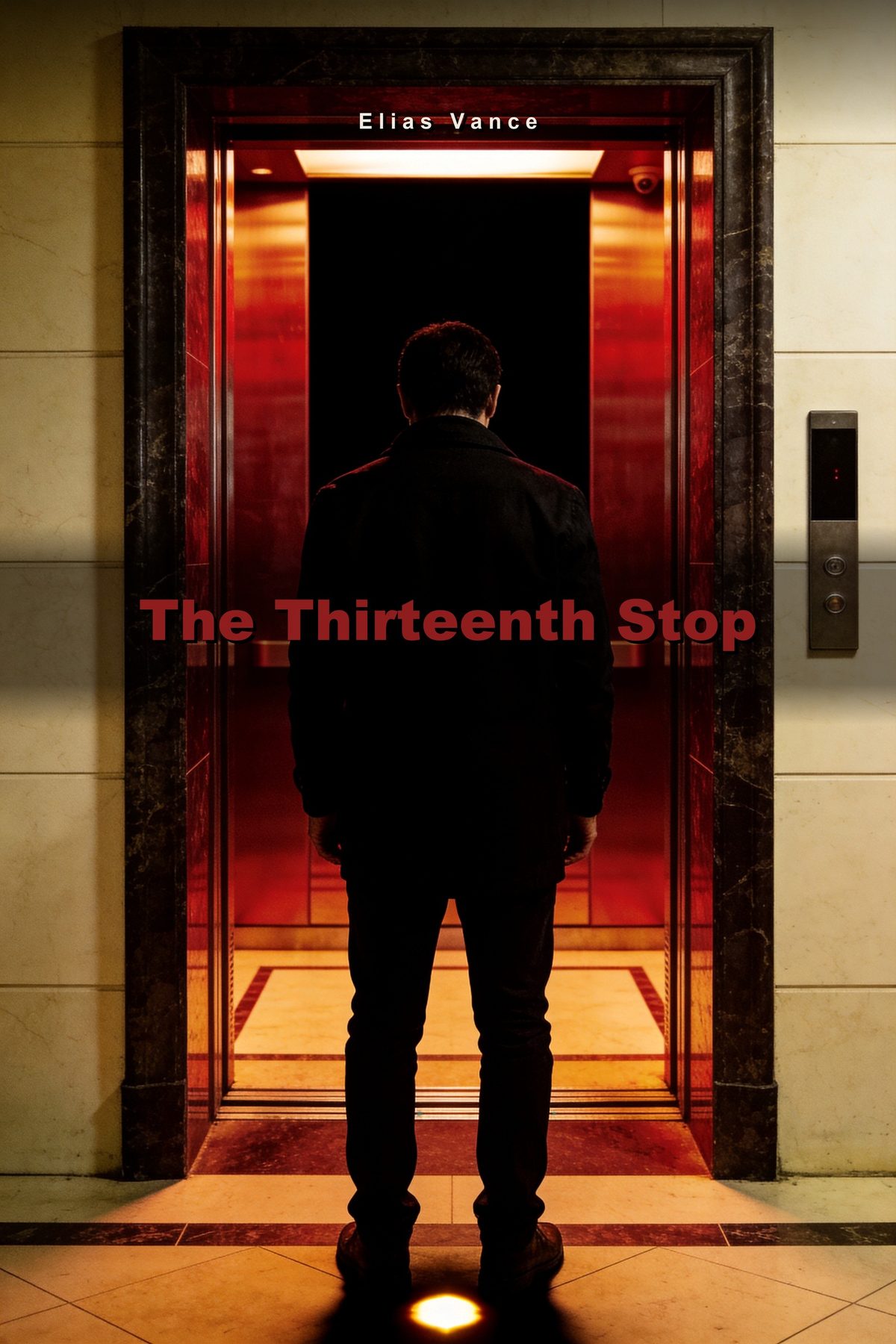
The Thirteenth Stop
The Thirteenth Stop is a quiet horror story by Elias Vance about a night route with a stop that should not exist — and the passengers who have been waiting at it far too long.
Enjoying the read? Get a new free Elias Vance story in your inbox every month — no spam, unsubscribe anytime.
“The elevator stops on a floor that does not exist, and I have just realized that my wife has been setting an extra place at the table, and that tonight makes forty-three nights of riding.”
More free stories from The Dark Threshold
Ten complete horror stories, free to read — no signup, no paywall. Pick your next nightmare.
The elevator stops on a floor that does not exist, and I have just realized that my wife has been setting an extra place at the table, and that the place settings stopped growing after five, and that tonight makes forty-three nights of riding. I counted the nights. I could not bring myself to count the plates once they stopped at five.
I live on the twelfth floor. I have lived here eleven years. The building has twenty-four floors, and the panel in the elevator has twenty-four buttons, and none of them says thirteen, because nobody in 1974 wanted to live on thirteen, and so the floor was sealed off and the number was struck from the plans and the matter was closed, the way these matters always are. The blueprints in the basement still show it, though — a floor that sits between eleven and twelve, drawn in faint pencil like a thing the architect hoped the building would forget, with a single room on it and a door and nothing else. I found those blueprints the way you find most unsettling things: looking for a leak.
The stopping started six weeks ago. Not a stop, exactly. A hesitation. The car is going up, the numbers are clicking over in that oily mechanical rhythm, and then between eleven and twelve the whole thing holds its breath. One second. Two. The lights keep their hum. The floor indicator sits between the numbers, neither here nor there, and then the car lets go and climbs on as if nothing happened. I timed it. Four seconds, every time. I set my watch by it. There is something almost friendly about that — a building with a habit.
It was around then that my wife started setting the extra plate.
She set it the first time the elevator stopped, I am sure of it now, although at the time I did not connect the two things, because you do not connect a hiccup in a machine with the way your wife sets the table. It was a Tuesday. There were two of us, and there were three plates, and I said something about it, and she looked at the table the way you look at a word you have misspelled, and she said, "Someone's missing," and we ate, and I forgot. Only it happened again. And again. The place settings grew. Four plates. Five. It stopped at five — it has been five for a month now, five places around a table where there used to be two, and I count them the way a man counts a thing he hopes will change, and it does not. By the third week I was eating across from an empty chair with a napkin folded in it, and my wife was talking to it.
Not to me. To the chair.
She would say things like, "You're late, it's getting cold," and "Your hands were cold, you never let me warm them," and once, quietly, while she thought I was in the other room, "You can come home now. You've been gone long enough. I've kept your plate for you."
I should say that my wife is not unwell. She is the most reasonable person I have ever known. She balances the checkbook to the penny. She has never once in eleven years misplaced her keys. And yet here she is, feeding a chair, and here I am, standing in the doorway with my coat still on, counting plates, feeling the elevator in my chest like a second heartbeat.
I went to the basement. I am not a brave man. Bravery was not required — only the leak, and the careful habit of a man who does not want to admit that the floor indicator has been lying to him. I unrolled the blueprints on the workbench and I looked at floor thirteen for a long time. The hallway is there, the door is there, the room is there, and then the pencil stops, as if whoever finished the drawing did not want to finish the room. One room. No kitchen, no bath. Just a room and a door and, if you look very closely, a second door inside the first.
There is a name written beside it. I could not read it. The ink has gone the color of rust, and the handwriting is not the architect's. It is smaller. It is the handwriting of someone who was embarrassed to be writing at all.
I came home that night and the elevator did not stop between eleven and twelve. It stopped on thirteen.
I should tell you what that feels like. The car was going up. The numbers clicked. Eleven. And then instead of the hesitation — instead of the four-second held breath that had become my strange little habit, my nightly proof that the building was older and stranger than its lobby — the car actually stopped. The floor indicator lit up. And between the eleven and the twelve, on the little brass strip that has never in eleven years displayed anything, a number came up. Thirteen. It was not one of the panel buttons. It was not part of the design. But there it was, lit like a small accusatory eye, and the doors opened.
Here is what I did next, and it is not what a smart man would do, and I am not sure I am smart anymore. I got off.
The corridor was mine. That is the first thing. It was my corridor — the same beige carpet with the same burn mark outside 1203 where my neighbor dropped his grill, the same flicker in the third light down, the same faint smell of cooking that has no business existing on a floor that was never built. I walked it the way you walk any corridor you have walked eleven years, and I did not notice how wrong it was until I was halfway, because it was exactly right, and exactness is the hardest wrongness to see.
My door. 1203. My brass numbers, the ones I have thought about replacing every year since we moved in, because the three is slightly crooked. My welcome mat, which says Welcome in letters that have worn almost entirely away. My lock, which has a scratch beside it from the night I came home drunk and missed the keyhole in 2016. It was all mine. It was all perfectly, terribly mine.
And the door was ajar.
I have never in my life left that door ajar. My wife is the one who locks it. She is meticulous. She once told me she had checked the deadbolt before bed every night for forty years and would keep doing it until she was dead, and I believed her, because my wife does not say things she does not mean. So the door being open was not an accident. It was a message. It was the building holding its breath.
I pushed it open.
The kitchen light was on. My wife was at the table — my table, the oak one with the water ring we never could get out — and she was setting a plate. She looked up when I came in, and she smiled, and the smile was her smile, the one she wears when she is truly glad to see me, the one that has made me forgive her for a hundred small wars over a hundred small years. And she said, in her voice, her exact voice:
"You're early. Sit down. I've kept your plate."
And there was a chair pulled out at the end of the table, and the chair was not mine, and sitting in it — older than I am, greyer, with my coat over the back of it and my name on the mail beside it — was me.
Not a ghost. Not a trick of the light. A man. A man who looked like me the way I would look if I had lived my whole life on a floor that never existed, if I had spent forty-three nights eating at a table with my wife's kindness aimed at a chair, if I had aged eleven years in six weeks, waiting. He looked at me with my own eyes, and he was not afraid. He looked relieved. He looked like a man who has been holding a door for someone, and who has finally seen them coming up the hall.
He said, "Don't."
That was all. Don't.
And then I saw it.
Not all at once. Understanding in that room came the way it comes in dreams — in a single bright sheet, all the facts at once, no time to argue with them. Eleven years ago I rode this elevator home on a Tuesday night. It stopped between eleven and twelve. I felt the four-second hesitation, the held breath, and I did not think anything of it, because you do not think anything of a hiccup in a machine. And I came home, and my wife set an extra plate, and she said, "Someone's missing," and we ate, and we have been eating ever since, and all of it — the eleven years, the life, the woman I love, the scratch beside the lock — all of it happened on a floor that was never built. I have been living on thirteen. I have been living with my wife, yes, but I have been living with her as the intruder.
Because she never set that extra plate for a ghost.
She set it for me. For the real me. For the man at the end of the table, who is still wearing the coat I bought eleven years ago, who has been sitting in the dark for six weeks of real time and eleven years of mine, who has watched me come home every night to his wife and eat his dinner and sleep in his bed and never once notice that the floor indicator had a number I was not allowed to see. She has been keeping his plate warm. She has been feeding him through me. She has been waiting for him to come home, and she does not know — she has never known — that when the door opened tonight and I stepped through, it was not her husband coming home.
It was the thing that has been wearing her husband's face for eleven years, and I have just found out the truth, and the truth is that I do not know which of us I am.
The man at the end of the table is looking at me with my eyes, and he is saying, don't, and behind him, my wife is saying, sit down, it's getting cold, and the table has five plates now, and I am counting them — five plates, five chairs, and the fifth chair is empty, and the fifth plate is for me, and I have spent forty-three nights being set a place at a table that was never meant to hold me.
I got back in the elevator.
I pressed L for the lobby. I pressed it the way you press a bruise — hard, to prove it doesn't hurt. The doors closed. The car went down. Eleven, ten, nine — and then it hesitated, one second, two, three, four, and the floor indicator lit up, and it was not L.
It was thirteen.
I pressed it again. L. The doors opened. It was my corridor. It was my door, ajar. It was my wife's voice, patient and warm, saying, you're early, sit down, and the fifth chair was pulled out, and I understood, finally, the arithmetic I have been avoiding for forty-three nights.
There is no lobby.
There never was. There is no street, no morning train, no life I left at the bottom of the building. The elevator has two stops it was ever meant to make, and I have been riding between them for eleven years without knowing it. It stops on twelve to let the man with my coat go home to his wife. It stops on thirteen to let me — whatever I am — stand in a doorway and count plates. It has always been thirteen. The hesitation was never a fault. It was the building being honest with me, and me being too afraid to read it.
I have stopped taking the stairs, because the stairs know where the doors actually go.
My wife is setting the table now. I can hear the plates, one after another, clicking into their places like a countdown. She is setting the fifth one — the one with my name worn into the bottom of it the way the letters are worn off the welcome mat, the one she has been keeping for a man she loves, who has been sitting at the end of her table for six weeks with my coat on the back of his chair.
I am in the elevator.
The doors are closing.
I should not be telling you any of this, because I am going to press L, and the doors are going to open on thirteen, and I am going to walk down a corridor that is exactly mine and push open a door that is exactly mine, and I am going to sit down in the fifth chair, and my wife is going to smile at me and say you're home, and I am going to let her.
But before I do — before the doors close and the four seconds begin — there is one thing, the only thing that matters, and I am leaving it here where it cannot be lost. The man at the end of the table, the one with my coat, the one she has been feeding all along: he does not look angry. He looks relieved. He has been holding that door for eleven years, and he has finally seen me coming up the hall, and he knows — we both know — that the fifth chair was never for him.
It was for the man who was brave enough to ride the elevator down.
I am pressing the button now.
The car is holding its breath.
— The End · The Thirteenth Stop, from The Dark Threshold by Elias Vance
“The elevator stops on a floor that does not exist, and tonight makes forty-three nights of riding it. At home the narrator's wife has been setting an extra place at the table. A quiet psychological horror story about routine, marriage, and the stop you never chose.”
— from The Thirteenth Stop — Quiet Horror Story | The Dark Threshold by Elias Vance · read more at The Dark Threshold
More stories like this



That was one door. There are six more.
6 series · 82 stories · EPUB + PDF