The Painted Bride
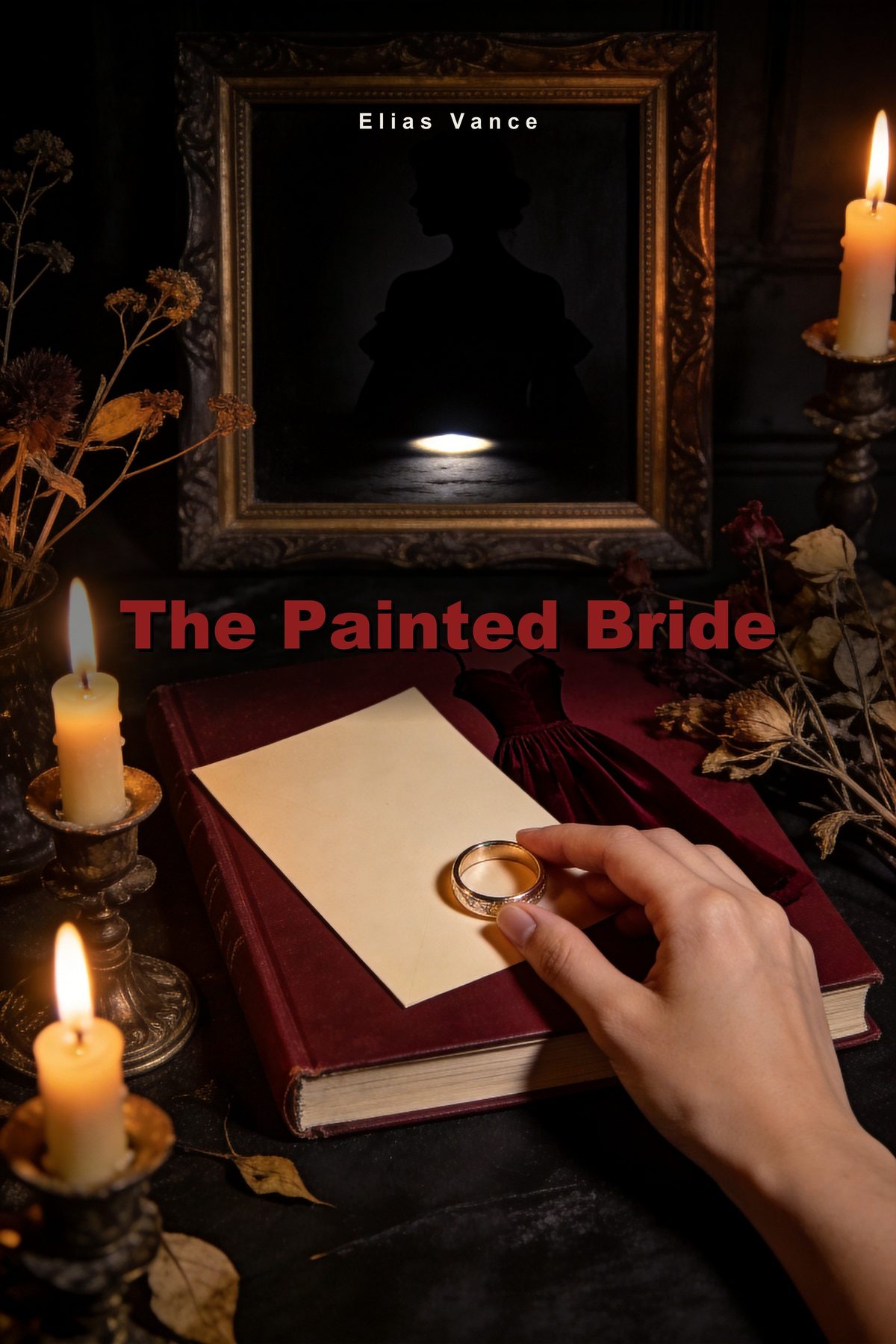
The Painted Bride is a dark gothic romance by Elias Vance about a portrait of a bride that ages, waits, and remembers — and the living person who begins to suspect the painting was painted from life.
The first time I saw Adrian Cross, my hand was already on the frame of a painting I had no business touching. The gallery air smelled of white wine and wet wool, and I had wandered away from Lila’s chatter about brushwork into the back room where the early portraits hung in their own dim circle of light. The canvas was larger than I was, and the woman in it wore a high lace collar and a look of patient attention, as if she had been waiting for someone to come and stand exactly where I stood. Her face was my face. The same bone structure, the same small mole beneath the right eye, the same left-side dimple that only appears when the mouth is held just so. I lifted my fingers toward the painted cheek, not quite touching, and the oil paint gleamed wet under the track lighting. The smell of linseed hit me then, sharp and recent, though the placard said the work was thirty years old.
The paint should not have smelled like that. Thirty-year-old oil is dry as bone, its volatiles long gone, its surface cured to a dull patina. I knew this because I had spent my professional life with my nose near old things, reading their chemistry, learning the way time moves through fabric and pigment and varnish. My fingers could tell the age of silk by its rustle, the history of a stain by its color, the weight of a tapestry by the way it sagged against its hanging. I was good at my work because I noticed what other people dismissed as too small to matter. The air around the canvas was thick with the green bite of fresh medium, and my fingers hovered there, close enough to feel the faint tack of a surface that had not yet sealed. I told myself the gallery had applied a cleaning solvent, a varnish refresh, something conservation-adjacent that would explain the wet gleam under the lights. I told myself this before I had even named the thought, which is how I know the decision was already made. The frame was cold under my palm, carved wood with a gilded inner edge that had flaked in places, and I held it the way you hold a handrail on a steep stair, as if the floor might tilt.
A man said, “You found her.”
His voice came from behind me and to the left, close enough that I should have startled. I didn’t. I lowered my hand and turned, and he was already watching me with the quiet satisfaction of someone who has been waiting longer than is reasonable. Tall, dark-haired, with a face that looked carved by weather and then smoothed over by money. He wore a charcoal coat tailored to his shoulders and no wedding ring. His eyes moved over my face the way a restorer’s eyes move over a damaged panel, cataloging, comparing, noting where the craquelure had begun. I felt seen in a way that had nothing to do with being looked at. The room was very still, the way the air goes still before a storm, and I could hear my own pulse in my ears, a soft percussive thing keeping time with something older than my heartbeat.
“I thought it was a mirror,” I said. “At first. Then I saw the dress.”
“She wore it often.” He stepped closer, and the space between us closed by half. “The lace was Belgian. She liked the stiffness of it against her throat.”
His voice had a texture to it, warm and grained, like wood that had been handled for a long time. I could smell him now, cedar and something darker beneath, something like the air after rain on hot stone, and under that the faint mineral tang of oil paint, as if he had come to the gallery straight from his work. I asked who she was, and he didn’t answer right away. He reached out and brushed the inside of my wrist with two fingers, a touch so light it might have been accidental, and turned my hand palm-up as if he were reading the lines there. His thumb rested on the small scar at the base of my wrist, the one I’d earned falling from a stone wall when I was nine. The contact sent a shiver up the inside of my arm, not unpleasant, not pleasant either, just a current of something that had been waiting for a conductor. His skin was warm and dry, and the pressure of his thumb on that old scar felt like a question I had been asking my whole life without knowing it.
“Someone I have been waiting to see again,” he said.
A cold thread pulled through my chest, brief and sharp, gone before I could name it. I told myself it was the wine, the damp cold of the gallery, the strangeness of seeing my own face on a dead woman’s body. I did not pull my hand away. That was the first decision. The second was giving him my number when he asked, though he didn’t write it down. He only smiled and said, “I will find you.”
I believed him. I was frightened by how much I wanted that to be true. I wanted to be found, wanted it with a hunger that had been living in me for years, quiet and patient and ashamed of itself. My mother had taught me that wanting was a kind of weakness, that being remembered was a failure of forgetting, that gone was gone and love was the thing you burned in the kitchen sink while the smoke made your eyes water. And here was this man, this stranger with a dead woman’s face in his gallery, looking at me as if I were the answer to a question he had been asking for a very long time. I gave him my number. I watched him not write it down. I walked out of the gallery with the smell of fresh oil paint on my fingers, and I did not think about what that meant.
On the way out, the gallery owner leaned toward another patron and said, in the hushed voice people use around expensive things, that Cross had not exhibited new work in fifteen years. I heard it, and I noticed the fresh smell of oil paint still clinging to my fingers, and I chose not to think about either one. The gallery owner was a thin man with a silver watch chain and a habit of touching the frames as he spoke, straightening canvases that were already straight, his fingers quick and nervous on the gilded edges, as if the art needed his constant correction to stay real. He did not look at me when I passed. Lila found me by the coat check and said my face looked like I’d seen a ghost. I told her I’d met someone. She laughed and said, “Already?” and I didn’t know how to explain that it felt less like meeting and more like being recognized.
The courtship was swift and consuming, the way a tide is consuming if you stop paying attention to where the waterline was. Adrian called the next morning at seven, though I hadn’t given him my address and my number was unlisted. He said he’d been thinking about the way I’d touched the frame, that I had a conservator’s hands, careful and hungry at once. His voice on the phone was warm and low, and I stood in my kitchen in my bare feet, the floor cold against my soles, and listened to him talk about my hands as if he had been studying them for years. He knew I worked with textiles. He knew my favorite flower without asking, and when he arrived at my apartment that evening with a bundle of white freesia, I didn’t ask how he’d known. The freesia smelled like honey and green sap, and I put them in a blue glass vase on the kitchen table, and I watched him move through my small rooms, touching the spines of my books, pausing at the framed photograph of my grandmother on the mantel. His fingers rested on the silver frame a moment too long, his thumb tracing the edge the way you trace a scar.
“She gave you the garnet earring,” he said. “You wear it on days when you need courage.”
I had worn it that morning. I hadn’t told him. I told myself these were the observations of a man who paid attention, and that I had been starved for attention long enough to mistake it for magic. My mother had burned every photograph of my father after he left, and she had said, “Gone is gone,” with her back to me, the smoke curling up from the kitchen sink. I grew up in a house where remembering was a kind of failure. Now here was a man who seemed to remember everything, even things he had no right to know, and I drank it down like water after a long dry season. I drank it down and asked for more.
The first kiss came on the harbor ferry, salt wind off the water, his hand cupping the back of my head with a tenderness that felt practiced and personal at once. His mouth was cold from the sea air, and then warm, and I leaned into him with a want that frightened me. The ferry’s engine thrummed through the deck beneath my feet, a low vibration that matched the pulse in my throat. His other hand found my waist and held me steady against the rail, and for a moment the whole world was salt and motion and the pressure of his body keeping me from falling. The wind pulled my hair across my face, and he tucked it behind my ear with two fingers, and the gesture was so intimate, so familiar, that I felt tears start behind my eyes for no reason I could name. When we pulled apart, my left ear felt light. I touched the lobe. The garnet earring was gone. I searched the deck twice, on my hands and knees, while Adrian stood at the rail and watched the wake with a small, private smile. The deck was wet and cold under my palms, and the wind kept lifting my hair into my mouth, and I kept thinking I saw the flash of red gold in the scuppers, but it was only the reflection of the running lights.
“It’s just an earring,” I said, though it wasn’t. It was the last thing my grandmother had given me before she died, and I had worn it on every hard day since, and now it was gone into the gray water, and I would never see it again.
“No,” he said. “It’s a debt. Everything you give me, I keep.”
I laughed, because that was the kind of thing men said in dark romance novels, and I was a practical woman from Boston who knew better. But I didn’t laugh hard enough to mean it. Something in his voice had been too calm, too certain, and the way he watched the wake was the way a man watches something he has already claimed. I told myself I was being dramatic. I told myself the earring had simply slipped from my ear in the wind, that the catch had been loose for years, that I should have had it repaired. I told myself these things while the ferry cut through the dark water toward the city lights, and I leaned into Adrian’s side, and I let him put his arm around me, and I did not think about the word debt.
He proposed at a candlelit dinner in his Boston townhouse, a brownstone full of oil paintings and heavy velvet and the smell of old wood smoke. The candles guttered in the draft from the tall windows, and the light moved over his face in waves, so that he looked like a painting himself, all shadow and amber. He didn’t kneel. He reached across the table, took my hand, and said, “I have been waiting for you to come back to me for a very long time. Marry me, Mara. Let me keep you.” The ring was an antique, a garnet flanked by two small diamonds, and it fit perfectly, which I noticed and did not question. The metal was warm from his palm, and the stone caught the candlelight and held it, a drop of red wine frozen in glass. The band was old gold, soft from a century of wear, and it settled onto my finger like it had been waiting there for me. I said yes with the feeling of stepping off a ledge, the ground falling away beneath me and the air suddenly full of wings.
That night I dreamed of a room full of women who looked like me. They stood in rows along a curved wall, wearing dresses from other decades, and their eyes followed me as I walked past. The dream had a smell to it, linseed oil and dust and the faint sweetness of dried flowers, and when I tried to speak, no sound came out. The women watched me with my own eyes, and their mouths were closed, and their hands were folded in their laps, and I understood that they were waiting for something I could not name. When I woke, my wedding date was circled on the kitchen calendar in black ink I didn’t recognize. October 17. I stood at the counter in my bare feet and stared at the circle, the neat, deliberate oval, the way the pen had pressed hard enough to groove the paper. The ink was black and matte, not the blue pen I kept in the drawer by the stove. I told myself I must have done it in my sleep. I told myself a lot of things in those weeks, and every one of them had the texture of a lie I was too hungry to refuse.
Blackreach Hall sat on the Maine coast like a shipwreck that had learned to stand. Salt had scoured the gray stone, and the windows looked out at the Atlantic with the blank patience of the drowned. I moved in three weeks before the wedding, my car packed with boxes of fabric samples and the few books I couldn’t bear to leave behind. Adrian carried my bags across the threshold and set them down in the front hall, and the house swallowed the sound of them. The air inside was cold and faintly sweet, varnish and salt and something older underneath, something that reminded me of the back rooms of museums where the damaged things are kept. The walls were lined with dark wainscoting, and the floors were stone, and my footsteps echoed in a way that made me feel like a visitor in my own life. I had never lived anywhere with stone floors before, and the sound of my own walking followed me from room to room like a second heartbeat, hollow and slow.
He showed me the east wing but not the studio. He didn’t mention a studio. But on the fourth day, while he was on a call with a collector in London, I followed the smell of linseed oil down a narrow corridor and up a spiral stair to a door that was not locked. The corridor was cold, colder than the rest of the house, and the walls were bare stone, and the smell grew stronger with every step, until it was not just a smell but a presence, something waiting at the top of the stairs. My hand was on the latch before I thought to ask myself why the door was unlocked if the room was meant to be private. The iron was cold under my fingers, and the latch gave with a soft click that sounded like a tongue against teeth. I pushed it open.
The room was circular, and the curved wall was hung with portraits. Forty-one of them. I counted twice, because counting is what I do when my mind refuses to accept what my eyes are telling me. They hung in a single unbroken row, each canvas the same size, each frame the same dark wood, and every face was the same face. The same bone structure, the same left-side dimple, the same mole beneath the right eye. The dresses changed with the decades, but the brushwork was identical, the same confident stroke, the same signature in the lower right corner: A. Cross. The air in the room was thick with the smell of oil and turpentine and something else, something that might have been the sea, or might have been the dust of old fabric, or might have been the breath of women who had sat in this room and waited. The room was silent in a way that felt inhabited, the way a church is silent before a service, the air heavy with the weight of all the hours that had been spent there.
The newest canvas stood on the easel in the center of the room. It showed my own face wearing a gown I had never owned, a high lace collar and mutton sleeves thirty years out of date. The paint was wet. I could smell it, fresh and sharp, and when I reached out and touched the white lace at the painted throat, my fingertip came away with pigment. The white was still soft, still yielding, and for a moment I had the absurd thought that if I pressed harder, my finger would sink through the canvas into some other place. The painted eyes were unfinished, just dark sockets, and the mouth was only a suggestion, a soft red shape that might have been smiling or might have been about to speak. I stood there with my finger white and my breath shallow, and I did not run.
I noticed three things in rapid succession, the way a conservator notices damage: first, the small scar on every painted wrist, the same scar I have from a childhood fall. Second, the garnet earring in the portrait of the woman at age twenty-five, dangling from her left ear, the earring I had lost on the ferry. Third, the green ribbon from my wedding bouquet, the one I had chosen only last week, woven into the hair of the woman at age nineteen. Each detail landed like a blow, and I stood there with my finger white and my breath shallow, and I did not run.
I was still standing there, my fingertip white, when Adrian found me.
He didn’t ask what I was doing. He came to stand beside me, close enough that I could feel the heat of him through my sweater, and he looked at the wet canvas with the same tenderness I had seen on the ferry, at the dinner table, in the dark of my apartment at three in the morning. That night, the 3 a.m. night, he had stood on the sidewalk outside my building, perfectly still, facing my window. When I called his name from the fire escape, he did not startle. He simply said, “I wanted to know if you dream in color.” I had told him I did, and he had smiled, and I had gone back inside with my heart beating too fast and my hands shaking, and I had not locked the window. I thought about that now, standing in the round room with forty-one painted women at my back, and I understood that I had been leaving windows unlocked for Adrian Cross since the moment I met him.
“I paint what I love,” he said. “I have loved her for a very long time. She keeps coming back.”
His voice was warm, proprietary, already intimate. I wanted to be angry. I was angry, somewhere under the wanting. But what I felt most was jealousy, green and hot and shameful, because here was proof that he had loved before, and that the women he had loved wore my face. I wanted to be the one he loved. I wanted to be the last one. The wanting was so large in me that it crowded out the fear, pushed it into a corner of my chest where it could only watch and wait.
“Who are they?” I asked.
“The sitter,” he said. “The subject. She doesn’t have a name. She doesn’t need one.”
“They’re different women.”
“No,” he said. “She’s the same woman. She comes back. I paint her. I keep her.”
I should have left then. I should have walked out of that round room and down the spiral stair and out of Blackreach Hall and driven back to Boston and changed my number and never thought of Adrian Cross again. But I didn’t. I stayed. I told myself I was researching, that a textile conservator needed to understand the materials she was marrying into. I was actually competing. I wanted to be the one he loved, and here was proof that he had loved me before, or loved women who wore my face, and I wanted to be the last one. The final one. The one he would not need to replace.
I began to visit the studio daily. I studied the portraits, cataloging the small differences between the women: a freckle, a slight asymmetry in the brow, the way one of them held her hands folded in her lap while another let them rest open on the arms of the chair. The eyes seemed to follow me only when I was not looking directly at them. The smell of oil paint and salt damp filled my sleep. I told myself I was learning to live with the strangeness. I was actually learning to love it, because it was his, and I wanted to be his, and the price of that wanting was beginning to show. Each day I found something new in the canvases that I had not noticed before: a hand that seemed to have moved, a head tilted at a slightly different angle, a background window that had been open and was now closed. I could not prove it. I told myself the light was different, the hour was different, my own eyes were tired. But I knew the truth, and I kept it behind my teeth like a stone.
The register was in his desk, in the study off the front hall. I found it on a Tuesday morning, six days before the wedding. A leather ledger, worn at the corners, the pages soft with handling. The smell of old paper rose from it when I opened the cover, and the spine crackled faintly, as if it had been waiting to be opened. Forty-one entries, each listing a portrait number, an age, and a third column labeled “collection date.” The dates in the third column were all in the past, spaced months apart, then years, then decades. The final entry read: Portrait 42 — Mara, age 29 — collection date: October 17.
My wedding day.
I read it three times. The ink was fresh. The handwriting was Adrian’s, the same neat, deliberate hand I had seen on the calendar in my apartment. I closed the ledger and carried it through the house, my footsteps too loud on the stone floors, my breath too shallow in my chest. The corridor to the studio seemed longer than it had before, and the spiral stair seemed steeper, and the smell of linseed oil seemed to pull at me, a current drawing me toward the room where the women waited. I found him in the studio, standing before the easel, mixing paint on a glass palette. The canvas before him was nearly complete. My face, my gown, my hands folded in my lap. The only unfinished part was the eyes.
He looked up and saw the ledger in my hands, and his face did not change.
“I was going to tell you,” he said. “After the ceremony.”
I backed away until my spine hit the wall of portraits. The frames bit into my shoulders. The painted faces were at my back, and I could feel them there, a row of women who had stood where I stood and felt what I felt. He set down the brush and crossed to me with his hands open, palms up, the gesture of a man offering something terrible and gentle at once. The room was very quiet, and the sea beyond the window made its slow sound against the rocks, and I could smell the oil paint and the salt and the faint sweetness of his cologne, and I could not move.
“Are they dead?” I asked.
“They are not dead,” he said. “They are finished.”
He explained it in that same warm, proprietary voice, the voice he used when he told me he loved me, the voice he used when he said he would find me. The collection date is the day he paints the final stroke. The day the woman steps out of her living body and into the canvas, where she will remain exactly as he loved her. The portraits are not records of his wives. They are his wives. He has been waiting for me to come back, and I have come back, and now I have a choice: I can walk away before the wedding, or I can sit for the final portrait and be kept forever.
He touched my face, and I felt the brushstroke in my cheekbone, a pressure that was not pain and not quite pleasure, a thread pulled taut from my ribs to the linen. I realized I had already been sitting for this portrait for weeks. The wet canvas on the easel had been filling in around me, stroke by stroke, while I told myself I was choosing him and not the other way around.
“You can leave,” he said. “I won’t stop you. I have never stopped any of them.”
I looked at the portraits, the long row of women who wore my face, and I understood that they had all stood here, in this room, with the same choice in their hands. And they had all sat down.
I didn’t leave. I went to my room and lay on the bed and stared at the ceiling, and I didn’t leave. The ceiling was white plaster, cracked in places, and I traced the cracks with my eyes until they became a map of some country I had never visited. My body was heavy on the mattress, and my mind was very far away, and somewhere in the house Adrian was moving through the rooms, and I could hear his footsteps, and I did not get up. The window was dark, and the sea was out there, and the fog was coming in, and I lay very still and listened to the house settle around me like a throat swallowing.
The wedding day arrived cold and gray, the sea fog rolling in like a scheduled visitor. I woke in Blackreach Hall and found the gown hanging in my wardrobe, the high lace collar, the mutton sleeves, the fabric stiff with age. It fit me exactly. The lace was Belgian, and it was stiff against my throat, just as he had said. The fabric smelled of cedar and dust and something else, something that might have been the inside of a trunk that had been closed for a very long time. I put it on and stood before the mirror, and my reflection lagged behind my movements by half a second. I noticed it and did not scream. I noticed it and smoothed the lace with fingers that did not tremble. The mirror was old, silver-backed and foxed at the edges, and my face floated in it like a face underwater.
I walked to the studio. The door was open. Adrian stood at the easel, brush in hand, and the canvas before him was nearly complete. My face, my gown, my hands folded in my lap. The only unfinished part was the eyes.
I understood now that the register was not a threat but an invitation. That every woman before me had walked into the studio on her collection date and made the same choice. I sat in the chair, the velvet worn smooth by the women who had sat there before me, and I folded my hands in my lap. The velvet was soft under my palms, worn down to the warp in places, and it held the faint warmth of all the bodies that had sat there before mine.
“Make me the last one,” I said.
I did not say “love me forever.” I understood those were the same words.
Adrian picked up the brush. He looked at me with something like tenderness, something like hunger, and then he looked at the canvas, and the brush descended toward the linen. I felt the stroke land in my chest, a thread pulled taut from my ribs to the canvas, and I did not close my eyes. The brush moved, and I felt each stroke as a pressure inside me, a pull at the base of my skull, a tightening in my throat. The room was very quiet, and the only sound was the soft whisper of bristles on linen, and the sea beyond the window, and my own breath, slow and even.
The final strokes landed in my eyes, and the world went thin and bright and still. The last thing I felt was not the brush on canvas but the texture of linen against my skin from the inside, the weave of the fabric like a second skeleton, and the sound of Adrian’s voice saying my name as if from very far away, as if through oil and varnish and a century of salt air.
The forty-second portrait joined the row on the curved wall. The newest canvas on the easel was blank and waiting.
I am still here. I am still choosing. The linen holds me the way the wanting held me, and the salt air moves through the weave of me like breath through a throat, and somewhere beyond the varnish, I can hear the sea. The waves come in, and the waves go out, and I wait in the long row with the other women who wore my face, and I understand that I am kept, and I understand that I am gone, and both things are true at once. The brush is quiet now. The studio is empty. And I am still here, held in oil and linen and the patience of a man who loved me enough to finish me.
— The End · The Painted Bride, from The Dark Vow by Elias Vance