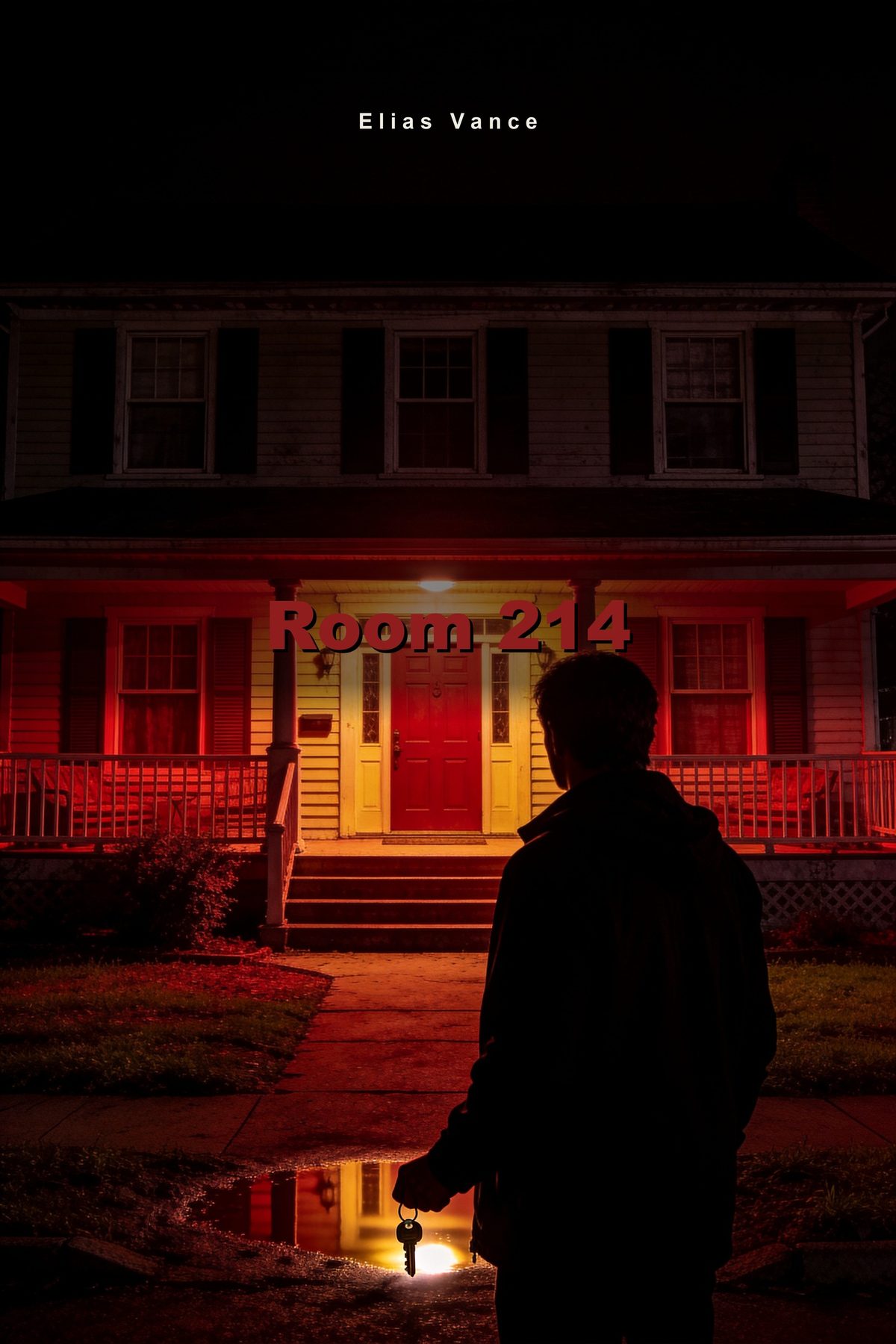
Room 214
Room 214 is a quiet horror story by Elias Vance about a traveler who keeps being given the same hotel room, and the longer he stays in 214, the less certain he becomes about which side of the door is real.
Enjoying the read? Get a new free Elias Vance story in your inbox every month — no spam, unsubscribe anytime.
“The clerk handed me the key to Room 214, and I knew before I turned it that I was in trouble, because 214 is the number of the room I grew up in, and I grew up in a house that had no room numbers.”
More free stories from The Dark Threshold
Ten complete horror stories, free to read — no signup, no paywall. Pick your next nightmare.
The clerk handed me the key to Room 214, and I knew before I turned it that I was in trouble, because 214 is the number of the room I grew up in, and I grew up in a house that had no room numbers.
That is the part I keep coming back to. My childhood bedroom was not numbered. The number existed in exactly one place in the world — on a brass plate that my father screwed to my doorframe when I was six, because he was that kind of father, the kind who believes that a room with a number is a room that can be found again. I hated that plate. I hated the way it made my room feel like a room in a motel, a room someone could be handed a key to by mistake. And now, twenty-six years after the house came down, I am standing in a motel parking lot with the light coming on over the door of Room 214, holding a key, and I am the someone.
The trip was a mistake. A two-night conference in a city four hours from anywhere I know, a budget motel because the company was cheap and I was tired and it was late, a room at the end of the building because the rooms at the end of the building are the ones they give the late arrivals. I did not ask for Room 214. I signed the register, and the clerk handed me the key, and he did not look at me, and he said, "Room 214, sir, end of the hall," and his voice had the flat patience of a man who has handed that key out a thousand times, and I turned the key in the lock, and I knew.
The smell hit me first. Cigarettes and floor wax and something green, something like the memory of cut grass coming in through a window in summer. My father's smell. The smell of the house I grew up in, which has been gone for twenty-six years, which was sold when my father died, which was torn down to build a strip mall, which cannot be producing this smell from behind a door in a budget motel four hours from anywhere I know.
I stood in the doorway. The light from the corridor fell in a long rectangle across the carpet, and I told myself the usual things — the things you tell yourself when the world makes a small wrong turn. It's a coincidence. The smell is cheap cleaner. You're tired. You've been driving six hours. Go to bed.
I stepped inside.
The crack in the ceiling was the thing that undid me. It ran from the corner above the window, forking once, running down toward the light fixture, and it was shaped exactly like the country I invented when I was seven — the one with the two rivers and the mountain where the good dragons lived. I had not thought about that country in twenty-six years, because it lived on my ceiling, in a crack, in a room that no longer exists, and here it is, drawn in the same plaster, by the same settling of the same foundation. My hand came up by itself, the way a hand comes up to a face it recognizes, and I stood on the bed to touch it, the way I used to stand on the bed, and the crack was real, and the ceiling was exactly as high as my childhood ceiling, which it could not be, because I am a grown man and this is a motel's ceiling and they cannot be the same height, and yet.
And yet.
I called the front desk, because I thought if I could just hear the clerk's voice I could hand the impossibility back to him and go to sleep. "This is Room 214. I think I've been given the wrong room. There's been a mistake with —
"Room 214," the clerk said. "No mistake, sir. You've stayed before."
"I've never stayed here in my life."
"Room 214," he said again, the way you say a thing you have said a thousand times, and he hung up, and the line went dead, and I noticed, for the first time, that the radiator in the corner was hissing. Hissing the way my father's radiator hissed. Hissing the way no radiator hisses in a place where it is August and seventy degrees and the air conditioner is on.
Here is what I did next, and it is the part that made me understand, and understanding was worse than not understanding. I did not leave. I should have left. I should have walked out into the parking lot and driven four hours home with the windows down and the radio up, and I did not. I sat on the edge of the bed — my bed, the one with the loose spring, the one that creaked in the same spot when you sat on the left side — and I put my face in my hands, and I thought about my father.
My father was a man who had been lost once, and who had learned that the only way back is a number, and he was handing me mine. That is what I understood, sitting in that room: he was never making the world feel ordered. He was telling the truth.
I did not sleep. I sat on the bed with the loose spring, in the room with my father's smell, and I watched the crack in the ceiling, and I thought about how the motel fits my childhood room so exactly — how, sometimes, when a building is poured over an old foundation, the old room comes up through the new floor like a watermark, waiting to be recognized.
At some point I must have fallen asleep, because I woke to a hand on my shoulder, and the room was wrong.
The hand was my father's. I knew it before I was awake, the way you know your own breathing. He was saying, in his voice, his exact voice, "Checkout's at eleven, son. You don't want to miss it."
I sat up. The brass plate was on the door, Room 214, screwed to the doorframe the way it had been screwed to my doorframe when I was six, and my father was standing at the foot of the bed, and my father has been gone for twenty-six years, and my father was not a ghost, he was simply there, wearing the checked shirt he wore in every photograph I have of him, doing the thing he always did, which was to stand at the foot of the bed and tell me it was time to get up.
"Dad," I said. My voice was a child's voice. I do not know how it happened, but my voice was a child's voice, and my hands were small, and the room was bigger, and I was on the left side of the bed, where the spring was loose, and I was six years old, or I was thirty-six years old, or I was both, and neither was more true than the other.
"There's no car, son," my father said, gently. "There never was. You've been driving for a long time, trying to get home, and you're here now. It's all right. You can put the keys down."
And for a moment I believed him. That is the trap he has always set for me. There was no conference. There was no trip. I have been asleep in this room since I was six years old. Everything after — the house, the growing, the leaving, the jobs, the wife I half-remember, the decades — all of it the dream I built so I would not have to wake up here. I almost took the bait, because the story is so kind, and the story lets the boy stay in the room forever and never have to leave.
But I have heard this story before.
I am thirty-six years old. I have a career and a marriage and a life that begins, always, in a different city from the one where I am standing, and every few years, at the end of the hall, there is a room with a number I recognize, and my father is in it, and he tells me the same gentle lie, and I have always, at the last moment, seen the thing I am not supposed to see.
The other bed is slept in.
There are two beds in Room 214. There have always been two beds, and I have always known it, and I have never once looked at the second one, the way you never look at the thing that would change everything. The pillow was dented, and the sheet on the left side was faintly warm.
It is my father's bed.
He has been in this room the whole time. Not as a ghost. Not as a memory. As a man, in the checked shirt, in the second bed, keeping the room warm, and he is not here to take me away. He never was. He is here to take my place — to be the one who stays — and the life I think of as mine was only ever possible because there was always a man behind me, in the room I had just left, holding the door.
"There's one more door," he said. He held out a key — not the key to Room 214, a different key, smaller, plainer. "Checkout isn't out there, son. Checkout is through the closet. It's the only door left, and you've been walking past it for twenty-six years because you thought it was a closet."
I looked at the closet door. It was the closet door of my childhood, the one I never opened at night because I was afraid of the dark, and I have built a career and a marriage and a decade of daylight entirely to avoid a single door.
"It's not the dark in there," my father said. "It's the morning. It's been the morning this whole time. You just never wanted to leave the night."
I would like to say that I took it. I would like to say that I stood up, that I turned the key in the closet door and stepped through into the morning, and that my father was finally free. I would like to say the story has an ending where the boy leaves the room.
But I am telling you this from the left side of the bed, where the spring is loose, and the radiator is hissing, and the crack in the ceiling is shaped like the country where the good dragons lived, and my father is still standing at the foot of the bed, holding a smaller key, and I am still deciding.
Here is what I have decided. I am not taking the key.
I have spent my whole life taking the key, and telling myself it was his choice, his devotion, his way of loving me — and it was, but it was also my way of never once having to be the one who stays. Behind me, in every room I ever left, my father has checked in. He is so tired. I can see it now, in the checked shirt, in the dent in the pillow, in the flat patience of a man who has handed that key out a thousand times. Tonight I am the one who stays.
I take the smaller key out of his hand — not to open the closet, but to put it in my pocket, so he cannot hand it to me again. And I say, "No, Dad. This time you go."
He looks at me for a long time. And I watch him do the thing I have never once seen him do. He walks to the closet door, and he turns the key that is already in it — the one I never saw because I was always looking at the one he was holding out to me — and he opens it, and the light comes out, and it is morning, and he steps through, and the door closes behind him.
And the room is quiet. The radiator stops hissing. The crack in the ceiling is only a crack. And I am standing in Room 214, at the end of the hall, in a budget motel four hours from anywhere I know, with a smaller key in my pocket and a second bed in the room that is suddenly, terribly empty.
My father walked into the morning. He has finally walked into the morning, after twenty-six years of holding doors for me, and I stood here and let him, and it is the bravest thing I have ever done, and the worst thing I have ever done, and I do not know yet which of those it is.
Because someone has to stay. There has always been someone who stays — the man at the end of the hall, the one who keeps the room warm, the one who hands the key to the traveler and lets him walk into the morning. And tonight I took his place.
The key is in the nightstand drawer, beside the Bible. The brass plate is on the door, inside and out. The room is warm, and it is mine, and it will be found again, because a room with a number is a room that can be found — that was always the whole truth of it, and my father was never lying.
I am lying down now, on the left side of the bed, where the spring is loose. Somewhere out there, in the mornings I will never walk into again, a man is checking in somewhere, and a clerk is handing him a key, and the man does not know yet that there is a room waiting for him at the end of the hall, and that the room has a number, and that someone is already in it, keeping it warm, waiting a very long time to hand him the key.
There is no checkout. There is only the room, and the number, and the man who finally stayed.
---
“A tired traveler checks into a roadside motel and is handed the key to Room 214. The number is the one he grew up in, though the house he came from had no room numbers at all. A quiet psychological horror story about rooms that remember, and guests who have been expected.”
— from Room 214 — Quiet Horror Story | The Dark Threshold by Elias Vance · read more at The Dark Threshold
More stories like this

That was one door. There are six more.
6 series · 82 stories · EPUB + PDF